Historic win pits Takaichi's vision of Japan against the markets
Published in Political News
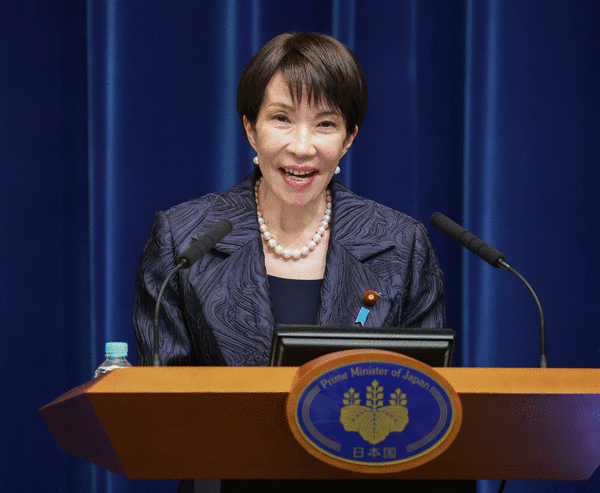
Back in October, Sanae Takaichi struggled to wrangle enough seats in parliament to become prime minister. Now she has the biggest election mandate of any Japanese leader since World War II.
The surprisingly large victory margin allows the staunch conservative to implement her nationalist vision of a more forceful, outspoken, self-sufficient Japan. She can strengthen Japan’s military, stand up to China and North Korea, move closer to the U.S., ramp up strategic investments, pressure companies to raise wages and push the central bank to think twice before raising interest rates.
With her Liberal Democratic Party controlling two-thirds of parliament, Takaichi will have more freedom to increase defense spending and cut the sales tax on food, even as she has vowed to be fiscally responsible. Her main opposition now may not come from parliament, but from the markets.
“The hurdle of gaining market confidence remains,” Nobuyasu Atago, a former Bank of Japan official who is now chief economist at Rakuten Securities Economic Research Institute in Tokyo. “How the Takaichi administration responds to the warnings the market will send through yen depreciation and rising interest rates starting Monday is critically important.”
As investors digest the impact, Takaichi, 64, can bask in a historic feat following an election gamble that looked risky only weeks earlier. In many ways, Takaichi’s extraordinary win is a reflection of how Japan and the world has changed. Russia’s invasion of Ukraine, China’s increased military pressure on Taiwan and U.S. President Donald Trump’s unreliability as an ally all created a sense of unease that had Japan’s 124 million people clamoring for strong leadership.
The LDP’s 316 seats is the most ever for a party that has dominated Japanese politics in the postwar era, and her coalition is set to secure 75% of seats in parliament. That would give her the ability to implement her spending plans and potentially kick-start the process of changing Japan’s pacifist constitution, which was imposed by the U.S. in 1947 and has never amended.
“I’ve been seeking a mandate on major policy shifts — most notably, a significant change in economic and fiscal policy, strengthening national security policy, and enhancing intelligence capabilities,” Takaichi said on Fuji TV on Sunday night, noting they had all faced considerable opposition. “If we do earn the public’s confidence, I feel a strong responsibility to commit myself fully to the work ahead.”
It’s a stunning turnaround for a party that has been adrift in recent years, losing its majority in both houses of parliament in elections in 2024 and 2025 while churning through a slew of uninspiring leaders. Challengers across the political spectrum rose in popularity with calls for tougher immigration restrictions, tax cuts and other measures to help citizens deal with rising prices for the first time in decades.
Her success resembles the sweeping victories of former Prime Ministers Junichiro Koizumi in 2005 and Shinzo Abe in 2012. Like those leaders, Takaichi won over voters with folksy appeal, an image of decisiveness and a message of better times ahead through bold new economic ideas that challenged LDP orthodoxy.
“She gives the Japanese public hope,” said David Boling, a former deputy assistant U.S. Trade Representative who is now at the Asia Group, an advisory firm. “She’s an ideological conservative, but she’s winning on optimism, charm, and communication.”
Takaichi portrayed the election as a referendum on her leadership and turned the vote into a presidential-style contest, drawing large crowds to her rallies. She was also helped by a complete collapse of her opponents, as the rival Centrist Reform Alliance — a merger between the largest opposition party and the LDP’s former coalition partner — only managed to win around 50 seats, despite strong concerns among some over Takaichi’s nationalism.
Taking on the bureaucracy may be the next challenge. Takaichi’s vow to accelerate talks on cutting the sales tax on food sent bond yields surging to once-unthinkable levels, exposing the growing concerns over how Japan will pay for her plans to ramp up defense and other spending. A quarter of the government’s yearly outlays are already devoted to servicing a debt load at around 230% of gross domestic product, the largest in the developed world.
“I am expecting her to want to wage war on the Finance Ministry,” said Tobias Harris, founder of consultancy Japan Foresight. “She was teasing that on the campaign trail. She’s saying ‘The public mandated me to do these things and I’m not going to let the bean counters stand in the way.’”
One of Takaichi’s priorities is to invest in economic security, including cybersecurity, supply chains and critical minerals. It’s an illustration of how she sees a great role for the state in the economy, rather than the emphasis of both Koizumi and Abe on unleashing market forces.
That economic vision fits with her strategy on defense. Though in power for just four months, Takaichi managed to both strike up a good personal rapport with Trump, who gave her an unusual election endorsement last week and will welcome her to Washington for a summit meeting on March 19, while also deeply angering Chinese leader Xi Jinping.
Back in November, Takaichi linked Taiwan’s security with Japan when answering a question in parliament, prompting Beijing to respond with diplomatic and economic measures targeting her country. But she didn’t back down, and was rewarded by voters on Sunday.
The scale of Takaichi’s victory may embolden her to go even further: attempting to revise Japan’s constitution to explicitly state a right to possess a military, a long-running goal of the LDP. Such a move would also require two-thirds support in the upper house, which her party doesn’t control, as well as the backing of a majority of the public in a national referendum.
Such a strong mandate inevitably raises the risk that Takaichi may overreach, trigger major market volatility or deviate from the pocketbook economic issues that voters care about the most. But for now, she appears set to break the mold in recent years of short-lived Japanese leaders.
“The LDP’s got its mojo back,” said Boling of the Asia Group. “She’s reclaimed the momentum and now she really owns the party’s future.”
_____
(With assistance from Yoshiaki Nohara and Rachel Lavin.)
_____
©2026 Bloomberg L.P. Visit bloomberg.com. Distributed by Tribune Content Agency, LLC.


















































Comments