'Sowing chaos': Nevada officials push back on Trump's call for nationalized voting
Published in Political News
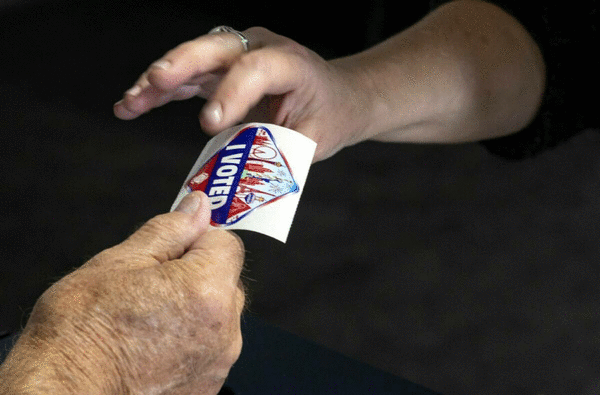
LAS VEGAS — President Donald Trump’s call to nationalize election processes on Monday prompted a bipartisan response from Nevada political leaders this week.
Trump called for Republican officials to “take over” voting procedures in multiple states during a podcast interview — a contradiction to the U.S. Constitution, which gives states the authority to run their elections and Congress the power to write laws related to congressional races.
“The Republicans should say, ‘We want to take over,’” he said. “We should take over the voting, the voting in at least many — 15 places. The Republicans ought to nationalize the voting.”
Though the president did not specify which 15 states he was referring to, Silver State officials were quick to push against the idea in Nevada. The federal government is already exerting pressure on state officials through a lawsuit attempting to force election officials to release unredacted voter roll information, which would include personal information like driver’s license or partial Social Security numbers.
Asked about how such a move could affect Nevada, the White House referred reporters to press secretary Karoline Leavitt’s comments on Tuesday. She said Trump’s remarks were referring to his support of the proposed Safeguard American Vote Eligibility Act, or SAVE Act.
“The president believes in the United States Constitution, however, he believes there has obviously been a lot of fraud and irregularities that have taken place in American elections, and again, voter ID is a highly popular and common sense policy that the president wants to pursue and he wants to pass legislation to make that happen for all states across the country,” Leavitt told reporters Tuesday.
The bill would require people to prove they are U.S. citizens before casting a ballot and forbid states from registering people who don’t provide proof. It also would require states to remove noncitizens from their voter rolls.
The legislation was introduced by Rep. Chip Roy, R-Texas, weeks before Trump took office. It made it out of the House and was sent to the Senate in April.
Politico reported Thursday that three Republican senators had met with the president to discuss next steps.
Nevada does not currently have a voter ID requirement in statute — though it could come in the future. A 2024 ballot question to establish the practice passed with 73.2 percent support and will be on the 2026 ballot for voter approval.
Republican Gov. Joe Lombardo, who plans to seek re-election, was careful to offer support of Nevada’s election system while still backing the voter ID requirements that Trump supports.
“Governor Lombardo has confidence in Nevada’s elections system, but has sought to strengthen state elections even further by implementing voter ID, making sure all ballots are counted by Election Day, and believes the state should not pay to send mail ballots to voters that don’t want them,” press secretary Josh Meny said in a statement Thursday. “Governor Lombardo is confident that state elections will be more secure when Nevada voters approve the Voter ID ballot initiative again in November. Anytime we can give voters more faith in the system, we should.”
Other reactions were more forceful against Trump’s comments. Former Republican Gov. Brian Sandoval and former Democratic Assembly Speaker Richard Perkins, co-chairs of the bipartisan Democracy Defense Project in Nevada, issued a statement reaffirming their support of state-run elections. The organization works to build trust and transparency in existing election systems.
“I have full confidence in Nevada’s election system, and I’m grateful to the election staff and volunteers who work long hours to keep it secure and accountable,” Sandoval said in the statement. “Nevada has the capability and experience to conduct elections in every county, and I trust our state is best equipped to collect ballots, count votes and certify our elections.”
Secretary of State Cisco Aguilar, the elected officer who oversees elections, said Trump’s calls for nationalized voting was a constitutional issue, not a political one.
Aguilar said the federal government could instead focus on helping county clerks administer fair and transparent elections through funding support. He said the biggest challenge election officials face before this fall’s election is misinformation and disinformation he says comes from the Trump administration.
“What it’s doing is sowing chaos into the process, and we know that Nevadans do not want chaos,” Aguilar, a Democrat, said. “They want leadership. They want a strategic vision to give the state what’s in the best interest of all Nevadans.”
Multiple members of Nevada’s Democratic federal delegation responded with strong opposition and questioned the need for a federal voter ID policy. When asked for comment, a spokesperson from the office of Rep. Dina Titus said she believed in the fundamental right of states in the Constitution’s Election Clause.
Sens. Catherine Cortez Masto and Jacky Rosen also pushed back on the effort. The lawmakers said they opposed the SAVE Act because noncitizens are already barred from voting, so it would put up unnecessary barriers to the ballot box.
Rep. Mark Amodei, Nevada’s sole Republican congressman, did not respond to a request for comment. He voted for the federal voter ID bill, while all three Nevada Democrats voted against.
Attorney General Aaron Ford, who has launched his campaign for governor, said in a Wednesday statement: “Any attempt by the federal government to take over Nevada’s elections should be viewed as an attempt to take away Nevadans’ constitutional right to vote. It will not happen on my watch.”
___
©2026 Las Vegas Review-Journal. Visit reviewjournal.com.. Distributed by Tribune Content Agency, LLC.





























Comments