After clunky Artemis test, Congress heeds renewed call to rely on companies like SpaceX, Blue Origin
Published in Political News
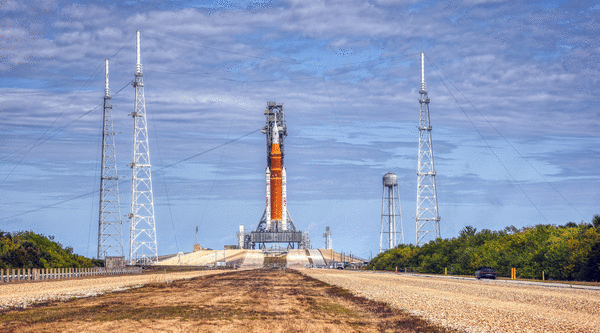
After a Trump administration push last year to kill off the existing architecture of NASA’s Artemis program, Congress made moves to save it injecting billions toward funding the pricey, oft-delayed Space Launch System rocket and Orion spacecraft.
In the same week NASA had to delay the launch of Artemis II, Congress may now be changing its tune.
The House Science, Space, and Technology Committee on Wednesday passed unanimously H.R. 7273, the NASA Reauthorization Act of 2026, which doesn’t have any funds attached to it, but will put into law if passed by the full House, Senate and signed by the president, an updated direction for NASA to follow.
One of the amendments gives the green light for NASA to pursue non-government-sponsored solutions on how to fly missions to the moon and Mars.
The lead amendment, which was offered by both Democrat and GOP House members including the Space Coast’s Rep. Mike Haridopolos, “enables NASA to procure commercial services to carry crew and cargo to and from deep space destinations.”
That would allow SpaceX to develop its own Starship rocket to pursue the ability to fly to and land on the moon and Mars and potentially for Blue Origin to develop New Glenn to launch the Orion spacecraft and replace SLS.
“This bipartisan bill — a top priority of mine and one that is especially close to my heart — strengthens our human exploration efforts, supports a growing commercial space economy, and invests in the technologies that will carry us from the moon to Mars,” said COP committee chairman Brian Babin.
The price and frequency of launches under Artemis came to a head again this week as NASA attempted to complete a wet dress rehearsal for the Artemis II mission, which aims to fly crew on Orion for the first time. They’re aiming for a 10-day lunar fly-by mission, which will be the first time in more than a decade that humans have flown past low-Earth orbit.
While NASA had been targeted a February launch, an incomplete test countdown during a wet dress rehearsal took that off the board. A liquid hydrogen leak that needs to be fixed forced NASA to delay launch until at least March. The leak is similar to leaks seen three years ago during testing and launch of Artemis I.
New NASA Administrator Jared Isaacman has been diplomatic in supporting the existing Artemis hardware, but pointed out it’s reliant on decades-old technology to some degree.
“The SLS architecture and its components long predate (Trump’s) administration, with much of the heritage clearly traced back to the shuttle era,” he posted. “As I stated during my hearings, and will say again, this is the fastest path to return humans to the moon and achieve our near-term objectives through at least Artemis V, but it is not the most economic path and certainly not the forever path.”
Congress in the last six months has kept funds funneled into the program through five missions, shoehorning $10 billion into Trump’s Big, Beautiful Bill as well as keeping annual funding in the recently passed fiscal 2026 NASA budget. Trump had earlier last year pushed in his NASA budget request, which Congress ignored, to kill off the existing reliance on SLS and Orion after Artemis III.
That notion was echoed during Isaacman’s initial confirmation hearings last year urging a shift to commercial companies like SpaceX and Blue Origin, something also suggested in NASA’s own Office of the Inspector General’s report about the program’s growing costs.
The Artemis program uses Orion, which was originally part of the Constellation program under President George W. Bush, but canceled by the Obama administration. It was recycled, though, by Obama who in 2010 directed NASA to pursue the SLS as a new moon-capable rocket, including the use of engines and solid rocket boosters used from the Space Shuttle Program.
Costs have ballooned, though, having topped $100 billion since the program was announced. And timelines have stretched. The first launch was supposed to have happened by 2016, but only came six years later in 2022, which has so far been the only launch in the books.
And the next launch won’t be until Artemis III, which the Trump administration is trying to fly before the end of 2028, meaning almost another two years between missions. Under his first administration, he had been targeting that launch by 2024.
“The flight rate is the lowest of any NASA-designed vehicle, and that should be a topic of discussion,” Isaacman said noting NASA won’t push forward with Artemis II’s launch until its safety can be assured.
He expanded on his previous belief that SLS isn’t the solution to the nation’s goals, a sustained lunar base outlined in Trump’s National Space Policy “with repeated and affordable missions to the lunar environment.”
“Along that journey, some functions that NASA has performed in the past and present may move to industry in the future, and that is when NASA recalibrates toward the near-impossible and undertakes the next grand endeavor,” he said.
During a press conference Tuesday following the incomplete test run, NASA Associate Administrator Amit Kshatriya also weighed in on the reliability of SLS and Orion.
“It’s an experimental vehicle,” he said. “Four days and 40 years from Challenger, nobody sitting in one of these chairs needs to be calling any of these vehicles operational.”
Because it’s been since 2022 since an SLS has been on the launch pad, he said it doesn’t matter that individual components had passed testing. There simply has not been enough previous flights to really count on anything without testing it all together.
“These are very bespoke components,” he said. “This is the first time this particular machine has borne witness to cryogens, and how it breathes and how it vents and how it wants to leak, is something we have to characterize.”
His realism about the rocket has been steered by Isaacman’s take on the program.
“He’s very passionate about making sure we achieve the objectives of the campaign using this, but also making sure that as we go forward, we try and get to a higher flight rate so we can get more learning,” Kshatriya said.
While SpaceX and Blue Origin may be on the path to a cheaper, more reliable option, it could still be years before they’re available, so SLS is the only game in town, he said.
“This is the configuration that we need, the energies we need in order to achieve these near-term missions,” he said.
But he’s ready to onboard commercial companies as they figure out their own capabilities.
“What we really want to do is let industry innovate on their own machines,” he said. “When they’re ready to support our missions, we’ll cut them into the architecture and use them as we need to.”
---------
©2026 Orlando Sentinel. Visit at orlandosentinel.com. Distributed by Tribune Content Agency, LLC.



















































Comments