Trump's move to send US ships to Mideast renews Iran threat
Published in Political News
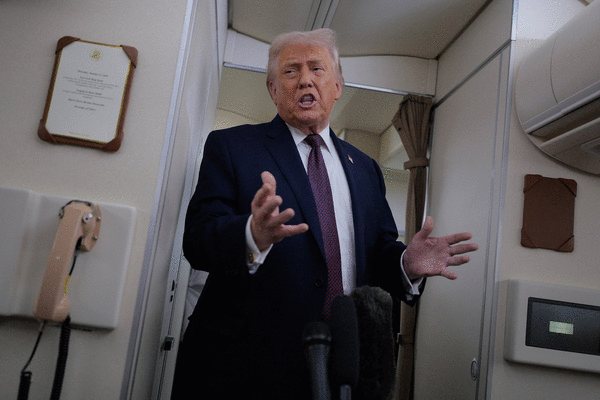
WASHINGTON — President Donald Trump has dispatched naval assets to the Middle East, prompting fresh speculation that he’ll follow through on threats to attack Iran’s senior leadership amid a violent crackdown on nationwide protests.
“We have a big flotilla going in that direction and we’ll see what happens,” Trump told reporters aboard Air Force One late Thursday as he returned from Davos, Switzerland. “I’d rather not see anything happen, but we’re watching them very closely.”
The USS Abraham Lincoln aircraft carrier and its associated strike group passed through the Strait of Malacca between Malaysia and Indonesia two days ago and are now in the Indian Ocean, according to two U.S. officials, who declined to specify their precise destination. They asked not to be identified discussing ship movements that haven’t been formally announced.
The Lincoln is accompanied by three Arleigh Burke-class guided missile destroyers — USS Spruance, USS Michael Murphy and the USS Frank E. Petersen Jr. — which can carry Tomahawk missiles. The carrier’s air wing includes F-35C fighter jets.
Those assets are similar to the military vessels that the US deployed to the Caribbean Sea weeks before the U.S. launched a military operation on Jan. 3 to capture Venezuelan President Nicolas Maduro. Given past U.S. attacks on Iran last year and the Venezuela operation, Trump’s bellicose rhetoric is ramping up pressure on Iran and put markets on edge for another round of strikes.
Even so, Trump walked back a previous pledge to strike Iran after saying he received assurances that its government wouldn’t follow through with the planned executions of hundreds of protesters. Tehran has warned the U.S. and Israel — which carried out strikes on Iranian nuclear facilities last year — against any attempts to intervene to aid the protests.
The large-scale protests, the biggest threat to Iran’s ruling regime in decades, were first triggered in Tehran by a collapse in the nation’s currency and then spread nationwide with calls for the end of Supreme Leader Ayatollah Ali Khamenei’s leadership.
Experts say the massing of U.S. military hardware in the region adds flexibility for Trump. But mobilizing assets in the Middle East does not necessarily guarantee a strike against Iran.
“The buildup signals the president’s determination to keep all options on the table, including military strikes against the Iranian regime,” said Mona Yacoubian, the director and senior adviser of the Middle East Program at the Center for Strategic and International Studies. “It certainly could be a prelude to an attack, or it could be meant as a coercive tactic focused on securing concessions from Tehran in advance of or as part of a negotiation.”
The Eurasia Group risk consultancy pegged the likelihood of U.S. and Israeli strikes against Iran before April 30 at 65%, on the grounds that “efforts at diplomacy are likely to fail.” Geopolitical risk company Rapidan Energy Group maintains 70% odds that the U.S. will strike Iran in the coming days and weeks.
But military action against Iran carries immense risks, and it’s still unclear whether the U.S. merely wants to use the threat of force to prevent more protester deaths or use airstrikes to spark regime change.
If the aim is to help the protesters, the U.S. could increase their access to Starlink internet terminals. But if the goal is to prevent the regime from killing protesters, the U.S. could disrupt Iranian command-and-control capabilities, or could conduct strikes against Khamenei and his inner circle, as well as key government sites.
At the same time, the Iranian regime seems to have already quelled the nationwide protests through violent repression, while the carrier strike group likely to be involved in a U.S. military response is still days away from arriving in the region.
“It’s hard to imagine a use of force absent any sort of uprising still going on,” said Mara Karlin, a former senior Defense Department official, adding that the U.S. military could use kinetic and non-kinetic options.
Trump has claimed that Iran was halting executions of the government’s political opponents based on his demands. One United Nations special rapporteur said the total number of people killed in the protests could be more than 20,000. The Iranian government claims just more than 3,000 have been killed.
Rather than signaling a climbdown, the president’s comments may have been designed to buy time for the U.S. military to position assets needed for potential strikes as well as protect American and allied positions in the region from possible retaliation, according to Becca Wasser, the defense lead for Bloomberg Economics.
The largest U.S. military installation in the Middle East, Al Udeid Air Base in Qatar, was the target of a Iranian missile barrage following the U.S. airstrikes against Tehran’s nuclear facilities. But retaliation could be more forceful if the regime in Tehran believes it faces an existential threat.
“Should the U.S. launch strikes, they have more options,” Wasser said. “Before, they were constrained to symbolic strikes or a limited strike campaign reliant on forces outside the theater. Now, there are additional abilities to prosecute a fight.”
The non-profit Soufan Center said in a briefing note on Friday the continuing movement of U.S. military assets into the region signals strikes could still occur, even as Tehran expresses confidence that the protests have ended.
“Underpinning Trump’s threat is an assessment that the regime has been sufficiently weakened by the defeat of its regional allies, its economic deterioration, and the U.S. and Israeli strikes on its strategic facilities in June,” the note said, adding “a modest application of U.S. force against regime targets might push the regime out of power.”
_____
(Tony Capaccio contributed to this report.)
©2026 Bloomberg L.P. Visit bloomberg.com. Distributed by Tribune Content Agency, LLC.




















































Comments