'It's not easy': Contradictions cloud Trump team's vision for Venezuela
Published in Political News
WASHINGTON — Official Washington on Monday continued to grapple with the aftermath of President Donald Trump’s order to capture and arrest Venezuela’s leader, Nicolás Maduro, wondering what Trump’s long-term plan is for the South American nation.
The answer remains far from clear, with Trump and officials like Secretary of State Marco Rubio offering contradictory assessments of why Maduro, who pleaded not guilty to drug and gun charges Monday in a Manhattan courtroom, was ousted and what should happen next.
Trump, who ran for president in 2024 on a mostly “America First” platform, late on Friday night again pegged his second term to global affairs by giving the order to strike targets in Venezuela’s capital, Caracas, and around the South American country to clear a path for American troops and law enforcement agents to storm Maduro’s compound and remove him from power.
The operation raised new questions about the president’s focus as polls continue to show voters, including Republicans, deeply frustrated by an economy that, as White House National Economic Council Director Kevin Hassett acknowledged last month, Trump has sole ownership of after nearly a year back in office.
In a major recasting of Trump 2.0, South Carolina Sen. Lindsey Graham, declared Sunday night that the American commander in chief was on a mission to “clean up” the Western Hemisphere by swapping out governments hostile to Washington with ones that would cut business deals with U.S. officials and corporations.
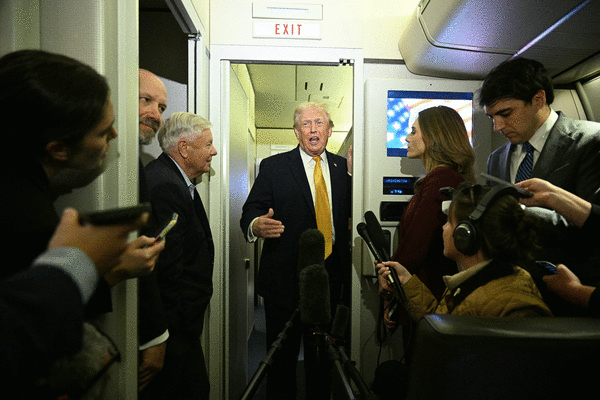
“Right after the election, he told me, ‘I’m gonna clean up our backyard,’” the Republican senator, who chairs the chamber’s State, Foreign Operations, and Related Programs Appropriations Subcommittee, told reporters on Air Force One as he joined Trump for a flight from South Florida to Joint Base Andrews near Washington.
“Now, this was long before. This was before he took office,” Graham said of the previously undisclosed conversation. “This is one of the president’s priorities, is to make sure that people in our backyard, narco-terror states, will not continue to kill Americans. … The number of people that would be alive today because Venezuela will be in different hands is going to be tens of thousands.”
Notably, Trump has a long record of slamming his predecessors as “stupid” for overseeing wars and open-ended global entanglements.
As Democratic lawmakers and some former U.S. foreign policy officials question the legality of the Maduro snatch-and-grab operation and the Trump administration’s true intentions for Venezuela, Graham said, “This is something to be celebrated … whether you like (Trump) or not.”
House Foreign Affairs ranking member Gregory W. Meeks in a Saturday statement called Maduro “an illegitimate leader,” but the New York Democrat warned that “without a defined objective or plan for the day after, and without support from our allies,” the administration’s move risked “entangling the United States in an open-ended conflict in Venezuela that could destabilize the entire region.”
“This action is also a violation of international law and further undermines America’s global standing,” Meeks said. “Congress must reassert its constitutional role before this escalation leads to greater instability, chaos, and unnecessary risk to American lives.”
The latter referred to a defining characteristic of the second Trump administration, which has seen the president blaze a trail of going it alone, skirting Congress and testing the judicial system. To that end, White House officials have made clear that the trend will continue during Trump’s second year back in office.
“I hear stories from my predecessors about these seminal moments where you have to go in and tell the president what he wants to do is unconstitutional or will cost lives,” Susie Wiles, the White House chief of staff, told journalist Chris Whipple during a series of interviews for a Vanity Fair series published Dec. 16. “I don’t have that.”
Graham on Sunday night echoed Trump administration officials by describing the Venezuela operation as what was best for business.
“This is a good thing. This is not interventionism. This is making America safer,” he told reporters. “We’re going to be more prosperous because of the business deals.”
‘The oil companies’
Asked about long-term plans for Venezuela and why he greenlit the mission, Trump over the weekend kept steering his responses toward reviving the South American country’s sputtering oil sector. He said that American energy giants intend to help rebuild subpar infrastructure and drastically increase production rates and that he had discussed booting Maduro with U.S. energy executives before and after the raid.
“The oil companies are going to go in and rebuild their system. They’re going to spend billions of dollars, and they’re going to take the oil out of the ground, and we’re taking back what they sold,” the president said Sunday night. “We’re not gonna spend very much money at all, if anything.”
However, his secretary of state and national security adviser earlier Sunday dismissed the notion that the Maduro ouster was largely about flooding the market with Venezuelan crude to drive down gas prices.
“We don’t need Venezuela’s oil. We have plenty of oil in the United States,” Rubio told “Meet the Press” on NBC. “What we’re not going to allow is for the oil industry in Venezuela to be controlled by adversaries of the United States.”
Trump and Rubio have also contradicted one another about the U.S. role in governing Venezuela.
“Don’t ask me who’s in charge because I’ll give you an answer, and it’ll be very controversial,” Trump said Sunday on Air Force One, prompting a reporter to ask, “What does that mean?”
He replied, “It means we’re in charge.”
But hours earlier, Rubio used another television appearance to describe an arrangement in which Trump administration officials would use a still-in-place naval blockade of Venezuelan oil tankers to force the country’s remaining leaders to bend to their demands.
“That’s the sort of control the president is pointing to when he says that. We continue with that quarantine,” Rubio told “Face the Nation” on CBS. “And we expect to see that there will be changes — not just in the way the oil industry is run for the benefit of the people, but also so that they stop the drug trafficking, so that we no longer have these gang problems … and that they no longer cozy up to Hezbollah and Iran in our own hemisphere.”
The White House hadn’t responded to a Monday morning query about what, if any, day-to-day Venezuelan governance decisions had so far been by the administration.
But as the military move left many Democrats and others wondering how the Trump administration would achieve their lofty goals, Trump offered a rare measured assessment about the path ahead.
After Commerce Secretary Howard Lutnick, also riding on Air Force One on Sunday, said the administration wanted to get American firms involved in reviving Venezuela’s steel, aluminum and mineral sectors, the president chimed in.
“But it’s not easy,” Trump said. “It’s really gone bad.”
_____
©2026 CQ-Roll Call, Inc., All Rights Reserved. Visit cqrollcall.com. Distributed by Tribune Content Agency, LLC.










Comments