Trump expands US travel ban to include two Caribbean countries
Published in Political News
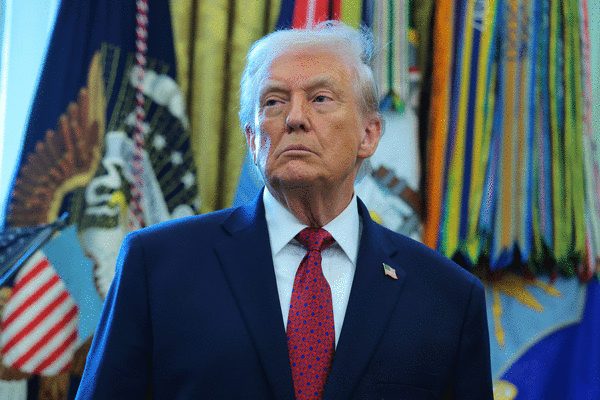
Citizens of Antigua and Barbuda and Dominica will face new restrictions on entry into the United States after President Donald Trump on Tuesday expanded a partial travel ban to include 15 new countries as of Jan. 1.
In adding the two eastern Caribbean nations to the list, Trump cited concerns about their Citizenship by Investment, or CBI, program, which allows foreign nationals to obtain a passport in exchange for financial investments.
The Trump administration said both nations have offered CBI “without residency” — a claim Antigua and Barbuda’s ambassador disputes — which “poses challenges for screening and vetting purposes.”
An administration proclamation also argues that CBI programs can allow foreign nationals from restricted countries to obtain passports from third countries not subject to travel restrictions, enabling them to apply for U.S. visas and circumvent the ban.
“United States law enforcement and the Department of State have found that, historically, CBI programs have been susceptible to several risks,” the proclamation said. “These risks include allowing an individual to conceal his or her identity and assets to circumvent travel restrictions or financial or banking restrictions.”
Antigua and Barbuda’s ambassador to the U.S., Sir Ronald Sanders, said he was “alarmed” by his country’s inclusion because his country had already amended legislation based on suggestions from U.S. officials about his country’s CBI program.
“So the fact that this has come out now is rather curious,” he said. “I really don’t understand it.”
Separately, Prime Minister Gaston Browne said “we are deeply disappointed” by his twin-island nation’s inclusion, especially considering they’ve spent the past year working “closely and constructively with several departments of the United States Government to strengthen safeguards within our Citizenship by Investment Program.”
“We have engaged in good faith, accepted practical suggestions, and taken concrete steps to ensure that our program presents no risk whatsoever to the security of the United States,” he said in a statement he shared with the Miami Herald.
Browne said he plans to write directly to President Trump and Secretary of State Marco Rubio, “offering the full engagement and cooperation of the Government of Antigua and Barbuda to address any concerns and to take all reasonable steps necessary to allow for the restoration of all visa categories.”
Dominica’s government said it is seeking “to obtain formal clarification on the cope of the measures, the basis on which they were taken and the specific implications for Dominican travelers, students, families and other legitimate holders of U.S. visas.”
“The Government of Dominica acknowledges the decision of the Government of the United States of America, announced by the White House on December 16, 2025, to impose partial travel restrictions affecting Dominican nationals, effective January 1, 2026,” the Ministry of Foreign Affairs, International Business, Trade and Energy said in a statement. “This matter is being treated with the utmost seriousness and urgency.”
Besides the two Caribbean countries, the expanded list of nations include Angola, Benin, Côte d’Ivoire, Gabon, the Gambia, Malawi, Mauritania, Nigeria, Senegal, Tanzania, Tonga, Zambia and Zimbabwe.
All but Tonga have majority-Black populations, and all except Tonga and the two Caribbean nations are located on the African continent. The proclamation states that “most of the countries” identified, “as well as others, continue to exhibit woeful inadequacies in screening, vetting, and provision of information.”
Others countries in the region that were already subjected to a partial or full travel ban were Venezuela, Cuba and Haiti.
The latest presidential proclamation also expands a U.S. travel ban to additional countries and narrows exemptions for family members of U.S. citizens. In addition to the previously restricted countries, the expanded ban prevents nationals of Burkina Faso, Laos, Mali, Niger, Sierra Leone, South Sudan, Syria and individuals using travel documents issued or endorsed by the Palestinian Authority from entering the United States.
In a statement, the International Refugee Assistance Project, which advocates for people around the world seeking safety, condemned the decision, noting that families could be separated indefinitely, including from their spouses and children. Additionally, Tuesday’s announcement comes amid an indefinite pause on the adjudication of all immigration applications and petitions for people from those countries, as well as the reexamination of those approved during the Biden administration.
Many of the nationals from affected countries were also targeted by previous government actions, such as the termination of Temporary Protected Status, which leaves hundreds of thousands of individuals at risk of deportation to countries the U.S. government itself has deemed unsafe.
Laurie Ball Cooper, vice president of U.S. Legal Programs at the International Refugee Assistance Project, said the organization “condemns the Trump administration’s escalating crackdown on immigrants from Muslim-majority and non-white countries. This expanded ban is not about national security but instead is another shameful attempt to demonize people simply for where they are from.”
She added: “Subjecting more people to this policy is especially harmful given the administration’s recent invocation of the travel ban to prevent immigrants already living in the United States from accessing basic immigration benefits, including pulling them out of line at citizenship ceremonies. This racist and xenophobic ban will keep families apart, but we are prepared to defend our clients, their communities, and the American values of welcome, justice, and dignity for all.”
Baffling decision
The Trump administration began targeting CBI countries in the Caribbean earlier this year when it leaked that Haiti, Cuba and Venezuela would be placed under some travel ban. After the names of four of the five countries offering the CBI program in the region leaked, regional governments began engaging U.S. officials in discussions about their concerns. None of the other three countries, Grenada, St. Kitts and Nevis and St. Lucia, have been placed under restrictions.
“I don’t understand why this is happening, because Antigua and Barbuda has been working with the United States — with the Treasury Department, Homeland Security and the State Department — to resolve any concerns about the Citizenship by Investment program,” Sanders, Antigua’s ambassador to the U.S., said.
Sanders said he has sought clarification from administration officials.
“I have not been able to speak with anyone in the State Department or in the White House who could give me any further information, at least not now,” he said. “So I suspect I’m this is going to be my activity over the next couple of days.”
Dominica Prime Minister Roosevelt Skerrit and Browne are two of the most vocal supporters of Venezuelan President Nicolás Maduro within the Caribbean Community. The other was Ralph Gonsalves of St. Vincent and the Grenadines. Gonsalves recently lost his country’s general elections to Godwin Friday and his New Democratic Party. While Gonsalves had long been publicly opposed to CBI, Friday touted it as an option ahead of the vote.
In the case of Antigua and Barbuda and Dominica, the proclamation states that the entry into the U.S. of nationals as immigrants, and as nonimmigrants on visitors and student visas, which include B-1, B-2, B-1/B-2, F, M, and J visas, “is hereby suspended.”
“Consular officers shall reduce the validity for any other nonimmigrant visa issued to nationals,” of Antigua and Barbuda and Dominica to the extent permitted by law.
Exceptions apply for certain travelers, including athletes, U.S. lawful permanent residents and individuals granted waivers on a case-by-case basis.
Under the restricted travel ban, individuals who do not have a valid U.S. visa or who qualify under one of the exceptions will be barred from entry.
_____
©2025 Miami Herald. Visit miamiherald.com. Distributed by Tribune Content Agency, LLC.














































Comments