Trump to cap unprecedented year that skirted Congress, tested court system
Published in Political News
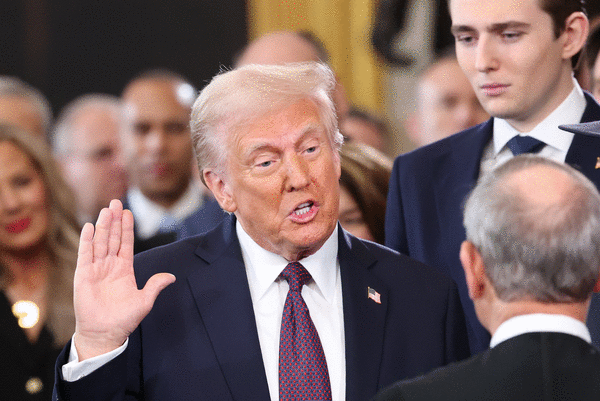
WASHINGTON — President Donald Trump soon will cap an all-gas-no-brakes 2025, with assessments mixed about a first year back in the White House that has overhauled the presidency.
Trump 2.0 reentered office on Jan. 20 with one of the most aggressive domestic and foreign policy agendas in American history. That included an unprecedented willingness to exploit or turn a blind eye to centuries-old laws and traditions that led past chief executives to reject certain courses of actions.
After many of them had spent years contributing to the conservative Project 2025 governing blueprint, administration officials spent the year repeatedly finding legal loophole after loophole. What has become apparent this year is few guardrails on the Office of the President have been etched into law over the centuries.
Virginia Sen. Mark Warner, the top Democrat on the Intelligence Committee, referred last week to Trump’s first 11 months back in office as “chaos on steroids.”
But Texas Republican John Cornyn, a member of the Senate Judiciary and Intelligence committees, said the president had been busy “putting points on the board” for conservatives.
Both veteran senators are up for reelection heading into next year’s midterms, which Michael Bitzer, a political scientist at North Carolina’s Catawba College, said would largely be about the president and his second term.
“Pretty much the iron law of mid-term elections is that voters make it a referendum on the president and the president’s party — especially if they are also in control of Congress,” he said in a Dec. 9 email.
That means Trump’s unprecedented interpretation and use of executive powers could be on voters’ minds.
“A lot, in fact a stunning amount, of what they have been doing is not illegal. It’s right at the margins — on purpose. Other presidents would not have gone there,” said one legal expert, granted anonymity because of ongoing litigation against the administration.
“And there is zero — zero — political loss for them, when they do lose on one of these policies in court,” the person added. “They can tell MAGA that they tried. And, as we have seen, they can abide by most of the judge’s order, but maybe not all of it, and get away with it.”
The Trump administration has pushed perhaps the most expansive view of executive power that Washington has ever seen. Over the past 11 months, the president’s eagerness to test the breaking points of the judicial, legislative and executive branches has caused some Democratic lawmakers and legal experts to conclude he has been governing like a monarch.
“Now, in our democracy, it’s clear we have a legislative branch, the House and the Senate, separate and co-equal. We’re supposed to provide a check and balance on an out-of-control executive branch. James Madison, in fact, one of the original framers of the Constitution, said that, at its best, Congress should be a rival to the executive branch,” House Minority Leader Hakeem Jeffries said Dec. 4.
“But that’s not what Republicans have done. These people are not rivals. They are a reckless rubber stamp for Donald Trump’s extreme agenda,” the New York Democrat told reporters. “And Donald Trump, of course, is behaving more like a wannabe king who’s uninterested in the scrutiny that comes from being part of American democracy.”
Trump has on multiple occasions rejected allegations that he views himself like a king. But 18 words he uttered during an Aug. 26 Cabinet meeting, which lasted more than three hours, revealed why his second-term governing approach has caused so many Democrats and other critics to push comparisons to monarchs and dictators.
“I have the right to do anything I want to do. I’m the president of the United States,” Trump said, words that few predecessors dared say publicly.
“If I think our country is in danger, and it is in danger in these cities, I can do it,” he added, referring to his threats to deploy National Guard troops and federal agents in Democrat-run places that he says are crime-riddled and poorly governed.
Big win
Trump and congressional Republicans scored a major victory in 2025 with their sweeping tax and domestic policy measure known as the One Big, Beautiful Bill Act.
“We got everything,” the president said of the measure last week. He often boasts that the law extended his 2017 tax cuts and implemented his campaign trail vows to nix taxes on tips and overtime.
Collectively, the president’s team has argued that the economy is set up for big things next year as the law’s various provisions kick in.
“Americans can also expect another boost to their bank accounts in the months ahead as 2026 tax refund season is upon us after the holidays, and it’s projected to be the largest ever thanks to President Trump’s passage of the One Big, Beautiful Bill,” White House press secretary Karoline Leavitt said Thursday. “According to recent analysis from Piper Sandler, when Americans file their taxes early next year, their refunds could be about one-third larger than usual, or roughly an extra $1,000 per filer.
“That is money straight into the pockets of the American people,” she added.
Aaron Cutler, a former aide to House Republican leaders, said he would give the president “an A+ for year one of the second term” and an “A++ for energy, because the president is an Energizer Bunny and always on and working.”
He added that Trump deserves credit for his work on the world stage, a major focus of his 2025 agenda, much to the surprise of once-loyal MAGA allies such as Georgia Rep. Marjorie Taylor Greene, who is resigning next month amid a highly public falling-out with the president.
“Promises made and promises kept. Most importantly, the hostages held in Gaza were released. Hamas knew that President Trump was not bluffing when he said there would be all hell to pay if the Oct. 7 hostages weren’t released,” Cutler said in a Dec. 10 email. “Several international conflicts have ended with President Trump’s involvement. And we have World Cup 2026 to look forward to in a few months, as well as America’s 250th birthday.”
‘A+++++’
Massachusetts Rep. Jim McGovern, the top Democrat on the House Rules Committee, said he would give Trump a “failing grade” for his first year back in office.
“If you’re a multibillionaire, if you’re a big corporation, then I’m sure you give Trump an A-plus,” he said.
For all of Trump 2.0’s frenetic actions, his first year was also memorable for things that did not materialize. Perhaps at the top of that list was the president’s renewed talk about some kind of legislative plan to give the 2010 Affordable Care Act a significant makeover. Trump has promised such a plan for more than a decade, but he has never delivered one to Congress.
“Part of the problem economically is what we have with health care. It’s not just because of Obamacare. We just encourage massive consolidations in the (health care) industry. Where’s the competition, right? There’s not one incentive in health care to drive down costs,” Wisconsin Sen. Ron Johnson, a top Trump ally, said Dec. 4.
“It’s not just that we don’t have incentives to reduce costs — every incentive is to increase it,” the GOP senator added.
The White House floated release of a health care proposal earlier this month but delayed such a move indefinitely amid a chorus of GOP objections.
High prices plagued Trump for all of 2025, intensifying as the holiday season set in. The president in recent weeks has appeared dismissive of those affordability concerns, most recently at a Dec. 9 rally in a Pennsylvania swing county.
As most Americans have grown weary of the still-sluggish economy, Trump’s approval rating and poll numbers on economic and other issues have slumped. Democrats have overperformed in special and regular elections this year, leading many political prognosticators to predict gains for the party in next year’s midterm elections.
To that end, Trump has pushed for mid-decade redistricting to help House Republicans pick up seats and defend their narrow majority. States such as Texas, Missouri and North Carolina have all crafted new congressional maps that are even friendlier to Republicans. But the process hasn’t been without hiccups for the GOP: California Democrats responded by approving a new map that could help them flip up to five House seats, while a redistricting effort in Indiana was rejected by the state’s GOP-controlled Senate.
Trump has publicly projected optimism that Republicans will retain control of Congress next year. “I think we have great spirit. We should win the midterms,” he said during a roundtable at the White House last week.
Asked during an interview with Politico earlier this month to judge the economy under his watch, he replied, “A+++++.”
To that end, Cutler pointed to what he described as “significant economic wins.” He credited Trump for “bringing manufacturing back to the U.S., including high-tech manufacturing,” as well as “stabilizing the U.S.-China relationship and setting the table for an AI-data center boom.”
Congressional Democrats, however, reject that rosy assessment.
“For working families, middle-class families, those who are struggling in poverty, this year gets an F grade,” McGovern said.
©2025 CQ-Roll Call, Inc., All Rights Reserved. Visit cqrollcall.com. Distributed by Tribune Content Agency, LLC.



















































Comments