Laura Yuen: After ICE, Minnesota enters the next chapter of loving your neighbor
Published in Op Eds





MINNEAPOLIS — When Jody Abramson enlisted in the resistance, volunteering to ferry kindergarteners to and from school, she knew little about the experiences of new immigrants in her community.
One afternoon an Ecuadorian boy fell asleep in the backseat of her old Toyota, so there was Abramson, a stranger, gently carrying him over a snowbank and returning him to his rental house in north Minneapolis.
On his doorstep, she knocked, holding his tiny hand. No answer. She knocked again, her panic rising. What would happen if nobody came to the door?
Someone finally did. A woman opened the door a crack, peering out. Abramson was startled. Why could this person barely show her face?
Over the next five months, as she deepened her relationships with immigrant families, Abramson would come to intimately understand the visceral fear in the woman’s eyes and the broader terror sweeping Minneapolis.
Her work started in mid-December, after federal agents began to flood Minneapolis as part of the largest immigration crackdown in U.S. history. Now, Abramson — one of countless Minnesotans who’ve stepped up to drive scared kids to school, shuttle families to immigration hearings and doctor’s appointments, and raise cash to pay their bills — is wiser to the journey of her neighbors and what it means to genuinely care for them.
“It only took a week of driving kids for me to see what has most definitely been in my backyard all along,” Abramson said.
Now that most of the roughly 4,000 federal agents have receded from Minnesota, Abramson and other volunteers who’ve spun a grassroots web of crisis-response networks are entering the next stage of loving their neighbors. It’s trickier, because the needs are different and the media spotlight has shifted, but the fear is still there.
So, too, are the bonds. They are the silver lining in the aftermath of a federal operation that killed two U.S. citizens, terrified residents and fractured families. The social fabric of Minnesota emerged from the winter stronger because of the friendships forged.
Ashley Fairbanks, a Minneapolis native who runs the mutual-aid website Stand With Minnesota, said the crisis changed how people give. She said even after a racial reckoning and outpouring of money following George Floyd’s murder, most Minnesotans snapped back to old routines and thought patterns. Fairbanks, who now lives in San Antonio, says that’s not possible this time.
“You can’t really snap back because you’ve been driving them to work for a month, or you’ve been driving their kids to school and you’ve gotten to know them,” she said. “When you’re delivering groceries or bringing them hot dish, you’re building a relationship that’s lasting.”
The interconnection of these lives, Fairbanks said, is the most radical aspect of the resistance. There’s no turning back.
Calling the ‘abuelas’
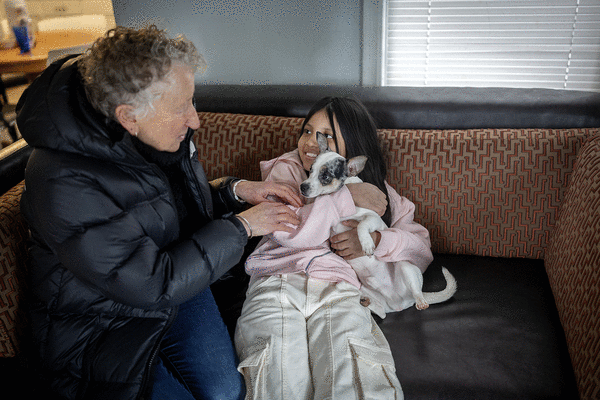
That’s certainly true for Abramson, a 68-year-old retiree who lives in quaint Bryn Mawr, adjacent to the city’s north side. She got to know several Latino families whose kids attended a predominantly Black, high-poverty school less than two miles away. Many of the volunteers were white grandmas who christened their efforts the “abuela project,” driving immigrant kids to and from Bethune Arts Elementary School.
One of the girls Abramson befriended was a spunky 9-year-old named Rosmery.
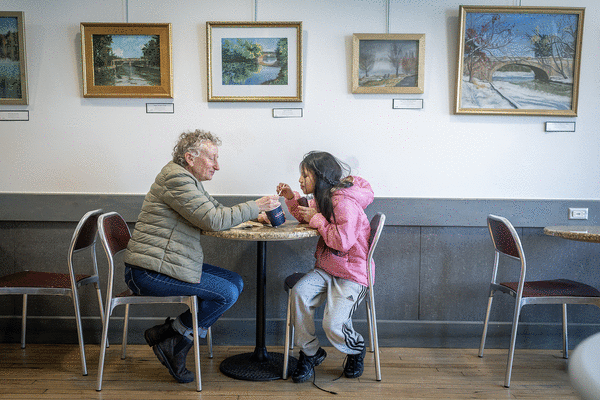
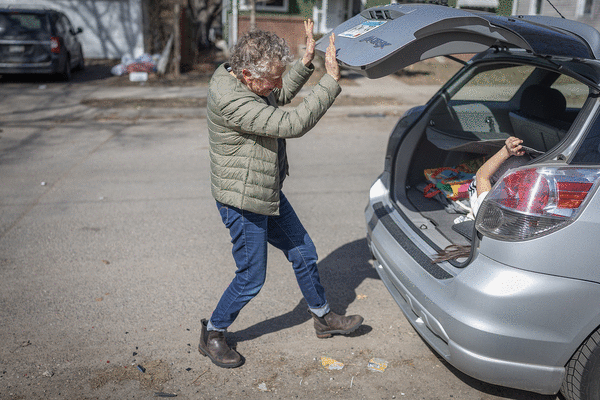
Fearless and playful, the girl in the pink parka stood out immediately. One of Rosmery’s favorite pranks — yes, during Operation Metro Surge — was to pretend she had gone missing. One afternoon, as Abramson returned to her car after walking another kid to the child’s front door, she saw no trace of Rosmery.
“I called her name with a tone of incredible fear,” Abramson recalled. “I hear this squeak — she had climbed over the backseat, gotten in the trunk and curled up with a look on her face. Oh, she was so pleased with herself.”
Despite the scare, it was sweet to see that Rosmery hadn’t lost a vital part of being a kid.
Abramson speaks to Rosmery and her mom, Maria, in English, typing words into her phone, fumbling for a passable translation in Spanish. On a couple of occasions, when somebody was able to interpret, she could piece together parts of their story.
Maria is raising five kids on her own. Her ex-husband was deported to Ecuador about a year and a half ago. Maria, who asked to withhold her last name from this column because she fears reprisal, has a pending application for asylum. During the surge, she relied on volunteers for groceries, too afraid to venture out after the killings of Renee Good and Alex Pretti.
“I couldn’t go to work or send my children to school,” Maria said in Spanish. “If they didn’t respect those two who are American citizens, what would they do to us?”
Maria taught her kids about all the Minnesotans who marched in the streets, fighting the sting of subzero cold. She pointed out the food left on their doorstep when their fridge was empty. She reminded her children that Good and Pretti were killed by federal agents while standing up for immigrants like them.
“These are things you should never forget,” Maria said. “We realize this country is very beautiful, specifically Minnesota.”
When I spoke to her in March, resources were dwindling. She was behind on her utility bills. What she needed was a job with more stable hours. The downtown hotel where she cleaned rooms cut her shifts to just twice a week. She had finally tasted the freedom of stepping outside, but she was nervous about sending Rosmery to school on the bus.
She thinks of Abramson as a “madrina,” or godmother, to Rosmery, and worries that after the drawdown, their new friend will soon fade from their lives.
“I can’t thank you enough for taking her,” Maria told Abramson. “Please don’t forget my daughter.”
“I won’t,” Abramson promised.
Caring up close
This type of caring is not as tidy and detached as writing a check to one’s favorite charity. It’s up close, and it can be awkward, messy and uncomfortable. That’s what being in a true relationship means.
It also means you help however you can, humbled by what you do not know, what you cannot say in another language, or how little control you have over another person’s future.
An organizer friend told me that she’s banking on the friendships between people like Abramson and Rosmery. These social bonds, she says, are the path to healing heartbreak and changing systems.
Ever since the wintry afternoon when Abramson returned the little boy, worried that no one would answer the door, she plunged into a complex immigration system of A-numbers, detention facilities and court hearings. Abramson learned that a handful of families lived in the house; all of the men — the primary breadwinners — were detained and deported to Ecuador.
Soon, three of the women decided to self-deport, along with their children, so their families could be reunited. That included the boy whose tiny hand Abramson held on his doorstep in December; she drove him and his mom to the airport.
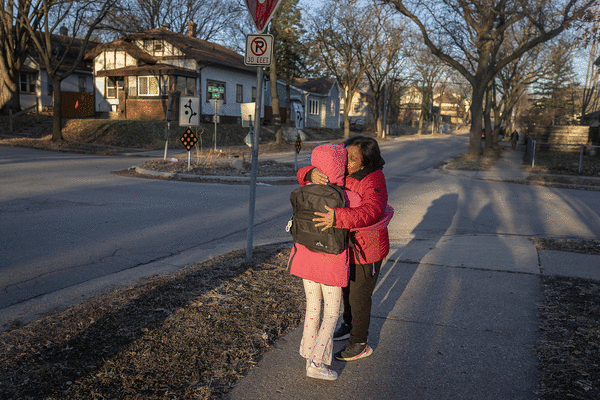
Abramson does not consider herself a revolutionary. She takes Rosmery to buy new shoes that fit her. She treats her to ice cream, surprised when the little girl orders three scoops. When Rosmery initiates a prolonged hug, you can almost feel Abramson’s heart swell.
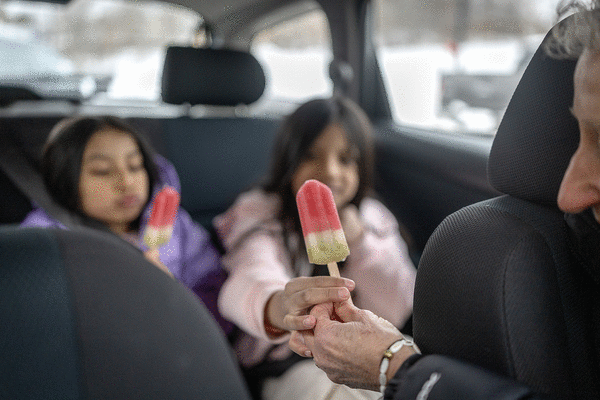
The ride rituals often begin with Abramson offering the children in her backseat a choice between a clementine and a popsicle.
On the last day Abramson picked her up from school, Rosmery surprised her with flowers, chocolate and a handwritten card that said, “I will miss you.” Rosmery would soon take the bus again.
What comes next?
The next question for the movement is how to leverage these relationships into lasting change. Some parents who went into hiding are still out of work. The monthly “rent debt” for low-income immigrant families in Minnesota — the money that tenants owe landlords due to missing payments — ballooned as a result of the ICE crackdown. Researchers at the University of Minnesota estimated the debt jumped by tens of millions of dollars for January and February.
It’s not too late to help, said Fairbanks, the activist. On her website, for example, you can buddy up with a family and help pay for their rent.
There’s also talk of mobilizing the Bethune “abuelas” as school volunteers, so they can read to students or lead them in art projects. Abramson said her eyes are open now.
“I’m going to stay connected,” she said. “I don’t know what that looks like. There are so many needs, and I don’t know how we’re going to meet them.”
After spring break, the abuelas officially retired from carpooling, so families were encouraged to send their kids to school on the bus.
Maria had just landed a new job with a cleaning service, thanks to one of Abramson’s leads. Hand in hand, seeing their breath in the morning cold, Maria and Rosmery walked to the bus stop.
The bus arrived as the sun rose, and mom and daughter quickly hugged. The girl in the pink jacket hopped aboard, not looking back.
____
Photographer Liz Flores contributed to this column.
___
©2026 The Minnesota Star Tribune. Visit at startribune.com. Distributed by Tribune Content Agency, LLC.




































Comments