Editorial: Budgets used to be about fiscal control. Not anymore
Published in Op Eds
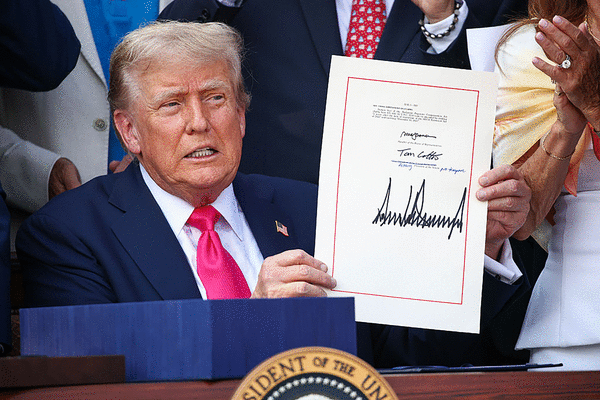
Presidential budget requests are rarely to be taken seriously. Congress typically ignores them and grinds out changes in spending and taxes according to its own priorities, in its own good time. Yet even by this standard, the White House’s budget for the next fiscal year is disappointing. Rather than merely failing to solve the country’s rapidly worsening fiscal problems, it chooses to ignore them entirely while advocating an enormous increase in defense spending.
The administration doesn’t actually bother to project deficits and public debt over the next decade. You have to estimate them from spending requests for the coming year and economic assumptions set out in the budget’s supporting “analytical perspectives.”
Crunching these numbers, the nonpartisan Committee for a Responsible Federal Budget reckons that the budget and its economic assumptions imply public debt rising to 103% of gross domestic product in 2029 before falling to 94% in 2036. But this prospect, which seems benign by recent standards, requires economic growth of 3% a year through the decade — far higher than the 2% or less expected by other authoritative forecasters — together with falling long-term interest rates and unimpeded tariff revenue, despite the Supreme Court’s recent ruling that most of the “Liberation Day” duties were unlawful.
If you plug in more plausible assumptions on growth, interest rates and tariffs, deficits would stick at more than 6% of GDP over the next 10 years. The debt ratio would reach 124% of GDP by 2036 and would keep going up from there. Even these more realistic projections are still pretty optimistic in two respects: They assume no recession in the coming decade, and they expect investors to keep on buying US government debt without causing interest rates to spike.
The budget’s main idea is an enormous increase in defense spending — adding up to more than $3 trillion over 10 years, partly offset by cuts in non-defense discretionary spending of around $2.5 trillion. Both proposals are questionable, to put it mildly.
Certainly, there’s a case for spending somewhat more on defense, given mounting geopolitical risks — but there’s also scope for overdue economies and greater efficiency. Outlays old and new need to be justified and competently managed. In this respect, the budget again has little to say. And it needs to be borne in mind that worsening fiscal stress is a security risk in its own right: A country that loses the ability to borrow in an emergency has undermined its ability to defend itself.
Lastly, what about those spending offsets? The budget purports to meet the cost of its new priorities not by raising taxes, and not with lower spending on so-called mandatory programs — mainly Social Security and Medicare — but by sharply cutting other “discretionary” spending. Non-defense discretionary programs include support for education and training, public health and medical research, food and nutrition programs, federal law enforcement, and so on. Savings here and there are doubtless feasible. But cuts of $2.5 trillion over 10 years would be both undesirable and politically impossible.
In short, economizing on non-defense outlays simply has to bring mandatory spending under review. Setting those programs aside says, in effect, “We have no intention of making this right.”
Another budget, another waste of everybody’s time.
____
The Editorial Board publishes the views of the editors across a range of national and global affairs.
©2026 Bloomberg L.P. Visit bloomberg.com/opinion. Distributed by Tribune Content Agency, LLC.

















































Comments