LZ Granderson: Faith lessons don't belong in public schools, and Christians know that
Published in Op Eds
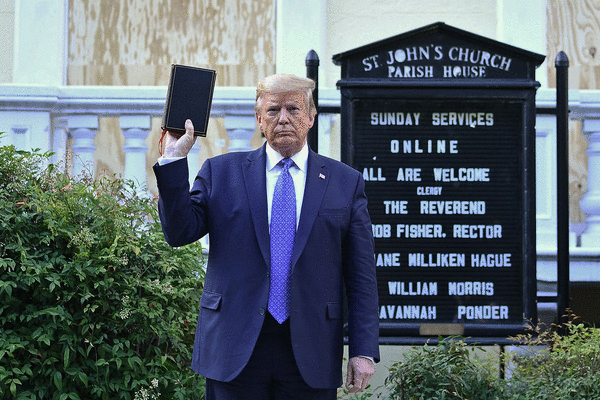
We had so much going on this week, with the new season of "Euphoria" coming out and the president threatening to wipe out a 2,600-year-old civilization, that it's easy to miss things like the latest attempt by conservatives to reshape the U.S. into a theocracy. Not satisfied with shoehorning Bible stories into its English curriculum and the push to display the Ten Commandments in public classrooms, the Texas Board of Education is now considering adding Bible verses to the required reading list for students.
Among the scriptures the board is considering are Psalm 23, the story of Jonah and the whale, and Lamentations 3, which talks about keeping your faith in God in good times and in bad. In fact, compiled together, the scriptures that officials are considering read like pages torn from "Chicken Soup for the Christian Soul." Which, as a Christian, I appreciate — however, as an American, I vehemently oppose.
For one of the country's largest providers of public education to consider requiring students to read Bible verses feels like a grenade being hurled at the wall separating church and state. However, when you factor in similar challenges from other red states such as Louisiana, which also wants to display the Ten Commandments in public classrooms, or Oklahoma, whose attempt to use public funds to create a religious online charter school was blocked by the Supreme Court last spring, it's clear state officials in red states have launched a full-on coordinated attack. Which means the collection of warm and fuzzy scriptures being considered in Texas is likely just a Trojan horse to either bring in more extreme theology next or force another visit to this conservative Supreme Court. And recall, it was the court's ruling on an antiabortion law out of Texas in 2021 that set the stage for overturning Roe vs. Wade the following year.
Now, in a country in which more than 60% of people identify as Christian, there may be a temptation to view the Ten Commandments in public schools as innocuous. Most of the content is uncontroversial: Murdering and stealing are bad; lying and cheating are things one should not do. However, how does a state government reconcile displaying "you shall have no other gods before me" in a democracy in which a third of citizens may have another god or no god at all?
And why place public school teachers, many of whom are not Christians themselves, in a position in which they may have to explain that religion's doctrine? If Gov. Greg Abbott saw fit to sign Senate Bill 12, a so-called parent rights law banning school employees from discussing gender identity and sexual orientation with their students, why would parents want teachers talking to kids about faith? Even among the two-thirds of Americans who identify as Christians, many denominations purport to take the Bible literally, while others consider it divinely inspired. So when questions about Jonah and the whale pop up, do you want teachers to talk about the theoretical logistics of breathing inside a fish (or cetacean?) or about the symbolism of a minority culture resisting assimilation? Or … would you rather that this topic simply not be raised in a public school classroom?
The desire to do good in the world is admirable, and I'm not so cynical as to think each attempt to bring religion into the public square is inherently nefarious. However, just as Chinese monks during the Tang dynasty set out to create an elixir to prolong life and instead invented gunpowder, or as Alfred Nobel created dynamite for infrastructure only to watch his invention be used in war, the original intent of religion is often in conflict with how it comes to be used. In fact, one of the main reasons the Bible was circulated in English in the first place was to serve a less-than-holy agenda: The Catholic Church wouldn't grant England's Henry VIII a divorce, so he sought to make up his own religion to get a new wife.
And when the new wife did not provide him with a son, he had her beheaded. Apparently, in his version of Christianity, doing so was perfectly fine in the eyes of God. As king, he was above challenges in the courts, and there was no free press to hold him accountable.
Let that sordid chapter serve as a reminder: Regardless of faith, we all should want the wall between church and state to stay right where it is.
____
YouTube: @LZGrandersonShow
____
©2026 Los Angeles Times. Visit at latimes.com. Distributed by Tribune Content Agency, LLC.































Comments