Editorial: As hurricane season looms, readiness takes center stage under new DHS head
Published in Op Eds
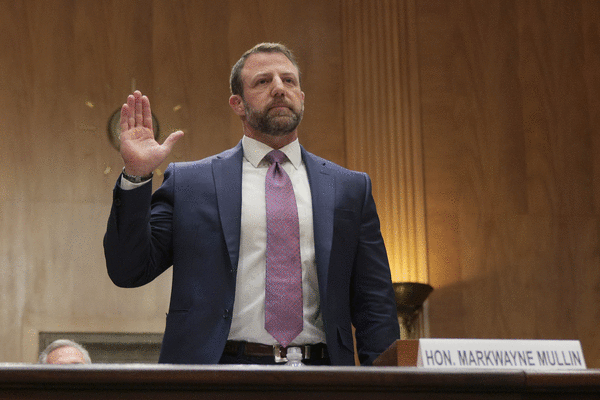
In his first Cabinet reshuffle of his second term, President Donald Trump last month ousted Department of Homeland Security Secretary Kristi Noem, the former governor of South Dakota, replacing her with Sen. Markwayne Mullin of Oklahoma, who was confirmed by the Senate on March 23.
While Mullin holds some views antithetical to the security of our nation, he can prove his mettle in this role by ensuring the Federal Emergency Management Agency is prepared to respond to hurricane season, which begins in a few weeks. Doing so would alleviate worries in storm-threatened areas such as ours about changes to that critical agency and inspire confidence that Washington is ready to respond when disaster strikes.
Leading DHS is arguably the most challenging Cabinet post in the executive branch. While others, such as attorney general and secretary of state, are equally, if not more, consequential, Homeland Security is the third-largest department by workforce and represents a sprawling Frankenstein’s monster of various offices consolidated under one umbrella in the aftermath of the 9/11 terrorist attacks.
These include Immigration and Customs Enforcement and Border Patrol carrying out the Trump administration’s often brutal and deeply unpopular immigration campaign, the subject of a funding impasse in Congress over Democratic demands that federal agents obey the law and honor court rulings in their operations. DHS also includes the Secret Service, Coast Guard and the Transportation Security Agency among its 22 agencies.
Top Videos DHS considers not processing international travelers at some airports
A key focus of the department is emergency readiness, and Congress gives DHS authority over FEMA. That agency helps coordinate resources and assistance to help battered communities after floods, fires, hurricanes and other disasters, and serves as a critical lifeline to victims in their aftermath.
Hampton Roads is no stranger to storms and residents here know all too well how helpful FEMA can be after a storm strikes. The agency has helped our communities after hurricanes and tornadoes, among other weather events, and has helped to ensure those affected get back on their feet as quickly as possible.
Under Noem, however, and at the direction of the president, FEMA pulled back from its stated mission “to help people before, during and after disasters.” Upon taking office in 2025, Trump moved to severely curtail, if not eliminate, the agency and deflect responsibility for disaster recovery from Washington to the affected states and localities.
That view ignores the important role FEMA plays in bringing various response agencies together and leveraging resources from the federal government to deliver assistance quickly. Few states can afford a billion-dollar disaster and, at a time when such disasters are increasingly common, sunsetting FEMA would effectively abandon victims in their time of greatest need.
There is no question that FEMA needs reform. It should be more forward thinking and robust in its efforts to mitigate the likelihood of disaster through investment in resilience and preparation rather than in the aftermath of an emergency. But it remains a powerful reflection of a nation that helps its citizens, wherever they may live, when the worst befalls them.
There is hope that Mullin, unlike Noem, understands this. As a resident of tornado-prone Oklahoma, he has experience with FEMA’s work on the ground amid the rubble of buildings and so many shattered lives. His recognition of the value of federal assistance should make him a better fit to guide FEMA through reforms than his predecessor.
Already he’s made one important change since his confirmation by ending Noem’s policy of requiring personal approval for disaster expenditures exceeding $100,000. That was unnecessary micromanaging that caused bottlenecks at a time when speed was key to helping people.
There is plenty about Mullin that is concerning, and his handling of the immigration campaign will define his tenure. But for communities such as ours that spend months warily eyeing storm formation in the tropics, his ascension to DHS secretary could mean better things for FEMA, which is a measure of comfort before hurricane season begins.
_____
©2026 The Virginian-Pilot. Visit at pilotonline.com. Distributed by Tribune Content Agency, LLC.




























Comments