Editorial: A growing culture of political violence
Published in Op Eds
After deadly riots swept Los Angeles in 1992 in response to a jury’s acquittal of four police officers who savagely beat motorist Rodney King, he begged for peace.
“People, I just want to say, you know, can we all get along?” King pleaded.
His poignant appeal is no less urgent now, as verbal violence overcomes civil national discourse. Venomous words presage physical violence.
A violent society
Violence is embedded in American culture. Four presidents have been murdered, and plots were found against at least 16 others. Four presidential candidates have been shot, one fatally.
The national temper is rising. The Government Accountability Office reported a 357% increase in domestic terrorism from 2013 to 2021.
Partisan political attacks are rising sharply, most from the right. A leading Democratic state legislator and her husband were murdered in Minnesota by a man who attempted to kill others. The state residence of Pennsylvania Gov. Josh Shapiro was torched.
There have been at least a dozen reported plots against President Donald Trump, including a shooting in Pennsylvania that nicked him and killed a spectator. Racists have committed mass murder in El Paso, Texas; Buffalo, N.Y.; and Charleston, S.C.
“(U)biquitous firearms, political polarization, and other factors have combined with the power of online communication and social media to generate a complex and varied terrorist threat that crosses ideologies and is largely disconnected from traditional understandings of terrorist organizations,” observes the liberal think tank New America.
Threats on the rise
From City Hall to Capitol Hill, a sense of danger gnaws at our psyche.
Direct threats and other “concerning” statements about members of Congress soared from 3,939 in 2017 to 14,938 in 2025 according to the U.S. Capitol Police, a surge of more than 5,000 cases from 2024.
Congress has 535 members. That works out to nearly 28 threats for each of them. Small wonder so many are leaving (58 in the House as of March 27, AP reports). Congress has set aside $200 million for its members’ security.
One who is not quitting but has had to accept sharp restrictions on public appearances is Rep. Jared Moskowitz, the two-term Broward County Democrat, who is Jewish.
Police have guarded his Parkland home since a convicted felon living nearby was arrested and imprisoned over a cache of weapons and files with a handwritten list of “targets” that included Moskowitz’s name, a synagogue, a Jewish cemetery, bar mitzvah halls and other entries bespeaking violent antisemitism.
“He was Googling where my wife worked, the temple where I went to,” Moskowitz said.
Not on watch lists
The suspect, John Kevin Lapinsky Jr., was not on any watch list before police were called to his Margate home by reports of gunfire. Moskowitz wonders how many other walking time bombs are undiscovered.
“There are other members of Congress who have security … dozens of us,” Moskowitz said. “This is something that probably started about two years ago. It’s gotten tremendously worse in the last year.”
Much of the problem, he agreed, owes to the language of Trump, laced with violent imagery.
Trump has said that his opponents are guilty of “treason” and deserving of death, that journalists who refuse to reveal sources should be put in prison to be raped and that immigrants were “poisoning the blood of our country” — a phrase straight from the neo-Nazi underworld.
That’s a much-abbreviated list of Trump’s language unbecoming his office.
Trump needs to cool it, Moskowitz said. But he is not confident — nor are we — that the nation’s temper will abate sufficiently when there’s a new president.
‘A life of its own’
“It has taken on a life of its own, and it’s going to outlive his presidency,” Moskowitz said.
That violent words can have violent consequences is as old as the murder of Archbishop Thomas Becket at Canterbury Cathedral in 1170 by four knights who heard King Henry II complain, “Will no one rid me of this turbulent priest?”
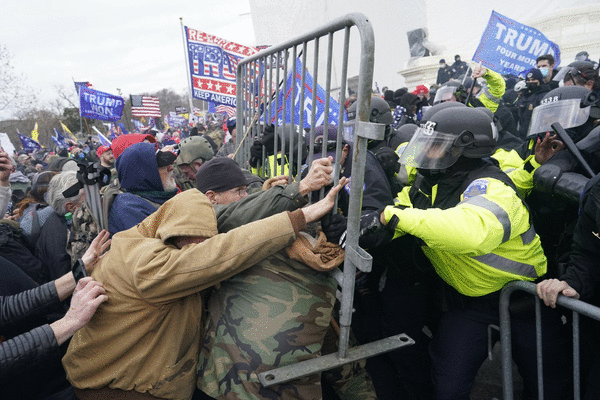
On Jan. 6, 2021, Trump’s violent words incited an insurrection against Congress as it met to count the electoral votes that defeated him.
“If you don’t fight like hell, you’re not going to have a country any more,” he said to a large crowd near the White House.
His apologists note that he followed up with an admonition to protest peacefully.
But those fighting words set the mood for the mob that invaded the Capitol. They injured more than 140 police officers, one of whom died of strokes that day. Four more died by suicide later.
On the first day of his second term, Trump gave clemency to the more than 1,500 people who were convicted or awaited trial for acting on his words.
Government is “the omnipresent teacher,” wrote Supreme Court Justice Louis Brandeis. “For good or ill, it teaches the whole people by its example.”
Somehow, Americans have to learn to get along again. The president must set a positive example, but this one won’t.
_____
©2026 South Florida Sun Sentinel. Visit at sun-sentinel.com. Distributed by Tribune Content Agency, LLC.







































Comments