Commentary: The Iran war triggers the US economy's engine light
Published in Op Eds
When the Trump administration launched the war in Iran a month ago, higher oil and energy prices were surely expected, yet there was a positive feeling that the U.S. economy was strong and vibrant enough to keep running smoothly. Like a family planning a long road trip in a sturdy seven-seat SUV, it believed the economic engine was serviced, checked, and ready for the toll of a grueling drive across deserts and mountain ranges.
Nonetheless, as tends to happen even to seemingly prepared travelers, the engine light is now on.
The president painted a bright picture in his February 24 State of the Union address: “Inflation is plummeting, incomes are rising fast. The roaring economy is roaring like never before, and our enemies are scared, our military and police are stacked, and America is respected again.”
Now, after more than 30 days on the road, that big SUV is still moving forward, but with signs of stress. Experts speak more seriously of recession. Were there severe bumps that the administration didn’t expect? In retrospect, has the lonely vehicle proved inadequate to weather this economic journey? With more wear-and-tear now exposed, is a war-generated breakdown ahead?
Let’s face it: There have been some meaningful data reversals and disappointments reflecting the pre-war period. The domestic economy may not have been as strong as believed as the conflict began on February 28, when the latest estimate for 2025 fourth-quarter GDP growth stood at a weak-but-positive 1.4%. This was revised down to 0.7% on March 13.
As the war progressed, we saw some heavy revisions in labor market data. The April 3 employment report showed a gain of 178,000 jobs for March, but February’s loss was revised down to 133,000 jobs. Overall, there has been a gain of only 253,000 on non-farm payrolls in the last 12 months.
We also learned that there had been no real 2025 job growth and that for the year’s first nine months, only four states saw manufacturing employment growth. The rest were losing factory employment.
We’ll have to keep watching the inflation gauge. On March 11, the Bureau of Labor Statistics reported that the February all-item Consumer Price Index had risen 2.4% over the prior 12 months — the same growth as in January and well above the Fed’s 2% target. Housing costs are the big inflation kicker, and war-induced higher interest rates had not yet figured in the CPI math. In early March, the 30-year fixed rate mortgage rate stood at 6.0%. On March 27, the rate was 6.38%.
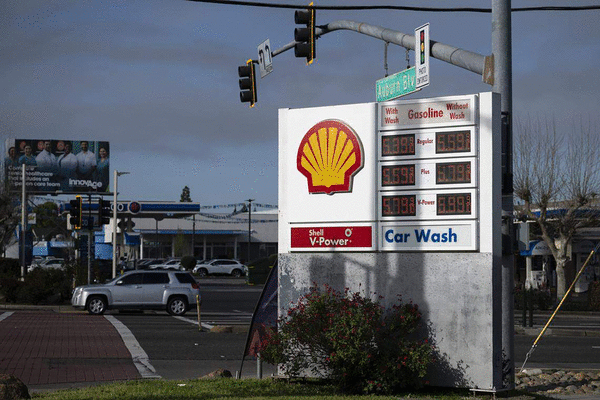
Then there’s the skyrocketing price of oil and energy inputs into gas prices, fertilizer and practically everything else. In late March, the cost of petroleum-based fertilizer inputs urea and ammonia rose 50% and 20% respectively. The engine light on the farm economy turned red. If crop yields fall, consumers will be voicing a lot of displeasure over food prices.
Now, forecasters are revising their estimates for what to expect on the road ahead.
Looking at the short-term, the Atlanta Fed has reduced its estimate for 2026’s first-quarter GDP growth from 3.0% on March 2 to 2.0% on March 23. For the longer-term, Wells Fargo’s chastened its U.S. GDP growth forecast a bit. This year’s second-quarter growth is now set at 1.3% rather than 1.6%, the weakest period expected for the year ahead.
Polymarket’s auction forecast for a recession before the end of 2026 has risen from 23% on February 27 to 36% on March 27. And of course, it is not just the United States that is suffering. Hardship is being felt across the globe.
Economics offers no obvious prescription for peace once a multi-country war is underway, but a key lesson from economist and Nobel laureate F.A. Hayek may make the trip to better times easier. When conflicts or emergencies arise, national leaders tend to subscribe too readily to the idea that they can treat the world’s economy like one complicated, but ultimately understandable, vehicle and chart the optimal path forward. A bunker mentality takes hold. Hayek referred to this as a “fatal conceit.”
The real world is simply too large and the necessary information too dispersed and ever-changing for command-and-control decision makers to engineer the outcomes they want. War-time decision makers must be ready to relax their grip on the economy, give other decisionmakers latitude to move freely, and let the market process operate.
Let us hope that, whatever assumptions were made at the outset of this war, our leaders remember that we’ll all have a smoother ride when cooperating in a free and open society.
_____
Bruce Yandle is a distinguished senior fellow with the Mercatus Center at George Mason University, dean emeritus of the Clemson College of Business and Behavioral Sciences and a former executive director of the Federal Trade Commission.
_____
©2026 Tribune Content Agency, LLC.

















































Comments