Abby McCloskey: Classroom iPads are teaching kids the wrong skills
Published in Op Eds
I’m going to say something from my firsthand experience as a mom: Schools have a terrible track record with screens. It tends to be adoption first, skepticism later (and then only maybe). That’s led to a generation of kids being treated as Big Tech guinea pigs and falling student achievement scores.
First, schools allowed kids to bring personal smartphones into classrooms like they were lunch boxes. Now there are school-sponsored screens and screen-based curricula. Some states are finally saying, “Enough,” but it will be a tough job for lawmakers to unwind technology that’s now embedded in almost every aspect of K-12 education.
Things accelerated during COVID. When the pandemic hit, our local public school closed its computer lab, issued my kindergartener an iPad, and never looked back. There was no overarching policy, no time limits for its use in the classroom, and the safety controls were leaky.
The pandemic dissipated, but the screens stayed. As I investigated different school options for my children, I found that both public and private schools like to boast about their 1-1 student-to-device ratios. A survey by the New York Times found that 81% of elementary school teachers said students received school-sponsored devices for use in class by kindergarten.
Even if teachers want to reduce the time their students spend on screens, many are unable to. According to a 2025 RAND report, one in three teachers reported that they are required by their district or school to use mostly or entirely digital instructional materials. And because nearly all states exclusively use digital statewide testing, screen-based test practice becomes necessary. That consequently influences much of the rest of the curriculum.
It would be one thing if screens were associated with higher student achievement. But that’s not what we’re seeing. In Senate testimony earlier this year, neuroscientist and author Dr. Jared Cooney Horvath argued that Gen Z is the first modern generation to score lower on standardized tests than the previous one, which he directly attributed to screen use in the classroom. According to a study out of the Interdisciplinary Reading Research Structure of the University of Valencia, students reading physical books have 6 to 8 times more comprehension than they do after reading on a digital device.
Tech optimists may point to the benefits screens can have for individual tutoring or supplemental materials. I don’t disagree that there are some good use-cases. But ask parents of school-aged children how screens are used in the classroom. If their experience is anything like mine, it goes far beyond such targeted interventions. Screens are used for indoor recess, core curriculum, testing and YouTube for lessons, but maybe also for a break.
This has parents concerned and states across the political spectrum starting to act. Most states have already imposed some type of restrictions on personal cellphone use in the classroom in recent years, although only three states are truly “phone-free.” Now adults are realizing they can lock up kids’ phones during the school day, and it’s not enough. Kids are still spending much of their classroom time hunched over a glass rectangle.
In the 2026 legislative session, 16 states introduced wide-ranging legislation to reevaluate screen time in the classroom. Some are focused on vetting screen-based educational materials. For example, Vermont legislators have introduced legislation requiring that tech products used in school be registered and certified with the Secretary of State to prove limited data collection and the absence of addictive algorithms.
Others are focused on limiting screen-based teaching for the youngest kids. Tennessee and Minnesota have little in common politically, but they seem to agree on this. In Tennessee, lawmakers have introduced a bill to ban students in K–5 from using tablets and laptops during the school day and promote a return to paper-based testing. Minnesota is considering similar legislation for preschool and kindergarten students.
The results of these local efforts, should they pass, will hopefully inform federal action. Whether or not a school-age child spends their school day on a screen shouldn’t be dependent on where mom or dad can find a job. But Washington has been missing in action. The Trump administration gutted the Department of Education and members of Congress have been unable to pass basic reforms like age limits for social media, despite widespread bipartisan support.
The courts, too, are limited. Legal victories like that against Meta and Google last week may feel good. But they are punishment, not prevention, and focus on an isolated part of the problem.
Addressing screens in school demands a greater sense of urgency. The complications of screens in the classrooms only grow from here as technology advances further. Consider that AI is still brand-new, and it’s already swamped schools. Eighty-five percent of teachers and 86% of students have used AI in the 2024-25 school year, according to a report from the center-left nonprofit Center for Democracy and Technology. Although it’s too early to know the consequences, common sense suggests that our usual strategy of adopting first and re-evaluating later will not work well here, as it has not worked well for phones and tablets.
It’s good that states are taking action to re-evaluate technology. But the clock is ticking. This generation of kids doesn’t get a chance to redo K-12 once we wise up.
____
This column reflects the personal views of the author and does not necessarily reflect the opinion of the editorial board or Bloomberg LP and its owners.
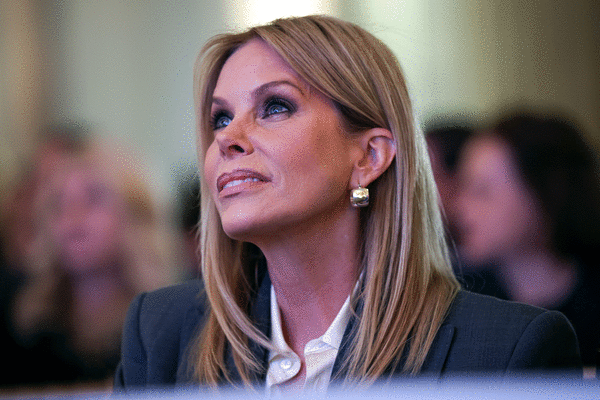
Abby McCloskey is a columnist, podcast host, and consultant. She directed domestic policy on two presidential campaigns and was director of economic policy at the American Enterprise Institute.
©2026 Bloomberg L.P. Visit bloomberg.com/opinion. Distributed by Tribune Content Agency, LLC.




















































Comments