Trudy Rubin: Trump's Iran quagmire distracts from Chinese threat to Taiwan
Published in Op Eds
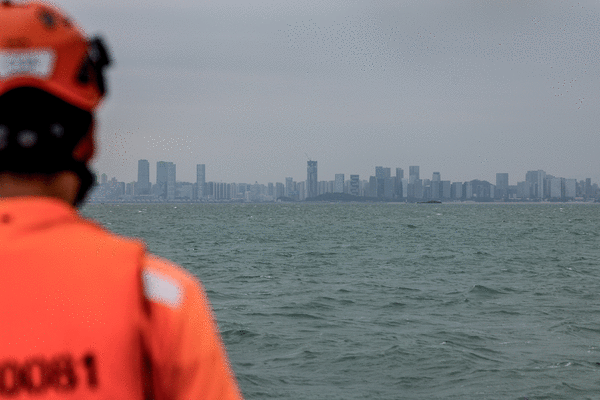
KINMEN, Taiwan — From this tiny outer island of Taiwan, which lies less than two miles from the Chinese mainland, one can view the high-rise towers of the Chinese port city of Xiamen.
Looking out over an extensive beach and through the mist at China, I realize Xiamen could probably be reached from where I stand by a good swimmer. From this vantage point, it’s easy to imagine Chinese leader Xi Jinping pursuing his obsession to “reunify” with the self-governing island democracy of Taiwan — whether by so-called peaceful means, by blockade of the Taiwan Strait, or using more direct force.
I traveled to Taiwan because President Donald Trump was supposed to meet Xi in Beijing this week. POTUS had previously signaled he might weaken long-standing U.S. support for Taiwan out of his desire to cozy up to the Chinese leader and sign an advantageous trade deal. Moreover, the White House has frozen a deal Trump had already endorsed for Taiwan to purchase around $11 billion to $13 billion worth of U.S. defensive weapons, so as not to upset Xi before the visit.
But Trump’s poorly planned war on Iran (he apparently never considered how Tehran would retaliate) has caused a postponement of the long-awaited trip until mid-May. As the erratic POTUS sinks into a potential Iran quagmire, lacking any cohesive strategy to thwart Tehran’s partial closure of the Strait of Hormuz, he is even less likely to focus strategically on the Taiwan issue.
Yet, any potential Chinese blockade of the Taiwan Strait in the next few years could present an equal or even greater security threat to the United States than Iran’s blockage of the Strait of Hormuz, through which about 20% of the world’s oil trade flows.
To understand why, it helps to know a bit about Kinmen’s history.
Until 1993, Kinmen was off-limits to visitors because it was a closed military zone, and locals lived under martial law from 1956 to 1992. Most of the 120,000 Taiwanese troops have been withdrawn, although a garrison remains.
Yet, endless rows of rusty anti-landing spikes along the beach line stand as a reminder of the 1949 civil war Battle of Guningtou between the Communist People’s Liberation Army (PLA) and Chiang Kai-shek’s Nationalists, who were defeated on the mainland and had retreated to Taiwan. With U.S. backing, the Nationalists set up the Republic of China (ROC) government on Taiwan’s main island, roughly 110 miles from Kinmen, and held off the PLA.
Those Americans who are old enough may recall the 1958 battle of Quemoy, as Kinmen was formerly known. During that battle, massive PLA shelling along with a Chinese blockade of the Taiwan Strait tested U.S. support for the ROC government. But President Dwight D. Eisenhower sent ships to break the blockade and repel the missiles. A local war museum displays huge photos of U.S. troops arriving on Kinmen.
Sixty-six years later, China tempts the youth of Kinmen with the glitzy shopping malls of Xiamen, reachable by a 30-minute ferry, while a massive new international airport, built on a man-made island, cuts the distance between China and Kinmen to roughly one mile.
Kinmen has become a tourist destination, with its beaches, war museums, and preservation of historic Qing dynasty homes. Chinese tourists pour into Kinmen, and the Beijing government promotes the purported advantages of “reunification” to the Kinmen public — including jobs and entertainment sites — as part of its effort to win Taiwan citizens to its side.
The Taiwanese government has blocked construction of a bridge that would connect the airport directly to Kinmen, presumably to prevent both the propaganda and the security threat of a direct link.
“Kinmen is at the front line of geopolitical conflict,” said youthful local Councilor Tung Sen-pao, as he greeted visitors in a curio shop. “We are a small lens through which you can view a much larger conflict between the U.S. and China and Taiwan and China.” As he spoke, the sound of military target practice reverberated outside.
Indeed, in recent months, China has been conducting the largest-ever live military fire drills all around Taiwan, and simulating a total blockade of its largest and smaller islands. An aggressive Xi refuses to rule out using force for “reunification.” Locals speculate what he might do by 2027, when he has ordered the PLA to be ready to invade (without making a commitment to do so).
This month, the U.S. intelligence community’s 2026 Annual Threat Assessment report determined that China does not plan to invade Taiwan in 2027 (although the report is published by the Office of the Director of National Intelligence, Tulsi Gabbard, whose gutting of the intel community raises the question of whether its reports can be trusted).
That trust factor becomes critical, as does American preparedness to respond if Xi does try to limit traffic or impose a full blockade of the Taiwan Strait, given its centrality to international trade.
An estimated 20% of global maritime trade passes through the Taiwan Strait, and it is the main maritime route for technology and consumer goods from South Korea, Japan, and Taiwan to U.S. consumers.
The United States has no treaty commitment to defend Taiwan, only a strategic necessity to prevent its forcible seizure by China. Little Taiwan, with 23 million people, produces 90% of the world’s most sophisticated semiconductor chips. If cut off, it could be disastrous for U.S. civilian and military needs.
Moreover, if Taiwan falls, the security of U.S. allies in Seoul, Tokyo, and Manila, with whom America does have military commitments, would be at deep risk.
Equally troubling, Trump’s Mideast war has drained missile interceptor stockpiles, including Patriot missile batteries and other weapons that are vital to dissuade Xi from taking rash steps. It is hard to believe a president who has acted so fecklessly on Iran strategy has any adequate plan for handling a meeting with China’s leader, except possibly to cave on supporting Taiwan.
Meantime, Councilor Tung admits that Kinmen will have little say over its future. “We are a tiny island,” he said with a wry smile. “There is now no way for us to counter an attack if China tries to invade Kinmen.”
However, he also believes “a direct attack on Taiwan in a conflict is more likely than targeting offshore islands such as Kinmen.”
The 50,000 or so permanent residents of Kinmen just hope the status quo can endure for a few more years.
___
©2026 The Philadelphia Inquirer, LLC. Visit at inquirer.com. Distributed by Tribune Content Agency, LLC.
















































Comments