Nia-Malika Henderson: Black voters are no longer Democrats' safety net
Published in Op Eds
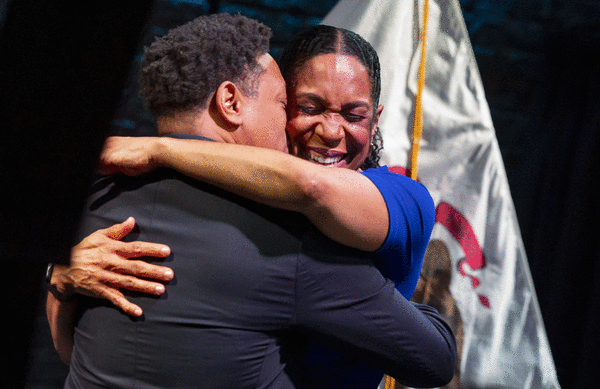
Two recent election results have Black voters, strategists and activists talking. One is the Senate Democratic primary in Texas, which saw Representative Jasmine Crockett lose pretty handily to James Talarico, a white candidate who is centrist in bearing if not in policy. The other is the Senate Democratic primary in Illinois, which saw Lieutenant Governor Juliana Stratton beat a crowded and diverse field that included another Black female candidate, a victory that almost certainly puts Stratton on a path to become the third Black person elected to serve in the upper chamber from the Land of Lincoln. (There have only been 14 Black U.S. senators since 1789.)
The contests left fresh intra-party divisions which will have to be sorted out as November approaches. Some wonder if Talarico, who ran strong among Latino and White voters, can rally Black voters to his side after a bitter and racially stratified primary, which left many Black women feeling like the party has abandoned them. Some say that Stratton, who won with the backing (and funding) of Governor JB Pritzker, isn’t getting enough credit for her own victory, with Pritzker getting lots of headlines as the muscle behind her win. All of this comes as a coalition of organizing groups is trying to figure out how to boost not only Black representation, but Black participation. It also comes as gerrymandering and a weakened Voting Rights Act could shrink the number of Black elected officials, watering down the power of Black voters.
Black voters, around the margins, helped President Donald Trump win a second term by slightly swinging right in states like Michigan, Wisconsin and Georgia. Once again, those states and the Black electorate will be crucial as Democrats aim to get back in power and rein in the destructive excesses of the Trump administration. For any hope of winning the Senate, Democrats have to keep their seats in Michigan and Georgia, and then flip several seats, including in North Carolina, which is about 20% Black.
But it will take more than the usual strategy of ad buys on Black radio, hiring Black strategists here and there and the predictable visits to churches, barber shops and beauty salons. It will take real financial investment and forethought, which the party hasn’t done consistently in the post-Obama years.
On the ground, activists I spoke with recently have been discouraged by disengagement and disaffection — worrisome, if not entirely new, trends given the stakes. Black female leaders, advocates and organizers gathered in Washington earlier this month as part of the 15th Annual Black Women’s Roundtable Women of Power National Summit, keen to diagnose and solve the issue of Black voter motivation — or lack thereof.
“[Black voters] really think that [politicians] are not listening to them, that they’re not really doing things for them. They’re not responding to their needs. That one side takes them for granted, one side just doesn’t care,” said Helen Butler, who is the executive director of the Georgia Coalition for the People’s Agenda in a telephone interview with me. “They also feel like their representatives aren’t fighting hard enough for them. You get them elected, and they’re just not fighting for them.”
Many of these same issues and sentiments came up in a series of focus groups held by HIT Strategies as part of a survey called The State of Black Opposition and Engagement in 2026, which will now be a kind of blueprint for people like Butler who are trying to register and engage Black voters.
“While Black people are expressing the highest concern around economics [and] attacks on democracy, they are the most likely to avoid this political environment, so we wanted to understand that avoidance,” said Terrance Woodbury, President & Founding Partner of HIT Strategies, which conducted focus groups and workshopped messaging. “They are saying we don’t want to ‘go high,’ we want to take the gloves off, we want to fight fire with fire, we want them to disrupt the functions of government. Stop playing by the old rules, and stop sitting quietly by while Trump tells lies.”
In the two Senate primaries so far, which happened in states with sizable Black primary populations, organizers see some promise and some problems. Crockett didn’t see enough of a surge of young and Black voters, who make up 20% of a likely Democratic primary electorate. Some have blamed voter suppression, others a weak ground game and the idea that Crockett wasn’t electable statewide. Texas is a huge state, with a largely moribund Democratic party that hasn’t seen a Democrat win statewide since 1994. Crockett chose to enter the race last, built a shoestring campaign that relied too heavily on social media, cable hits and the usual campaign stops. Even with those missteps, she didn’t do poorly, suggesting that if she had put more effort into building a real campaign, she could have won.
Stratton won a broad base of voters, including sweeping all 17 predominately Black wards in Chicago. Though she was quite polished, she also campaigned with Crockett-esque fire and vigor. One of her YouTube ads featured voters on the street praising Stratton, saying “F--- Trump, vote Juliana.” That obviously worked quite well for Stratton, as did her focus on the economy and immigration.
Woodbury and Butler said that the most pressing issue for Black voters is the economy, including health care and education costs, and now worries about the war in Iran. Woodbury also says his data show that defending democracy is also a promising thread among Black voters.
“We have to connect the dots of what this federal government is doing and how it is hurting Black people personally and Black communities,” Woodbury said, emphasizing the need for campaigns to use the voices and stories of average people. “My warning to Democrats is not that these voters have come back home. They are proving that they are swing voters. They were Trump-curious in 2024. In 2025, they were Trump-furious and angry at his policies. In 2026, it is yet to be determined.”
It will be up to Democrats to make that determination. And as they plot their way forward, they abandon and ignore their core voters at their peril.
____
This column reflects the personal views of the author and does not necessarily reflect the opinion of the editorial board or Bloomberg LP and its owners.
Nia-Malika Henderson is a politics and policy columnist for Bloomberg Opinion. A former senior political reporter for CNN and the Washington Post, she has covered politics and campaigns for almost two decades.
©2026 Bloomberg L.P. Visit bloomberg.com/opinion. Distributed by Tribune Content Agency, LLC.











































Comments