Editorial: Amid mounting risks, the Fed wisely puts rates on hold
Published in Op Eds
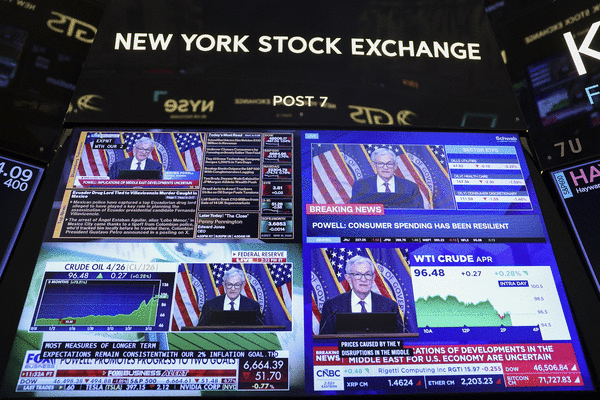
Much as expected, the Federal Reserve left its policy rate unchanged last week, stressing new uncertainties in the economic outlook and the limits of monetary policy in managing them. This was the right call: If ever there was a time for a central bank to wait and see before altering interest rates, it’s now.
Accordingly, the Fed’s new economic projections, closely watched by investors for clues on where things are headed, had no surprises about policy in the short term: They point — tentatively — to another quarter-point cut in the short-term rate this year followed by one more in 2027. In other ways, though, the summary did shift, and in potentially consequential ways.
Most notably, the central bank’s policymakers raised their estimate of long-term economic growth to 2% from 1.8%. This recognizes that artificial intelligence is likely to mean faster growth in productivity, plus higher investment and consumption. This in turn will boost demand and modestly raise the “neutral” rate of interest — all with inflation expected to be back on target at 2% and the unemployment rate steady at an eminently acceptable 4.2%. Altogether, an encouraging prospect, however distant it might seem.
Unfortunately, the path from here to there looks far more hazardous than before. In particular, the short-term outlook for inflation has worsened. The Fed expects its preferred measure, personal consumption expenditures excluding food and energy, to be 2.7% at the end of this year. That’s lower than now — core PCE inflation was 3.1% in the year to January — but higher than the 2.5% projected in December. The effect of tariffs is taking longer than expected to dissipate, and if the war in Iran goes on and energy prices rise further, inflation will almost certainly be higher still, at least through the course of this year.
Given the risk of persistently higher energy costs, why isn’t the Fed thinking about raising, not lowering, the policy rate this year? With luck, that shouldn’t be necessary, for reasons Fed Chair Jerome Powell explained. The best response to a strictly one-off shock to the economy’s supply side is for the central bank to “look through” it: Inflation will rise temporarily, then subside with no need to tighten monetary policy. The same logic applies to inflation induced by tariffs.
There’s just one problem. Thanks to the administration’s torrent of disruptive policies, the shocks keep on coming. If consumers and producers start to factor this into their own inflation forecasts, longer-term expectations will no longer be anchored by the Fed’s target of 2%. They’ll start to creep up — and higher-than-target inflation will get entrenched. To prevent this, the central bank would indeed have to push the policy rate (now at 3.5% to 3.75%) back up, despite the consequences for output and jobs. Investors understand this, making the threat of an abrupt financial-market setback all too possible.
In his remarks, Powell paid tribute to the remarkable strength of the U.S. economy. An essential aspect of this resilience is the confidence investors place in the Fed’s commitment to get inflation back on target — eventually. Inflation has now been higher than 2% for five years, lately for reasons beyond the central bank’s control. Even so, longer-term expectations haven’t slipped their anchor. That’s quite a tribute to Powell and his colleagues.
With Powell’s term as chair coming to an end, and the administration’s appetite for upheaval not yet sated, don’t take this confidence for granted.
____
The Editorial Board publishes the views of the editors across a range of national and global affairs.
©2026 Bloomberg L.P. Visit bloomberg.com/opinion. Distributed by Tribune Content Agency, LLC.





























Comments