Editorial: AIPAC money came with a big downside. But Ill. Gov. JB Pritzker's bucks proved golden
Published in Op Eds
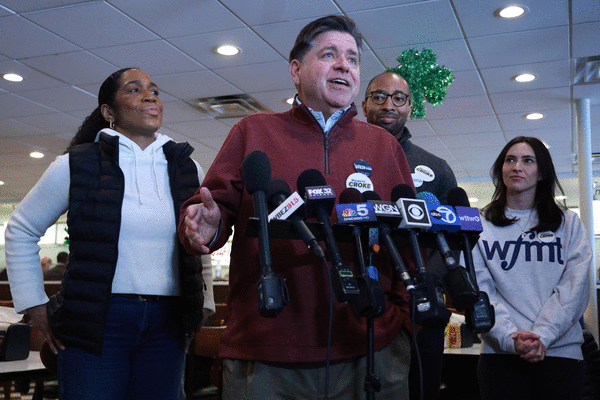
Here’s a quiz question on Tuesday’s primary elections: Who spent the most money in support of a single candidate?
If you answered the American Israel Public Affairs Committee, you’d be forgiven because that big-spending lobbying group got outsized attention as candidates without its largesse cast it as a millstone around the necks of the candidates it supported, such as Donna Miller, Melissa Conyears-Ervin and Laura Fine. But you’d be wrong.
You’d similarly be incorrect if you referenced super political action committees such as Fairshake, crypto money or Think Big, which operates in support of those with a vested interest in artificial intelligence. In aggregate, those groups spent a small fortune.
But the most money in a single race, that for United States senator, came from Illinois Gov. JB Pritzker. According to the Cook Report, he dropped about $15 million in support of the hitherto cash-starved Lt. Gov. Juliana Stratton, who emerged victorious as the Democratic Party nominee.
Given the additional success of Illinois state Rep. Margaret Croke, whom Pritzker successfully supported for Illinois comptroller, Tuesday night was a very good night for the governor. Yet more interesting, to our minds, is how his massive financial influence proved not to come with the backlash that accompanied other big funders of preferred candidates.
Why not? The fact that Democrats overwhelmingly like Pritzker is surely part of the answer. His being a known and local quantity, a duly elected official, surely is another.
And thus his available tens of millions to move political races are widely seen by Democrats as benign, even by those who simultaneously decry the very existence of billionaires or the role of outsized money in our elections. Pritzker’s cash transformed the race for U.S. Senate. But the evidence shows he has convinced the majority of his party that he is their billionaire and will use his fortune for good.
The most striking message from Tuesday night was how effectively Pritzker has expanded his own definition of what is good into what Democrats perceive as the greater good. It’s also notable how shrewdly the governor has occupied the most effective Democratic lane Tuesday night: solidly progressive, especially when it comes to confronting President Donald Trump and his invasive immigration enforcement machinations, which were a gift to him, but not too progressive as to be part of the anti-capitalist, burn-it-all-down crowd.
None of the candidates in the most important primary, that for the U.S. Senate, effectively tied Stratton to Pritzker’s transformative fiscal dominance; indeed, the defeated Raja Krishnamoorthi instead emphasized how much he liked the governor. Krishnamoorthi likely calculated the alternative would come with a downside all its own.
So what we saw Tuesday was a Pritzker trifecta of popularity, the advantages of incumbency, and a massive and flexible bankroll that can be put to use on a single command from its owner. It was as unique as it was effective.
No doubt the national party is taking notice.
All the worries in the Senate race about “splitting the Black vote” turned out to be unfounded. Pritzker’s well-known dislike of U.S. Rep. Robin Kelly, as manifested by his not funding Kelly, was more than enough to do Kelly in.
All over the primaries, endorsements by Sen. Bernie Sanders or Justice Democrats, or even AIPAC or the crypto cash so fired up in favor of Krishnamoorthi and against Stratton, had very mixed results Tuesday night.
But Pritzker ran his carefully curated table.
______
©2026 Chicago Tribune. Visit chicagotribune.com. Distributed by Tribune Content Agency, LLC.



































Comments