Editorial: When leaders fade but systems endure
Published in Op Eds
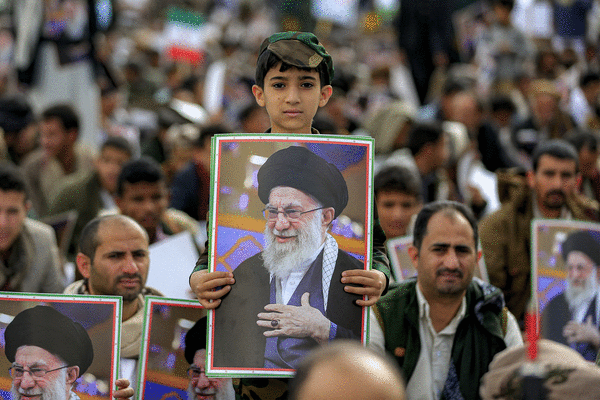
In politics, we often become captivated by personalities. Charismatic leaders dominate headlines, command television screens and shape public imagination. Their speeches, ambitions and conflicts can seem to define entire eras. Yet history reminds us of a deeper and more enduring truth: While leaders may shape moments, cultures shape eras.
The political culture of a nation — its institutions, traditions, governing habits and shared beliefs — often proves far more powerful and durable than any individual leader.
Public discourse frequently treats leaders as if they alone determine the fate of nations. Elections, revolutions and political movements are often framed around individuals whose names become symbols of an entire system. But leadership, no matter how powerful, operates within structures that are far older and far more resilient than any one person.
History offers many reminders of this reality.
When Ho Chi Minh died in 1969, the Vietnam War did not suddenly end. The ideology, institutions and revolutionary culture he helped build continued to guide the country’s direction. The machinery of the state and the broader political movement carried forward the same goals and strategies that had defined the revolution for years.
A similar lesson can be seen in Cuba. For decades, Fidel Castro symbolized the Cuban revolution. His personality and leadership became inseparable from the identity of the regime itself. Yet when Castro stepped aside and later passed away, the system he had created remained firmly in place. The governing party structure, political institutions and ideological framework continued under new leadership, demonstrating how political systems often outlive the individuals who first bring them to power.
The Soviet Union offers another powerful example. When Joseph Stalin died in 1953, many observers wondered whether the authoritarian machinery he built would collapse with him. It did not. Leadership changed, but the centralized political culture and institutional framework of Soviet power continued for decades.
More recently, Venezuela illustrates the same pattern. Hugo Chávez built a powerful political movement fueled by populism, nationalism and a strong personal following. Yet his death did not fundamentally alter the direction of the country. The political structure and governing ideology he created persisted under Nicolás Maduro, sustained by the institutions and networks Chávez left behind.
These examples reveal an important truth about political power, one that is a vital lesson for our conflict in Iran: Removing a leader does not necessarily transform a regime.
Personalities can capture public attention and symbolize authority, but deeper forces sustain political systems. Institutions shape behavior. Bureaucracies enforce continuity. Ideologies shape expectations. Political culture, often built over generations, anchors a nation’s direction even as leaders come and go.
This reality should give pause to those who believe political change can be achieved simply by removing a single individual from power. Genuine transformation requires far more than replacing a leader. It requires changing the institutions that enforce authority, the incentives that guide decision-making and the cultural assumptions that shape public life.
In modern politics, it is tempting to see global events through the lens of personalities. Leaders provide compelling narratives. Their rise and fall create dramatic headlines. But focusing too narrowly on individuals risks overlooking the deeper forces that actually shape history.
Political culture evolves slowly. Institutions mature over generations. Ideologies embed themselves in the fabric of society.
History reminds us again and again that while leaders may define a moment, it is culture that defines the age.
_____
©2026 The Baltimore Sun. Visit at baltimoresun.com. Distributed by Tribune Content Agency, LLC.














Comments