Kaitlyn Buss: Trump's biggest political battle isn't in Iran -- it's at home
Published in Op Eds
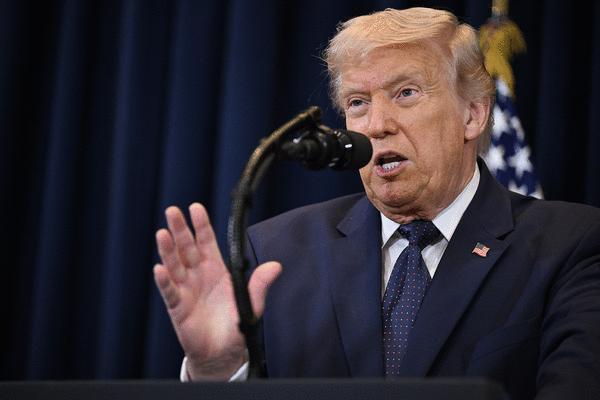
Donald Trump has chosen to govern as a wartime president. But history shows that military strength abroad rarely saves a president who is losing control of the political battlefield at home.
Trump’s campaign against Iran — from airstrikes on strategic targets to the killing of top Iranian leadership — has quickly become the defining moment of his presidency. But, like other modern presidents, he now has to split his attention between reshaping a volatile region overseas while confronting more stubborn economic frustrations at home.
It is the second task that will likely determine the trajectory of his presidency, and ultimately his legacy.
Poll after poll shows many Americans believe their economic circumstances haven’t improved. Groceries remain expensive. Rent and mortgage payments are still squeezing families. Credit card debt has climbed to record levels as households try to keep pace with rising prices.
For voters, headlines about war in the Middle East may dominate the news, but the daily experience of affordability is what shapes how Americans judge their leaders.
Unlike past wartime presidents, Trump governs in an era dominated by social media and constant economic and emotional awareness. Americans can follow breaking developments overseas in real time while simultaneously holding congressional hearings, demanding information about UFOs and the Epstein files and venting about groceries on their phones.
That dynamic is critical as the November midterm elections approach. Trump is effectively on the ballot.
If Republicans lose the U.S. House in November — a very possible scenario — Democrats would almost certainly move quickly toward investigations and renewed impeachment efforts.
Trump has a matter of months to rally voters back to the America First agenda he ran on.
So far, the Iran operation hasn’t won broad public backing — just one in four Americans support the recent U.S. and allied strikes, according to a Reuters/Ipsos poll. Core MAGA supporters unsurprisingly back it almost without question, but support among Republicans is notably lower than in past foreign engagements.
Sixty percent of Americans believe Trump does not have “a clear plan for handling the situation and 62% saying he should get congressional approval for any further military action,” according to a CNN summary of the survey.
Meanwhile, questions persist about the rationale for the entanglement, an issue that matters far more to voters than the success of military operations.
If the war is ongoing, draining resources and costing U.S. lives by November, it is nothing but an albatross around Republicans’ necks — and Trump’s second-term fate will be all but sealed.
History offers a warning.
Former President George W. Bush surged in popularity after the 9/11 attacks and the invasion of Iraq in 2003. But as the war dragged on, loss of life and economic anxiety mounted at home and public support eroded, reshaping the political landscape in the 2006 midterms and paving the way for Barack Obama’s victory in 2008.
Trump is now walking an eerily similar tightrope.
Maintaining support for prolonged military engagement requires a narrative that connects foreign efforts to tangible benefits for ordinary Americans.
If Trump hopes the Iran campaign becomes a defining moment of strength in his legacy, he has only a few months to show voters that the fight abroad hasn’t come at the expense of the promises he made to Americans at home.
_____
©2026 www.detroitnews.com. Visit at detroitnews.com. Distributed by Tribune Content Agency, LLC.



















































Comments