Editorial: What Texas tells us about the 2026 midterms
Published in Op Eds
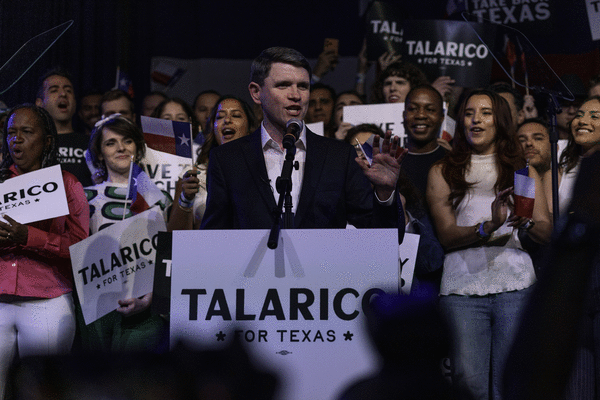
The early political signals emerging from Texas may offer a revealing preview of the national mood heading into the 2026 midterm elections. While one state rarely defines the entire political landscape, Texas often serves as an important barometer for the broader tensions shaping American politics today: polarization, ideological intensity and growing voter fatigue with both.
Recent primary results in Texas illustrate these dynamics clearly. In the Democratic primary, James Talarico defeated Jasmine Crockett, a race many observers framed as a clash between competing visions within the Democratic Party.
Crockett entered the race with a high national profile and a reputation for combative political rhetoric that resonated strongly with activist audiences. Yet Talarico’s message focused on faith, public service and a less confrontational tone aimed at appealing to a broader coalition of voters.
The outcome suggests that while passionate rhetoric can dominate social media and cable news, it does not always translate into electoral victory. Voters often reward candidates who project steadiness, seriousness and an ability to govern rather than simply perform politically.
A similar story may be unfolding on the Republican side. Four-term Senator John Cornyn was forced into a runoff with Texas Attorney General Ken Paxton, a contest reflecting ongoing debates within the Republican Party about direction and leadership. Paxton represents a more combative, populist wing of the GOP, while Cornyn is viewed by many as a traditional institutional figure within the Senate.
Together, these contests reveal something deeper about the political environment heading into the midterms: Voters are navigating a landscape shaped by intense ideological energy on both ends of the spectrum. Activist bases remain powerful forces within both parties, often rewarding candidates who speak in stark and uncompromising terms.
Yet general election voters frequently operate under a different calculus. When the broader electorate weighs questions of governance, stability and electability, the appeal of political confrontation can fade.
This tension between ideological enthusiasm and broader voter appeal may become one of the defining features of the 2026 midterm elections. Candidates who energize their base with aggressive rhetoric may find themselves celebrated in partisan media but struggle to expand their coalition when facing a statewide or national electorate.
Another factor shaping the midterms is a growing sense of exhaustion among voters. After years of political escalation, cultural conflict and nonstop campaign-style rhetoric, many Americans appear increasingly interested in leaders who offer steadiness rather than spectacle. While partisan loyalties remain strong, voters are also demonstrating a willingness to evaluate tone, temperament, and credibility alongside ideology.
Texas alone will not determine the outcome of the 2026 midterms. But its recent primaries offer a useful glimpse into the pressures reshaping both parties. Candidates who can combine conviction with discipline, and principle with the ability to persuade beyond their base, may find themselves best positioned in the months ahead.
In that sense, the message emerging from Texas may be simple but powerful: Voters are still listening, but they are also watching closely how their leaders speak, govern and carry the responsibility of public office.
_____
©2026 The Baltimore Sun. Visit at baltimoresun.com. Distributed by Tribune Content Agency, LLC.

















































Comments