Commentary: How to bring down gas prices in California (Hint: Pumping oil won't help)
Published in Op Eds
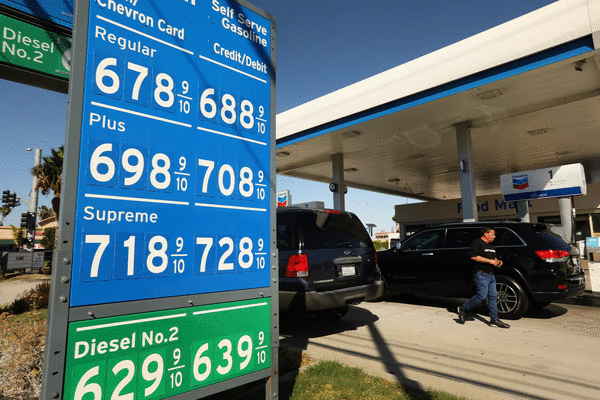
Growing up in California in the 1990s, I remember noticing gas prices along the drive to school. Any time the signs showed more than a dollar a gallon, we would hear the late great Bob Edwards on my parents’ car radio, interviewing energy experts on NPR’s “Morning Edition” about why costs were so high and when they’d come back down.
Now, as a professor of energy politics at UC Santa Barbara, I’m asked the same questions. Students, my family, government leaders and journalists covering the race for governor all want to know: Why are gas prices so high here in California? And how can we lower them?
Anyone who has taken an economics class would tell you about the law of demand: If you reduce how many people want something, its prices go down. If people use less gas, it will get cheaper. My research shows that the best way to do this is by investing in public transportation and walkable neighborhoods. Think of transit solutions like L.A.’s “ 28 projects by 2028” initiative.
We can also reduce demand by adding more electric vehicles into the market and by replacing old gas-powered vehicles with more-efficient models. In fact, California has already cut annual gasoline consumption by 13% since 2019. But cars and trucks take years to replace. In the meantime, demand-side strategies are not enough on their own to meaningfully curb prices at the pump.
What about the law of supply? If we produce more of something, prices go down. But that works only in a competitive marketplace. And right now, California’s gasoline market is far from competitive. Refineries turn crude oil into gasoline and other products. And just four companies hold 90% of California’s refining capacity, giving them tremendous market power. Our gasoline market looks more like OPEC than like Adam Smith’s vision of competition. To reduce prices through the supply side, we need to make that supply more competitive. Three strategies can help us get there.
First, we need to open up California. To break the cartel-like power of California’s refineries, we need to make them compete. This means importing more gasoline from outside, which would force in-state suppliers to match the (typically lower) prices from out-of-state suppliers in Texas or South Korea. This would also help backfill lost production from refinery closures. There also would be a climate benefit from opening up our markets: refineries outside California are processing less carbon-intensive crude oil, emitting less climate pollution per each gallon of gas. And existing regulations can ensure imports meet the state’s high environmental standards.
Second, we need to root out hidden prices. On average, gasoline prices in California have been 41 cents per gallon higher than the rest of the country even after accounting for state taxes and environmental programs. This premium even has its own nickname: the “ mystery gasoline surcharge.” Three years ago, lawmakers created an independent division to oversee fuel markets. We already understand that supply disruptions aren’t the only reason for price spikes; the state’s gasoline market is under-regulated. There are too many dark corners in which companies can hide charges. The new independent division gives the California Energy Commission new tools for oversight, but lawmakers should bolster funding to shine more light on the murky practices that enrich companies at the expense of California drivers.
Third, we need to tackle price discrepancies between distributors. Not all stations charge the same for a gallon of gas. As Gov. Gavin Newsom’s administration has noted — both formally and in meme form— brand-name stations such as Arco, Chevron and Exxon Mobil charge higher prices compared with those not under a name brand. The new independent division also found that high branded prices are unique to California. Lawmakers should closely scrutinize these high prices and consider competition-based solutions to defeat them.
Notice what’s not on this list: pumping more oil. In-state oil production has little to do with high gasoline prices. The global oil market, including global refining volume, sets the price you pay at the pump. It won’t be affected by the well down the street. California’s oil production has been naturally declining since 1986. And since the late 1980s, California has been importing more crude oil than it produces. That doesn’t explain why our gasoline prices are higher: They didn’t begin to diverge from the rest of the country’s until 2015.
Also not on the list is state control over refineries. This idea has cropped up across California in the hopes of keeping aging refineries open. But decades of research, including my own, has shown that state ownership in the oil industry leads to inefficiency at best and corruption at worst. State-owned oil companies tend to pursue the industry’s interests rather than the government’s goals. This means more business as usual — and not just for prices, but also for the climate.
So how do we lower gasoline prices? In the long run, the answer is clear: reduce demand through electric vehicles and better public transit. But in the meantime, we need to open up California’s gasoline market and break apart the political stranglehold of the state’s oil industry. What we don’t need are half-baked answers such as increasing California’s oil production or putting refineries under state control. Those ideas simply ignore the research and the data. As Bob Edwards used to say on “Morning Edition” back in the ’90s, “A little learning is a dangerous thing, but a lot of ignorance is just as bad.”
____
Paasha Mahdavi is a professor of energy and environmental politics at UC Santa Barbara, where he directs the Energy Governance and Political Economy lab.
©2026 Los Angeles Times. Visit at latimes.com. Distributed by Tribune Content Agency, LLC.



















































Comments