John Rash: One Iranian's perspective on his country's convulsions
Published in Op Eds
“One Battle After Another” may be the odds-on Oscar favorite, but another nominee, for Best International Feature Film, says more about a society perpetually stressed by militarism. “It Was Just an Accident” comes from Iranian director Jafar Panahi, who channels his two terms in Tehran’s notoriously evil Evin prison into a plot about a low-key mechanic who unexpectedly comes across a man who he believes was his cruel Evin interrogator. The mechanic and a disparate group of other detainees kidnap the man, unsure if he’s actually their tormentor — and unsure what to do if he is.
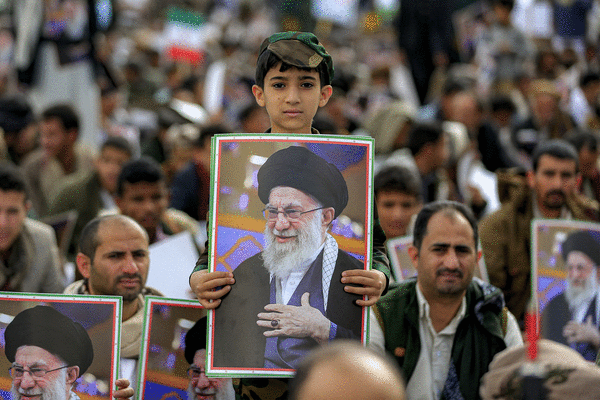
The moral dilemma and drama could soon be a case of art imitating life if the American and Israeli attack on Iran, which on Feb. 28 killed Supreme Leader Ali Khamenei and several other high-level leaders of the Islamic Republic, accomplishes President Donald Trump’s initially stated objective of regime change. (Though the goalposts may be moving after Defense Secretary Pete Hegseth said on Monday, March 2, that “this is not a so-called regime change war, but the regime sure did change.”)
Most Iranians’ rage is real, which in part explains the explosion of celebration in Iran and dancing in Iranian enclaves across the world, said Miad Maleki, 42, who grew up in Iran but later served in the U.S. Air Force and then helped the U.S. Department of the Treasury implement economic sanctions against the Iranian regime. Now a senior adviser for the Foundation for Defense of Democracies’ Iran Program, Maleki recalled living just blocks from Evin prison in the early years after the 1979 revolution. The very loud sounds he heard in the morning, his father later told him, were firing squads. Leaving even less to the imagination, Maleki said that “it’s hard to find an Iranian who has not seen a public hanging by this regime.”
Indeed, in matters profound and prosaic, from Evin executions to immiserating millions (with the depravations deepening during the ‘80s-era eight-year Iran-Iraq War) to making Maleki as a young child stand in line at 4 a.m. to get a bottle of milk, the theocracy betrayed its adherents — even though the majority of Iranians initially supported the revolution.
“A large portion of the population in 1979 thought this wasn’t a democracy,” said Maleki. Instead of the monarchy, “they wanted a government where they could all have a strong voice with real elections.” And such was the promise and the premise of the seismic shift in what was once one of America’s key Mideast allies. But soon, it became clear that Ayatollah Khomeini created a regime that didn’t understand economics, governance or diplomacy.
“They were clerics,” Maleki said.
Clever clerics at that, at least regarding the potential nuclear-weapons program, according to Maleki, who said that it was used to “blackmail the international community.” Concurrently, oil revenue was used to support supplicants like Hamas, Hezbollah, the Houthis and other proxies all while demonizing the West and Israel, and to secure internal support from the regime’s Revolutionary Guards and other militarized groups as well as a significant cohort of ordinary Iranians. “It’s a dictatorship, yet it’s a dictatorship with a pretty large number of supporters,” said Maleki, who estimated that about 10-20% were loyalists — the kind seen publicly mourning Khamenei in recent days.
The remaining 80% expressed disappointment, then discontent, then defiance in a series of uprisings, most notably when the country convulsed during the “Green Movement” in 2009 and the “Woman, Life, Freedom” movement that began in 2022 after Mahsa Amini, a young Kurdish woman, was arrested for how she was wearing her hijab and died at the hands of Iran’s morality police.
Enforcing morality played a part in Maleki’s youth as well, just as it did across the country. Owning VHS tapes or machines could mean jail time. Later, surreptitious satellite dishes brought Western media (meaning Western values, to the regime), at least until the devices were destroyed or confiscated.
Film also played a part in Iranians’ nostalgia for a pre-revolutionary time many never experienced. While most movies moved past the monarchy’s abuses, Maleki said they were effective. “Watching these movies in the ‘80s and ‘90s, we were seeing a free Iran. We were seeing an Iran that was economically stable. People were happy — dancing — they were allowed to be happy, they were allowed to make their own social decisions.” That, he said, “is what Iranians want to come back to. Iranians are dreaming about a new government that is secular, that separates religious rules and laws and religion in general from politics and government.” (Some even support the son of the shah deposed in ‘79, as at least a transitional political leader.)
Many holding this dream of a new government 20-plus years ago were more reticent than recent times to take risks, said Maleki. “When it came to the question of, ‘Are you willing to put your life at risk and go out on the street?’” the answer was couched in the context of not knowing if what would come next would be any better. Now, political, social and economic conditions have changed that calculus, altering “the mentality to the point that the Iranians have become more and more willing to go on the street to really sacrifice what they have and push for regime change.”
Tragically, many have already paid the ultimate sacrifice, with estimates in the tens of thousands the theocracy has killed just this year.
“They have killed many innocent Iranians; they’re probably going to kill more,” said Maleki, who said that “unfortunately, I anticipate violence” from some if the regime does in fact collapse. But, in some ways mirroring the morality play that plays out in Panahi’s film, others may move on. “The Iranian culture does have very strong elements of reconciliation,” said Maleki.
There’s also, he added, a “strong sense of nationalism in Iran because of the thousands of years of history.” So while the 47 years of the Islamic Republic is a literal lifetime for most, it contextually could be a brief period for Persians, Kurds, Azeris and other members of the nation’s mosaic, most who hope, it appears, that the era can indeed soon be considered just an accident and that today’s turmoil isn’t tragically the beginning of one battle after another.
___
©2026 The Minnesota Star Tribune. Visit at startribune.com. Distributed by Tribune Content Agency, LLC.


















































Comments