Mark Gongloff: El Niño is returning with another stark warning
Published in Op Eds
A science-fiction trope is the time traveler who visits the present day with a dire warning about the future only to be tragically ignored. It resonates because it’s so believable. In fact, Earth had just such a visitor recently, and we dismissed it completely.
Three years ago, scientists warned that an approaching El Niño in the Pacific Ocean could temporarily boost global temperatures past 1.5 degrees Celsius above preindustrial averages, offering a taste of what the world would be like if we breached that long-term limit set by the Paris accords in 2015. Naive climate columnists wondered whether this would be enough to scare people into doing more to avoid that future.
As expected, the El Niño of 2023 and 2024 delivered record-smashing temperatures. It was indeed frightening. And Americans responded by putting a virulent climate-change denier back in the White House, one whose stated goal was to burn more of the fossil fuels heating up the planet. Meanwhile, the political will to cut greenhouse-gas emissions flagged elsewhere in the world.
El Niño is likely to return this year, threatening even higher temperatures. It seems foolish to think that this time will be different, that the experience will motivate voters to minimize future environmental chaos. But it would also be remiss to ignore the fact that the full, devastating effects of this new El Niño will be plainly obvious by 2028 — the year of the next presidential election.
El Niño and La Niña are phases of the El Niño-Southern Oscillation, a climate pattern in the tropical Pacific. El Niño occurs when a large swath of the ocean is warmer, often boosting global temperatures temporarily. La Niña, when the water is cooler, is the phase we’re in now. There’s a 60% chance La Niña will end by April, according to the National Weather Service, and a 50% to 60% chance of a new El Niño forming by early fall.
The next El Niño might not heat the planet quite as aggressively as its predecessor, which was one of the strongest (meaning warmest) in recent decades. Nevertheless, it still raises the risk of a record temperature, probably in 2027, topping 2024’s mark of nearly 1.6C above preindustrial averages.
“If El Niño develops, and if it’s moderately strong, then 2027 would be the odds-on favorite to be the warmest year on record,” Zeke Hausfather, a climate scientist at the nonprofit research group Berkeley Earth, told me.
This year is already on track to be the second-hottest in recorded human history. The current forecast is for an average global surface temperature of 1.48C above preindustrial averages in 2026, according to the Climate Brink dashboard that Hausfather helps maintain. (1)
The influence of El Niño and La Niña on global temperatures is small and temporary. They can’t affect the long-term trend, which is inexorably higher thanks to the planet-heating gases humans pump into the atmosphere. The Earth has been in relatively cooler La Niña phases for most of the past 30 years, but heating has continued apace. Last year was the third hottest in human history — hotter than in any El Niño before 2023 — despite prevailing La Niña conditions.
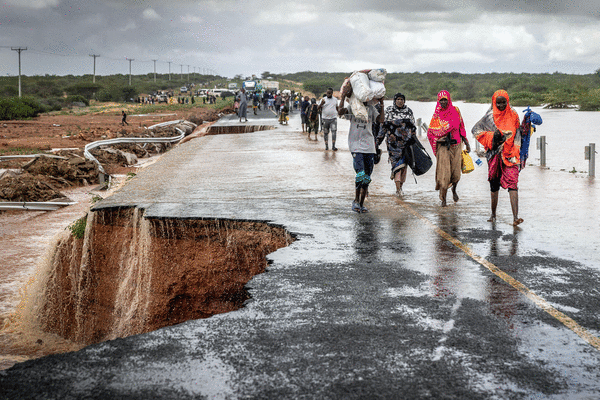
Nonetheless, even small nudges can have big impacts. Past El Niños have led to widespread coral bleaching, devastating African droughts, South American floods and more.
And 2026 and 2027 will probably be the fourth and fifth consecutive years in which global temperatures have been about 1.5C hotter than preindustrial averages, the most optimistic limit of the Paris accords. Five years of flirting with that limit don’t necessarily mean we’ve failed to meet that goal. Such targets are measured over many years, not just a handful. But at this point, it would take a miracle to avoid overshooting 1.5C.
Unfortunately, that 1.5C figure isn’t arbitrary, no matter what you might hear from certain quiet-quitting environmentalists. It’s the minimum level at which several climate “tipping points” risk being triggered, noted a new study in the journal Environmental Research Letters.
The “tipping point” concept is fraught with uncertainty, but it refers to crucial Earth systems that might be permanently altered at certain temperatures, causing severe knock-on effects, which could include even faster warming. Coral reefs, permafrost and the North Atlantic subpolar gyre (a vital circular ocean current) are all at growing peril at 1.5C of warming.
And a breach of 1.5C doesn’t have to be permanent to trigger some of these tipping points, said researchers in a recent study in the journal Nature: Communications Earth & Environment. They called the heat from the 2023-24 El Niño “a warning that the Earth is within range of entering a period of hazardous climate change.”
The author and activist Bill McKibben recently suggested the 2026-27 El Niño will be significant enough to put to rest the unwelcome revival of climate denialism accompanying President Donald Trump’s reelection. It might even convince scientists that warming has accelerated and rev up talk of geoengineering, McKibben warned in his newsletter.
Lived experience would suggest American voters have the memories of goldfish. But 2027 temperatures won’t be official until early 2028, when Americans will be voting in presidential primaries. At that point we may still be cleaning up El Niño’s wreckage after years in which the Trump administration has killed climate research, stymied clean energy and protected fossil fuels all while home-insurance premiums soared. Predicting the future is hard, but it’s also hard to imagine a better moment than 2028 to finally heed El Niño’s warning.
____
(1) Come for the daily, monthly and annual temperature anomalies; stay for the 86-year distribution chart modeled on the cover of Joy Division’s “Unknown Pleasures” album.
____
This column reflects the personal views of the author and does not necessarily reflect the opinion of the editorial board or Bloomberg LP and its owners.
Mark Gongloff is a Bloomberg Opinion editor and columnist covering climate change. He previously worked for Fortune.com, the Huffington Post and the Wall Street Journal.
©2026 Bloomberg L.P. Visit bloomberg.com/opinion. Distributed by Tribune Content Agency, LLC.




















































Comments