Noah Feldman: The Supreme Court's ruling on tariffs marks a turning point
Published in Op Eds
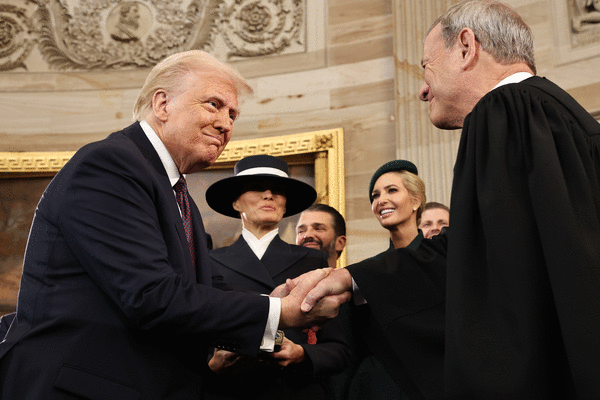
It took almost a decade, but Chief Justice John Roberts and the Supreme Court finally found a way to stand up to President Donald Trump’s executive power overreach, striking down the tariffs that are the signature initiative of his presidency. Not since the Supreme Court struck down the first New Deal in 1935 has the court reversed a policy of comparable importance to a sitting president.
The 6-3 decision gives Trump two options. He can accept the outcome and attempt to reenact various tariffs using other sources of legal authority, triggering future legal battles that he might win if he sticks to legally mandated procedures. In that case, the court’s conservative majority will continue to allow many of his extensions of executive power to stand in other areas.
Or Trump can take an extremely aggressive stand against the court, in which case the decision could become a turning point, emboldening the justices to strike down additional Trump initiatives that violate longstanding legal precedent.
The tariffs case presented an especially good opportunity for the court to take on Trump because it could be confident that its decision would actually be implemented. Unlike a situation in which the court orders the executive branch, say, to return a person deported abroad, and the executive might refuse, the collection of tariffs is a legal proceeding that cannot proceed without judicial authorization. The opinion in the tariffs case will boost not only the court’s legitimacy as an institution capable of standing up to the president but also its power to constrain Trump in practice.
Seen in historical terms, the tariffs decision hints that the Roberts Court realizes it hasn’t, until now, fulfilled its fundamental task of keeping Trump within the rule of law. The court’s compromise decision in the Muslim ban case, Trump v. Hawaii, back in 2018, failed to send Trump the message that the Constitution matters. Worse, the court’s presidential immunity decision, Trump v. U.S., which Roberts designed to preserve the republic by stopping presidents from prosecuting their predecessors, backfired disastrously, emboldening Trump to act lawlessly. Now the court is trying a different tack, flatly telling Trump he can’t do what he believes he can.
The majority opinion, written by Roberts, grounded the decision in the text of the International Emergency Economic Powers Act (IEEPA), which Trump relied on to impose the unilateral tariffs. He, the court’s three liberal justices, arch-conservative Justice Neil Gorsuch, and swing Justice Amy Coney Barrett all agreed that the words “regulate … importation” in IEEPA do not give the president authority to impose open-ended tariffs even in an emergency.
In a part of the opinion joined only by Gorsuch and Barrett, Roberts invoked his personal favorite theory, the major questions doctrine. Roberts invented the doctrine during the Biden administration as a tool to limit executive branch statutory interpretations deemed unprecedented and big enough to warrant the court’s perspective.
By applying the major questions doctrine against Trump, Roberts sent the message that he is capable of acting in a nonpartisan manner. That self-understanding is crucial to Roberts’s judicial philosophy and his hopes for his judicial legacy. Famous for describing himself as an umpire calling balls and strikes, Roberts has been looking for an opportunity to show that he is not in Trump’s pocket.
The liberal justices, Elena Kagan, Sonia Sotomayor, and Ketanji Brown Jackson, remain skeptical of the major questions doctrine, which the conservative Supreme Court used against the Biden administration. Accordingly, they only joined the part of the opinion that relied on statutory text. But all three of them detest Trump’s many efforts to extend executive power beyond the limits of the law or the Constitution. They welcome any chance to join a majority opinion shutting him down. Such opportunities have been far and few between at the court.
Barrett, who has emerged as the pivotal justice, with four justices regularly to her right and four to her left, is still no moderate. But as a devotee of the late Justice Antonin Scalia, she strives to interpret statutes without regard to partisan considerations. Here, she showed what has become her characteristic ability to reach a carefully reasoned decision on the basis of her own considerable legal brilliance and the beat of her own drum. Her vote in the tariffs case should help establish Barrett as one of the most important independent judicial voices in the court’s modern history.
Gorsuch, for his part, is typically among the court’s most conservative members. But he is genuinely motivated by a deep jurisprudential commitment to strengthening the separation of powers. For him, that means limiting the executive to actions that fall within his constitutional authority and preserving Congress’s exclusive power over lawmaking and taxation. So he was prepared to say that, by imposing tariffs, Trump had impinged on Congress’s exclusive power to levy taxes. Gorsuch is staking his judicial reputation on an unwavering commitment to his fairly rigid jurisprudence. Here, he admirably demonstrated that he would not bend his principles to fit the Trump administration’s interests.
Meanwhile, Justices Clarence Thomas, Samuel Alito, and Brett Kavanaugh, all of whom profess textualism — the view that only the words matter in statutory interpretation — dissented, maintaining that the phrase “regulate importation” in IEEPA was enough to authorize Trump’s tariffs. In the abstract, this wasn’t an embarrassing argument on statutory interpretation. In practice, however, it left them in the awkward position of accepting a broad statutory interpretation advanced by Trump that they would surely have rejected had it come from a Democratic president.
As of this writing, Trump has called the decision “a disgrace” and referred to some of the justices as “fools and lapdogs.” That would be a shockingly aggressive attack on the court if made by any other president in history. However, by Trump’s standards, it’s relatively constrained. The justices can take being insulted if their authority is respected. The tactically smart thing for Trump to do would be to take his lumps in this case and expect the court to continue to give him leeway to do much of what he wants.
Trump can also use other statutory authority to try to reimpose the tariffs in some form. Those efforts will certainly be met by other judicial challenges, but if the president crosses his Ts and dots his Is, it’s probable that tariffs in some form will ultimately be upheld.
Still, Trump being Trump, it’s possible he will attempt a more confrontational response that flouts the court’s ruling. If he does, he risks threatening the rule of law itself and alienating Roberts and Barrett. That, in turn, could mark the beginning of a more aggressive period of Supreme Court resistance to Trump’s unlawful actions.
____
This column reflects the personal views of the author and does not necessarily reflect the opinion of the editorial board or Bloomberg LP and its owners.
Noah Feldman is a Bloomberg Opinion columnist. A professor of law at Harvard University, he is author, most recently, of “To Be a Jew Today: A New Guide to God, Israel, and the Jewish People."
©2026 Bloomberg L.P. Visit bloomberg.com/opinion. Distributed by Tribune Content Agency, LLC.
















































Comments