Michael Hiltzik: RFK Jr.'s attacks on vaccines could undermine American science for generations
Published in Op Eds
During the postwar decades, American medical science reached a sort of financial equilibrium: The government would fund basic scientific research with billions of dollars in academic grants, then entrust the subsequent development of health-giving products to private enterprise.
The arrangement hasn't always worked in the public's interest — some companies have marketed drugs developed from government-funded research at ridiculously high prices. And the government has never exercised its "march-in rights" to force drugmakers to make those products widely and publicly available on "reasonable" terms, potentially including accessible pricing.
Still, as I've reported, a 2020 study found that funding from the National Institutes of Health played a role in research associated with every new drug approved by the Food and Drug Administration from 2010 to 2019. The funding produced 22,000 patents.
So there's no question that as a boon for public health, the arrangement has stood the test of time.
Until now.
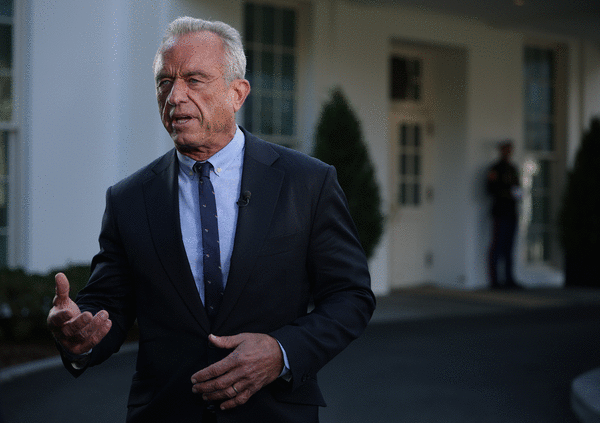
Under its secretary, the anti-vaccine activist Robert F. Kennedy Jr., the Department of Health and Human Services has taken aim at publicly funded R&D and thrown the regulation of new drug development into chaos.
Most recently, on Feb. 3 the FDA issued a so-called Refuse-to-File letter to the biotech company Moderna over a flu vaccine the company developed using its mRNA technology, which was the core of its COVID-19 vaccine and is at the center of Moderna's pipeline of developmental vaccines against cancer, HIV, Lyme disease, respiratory syncytial virus (RSV) and many other conditions.
The letter, which was signed by Vinay Prasad, the vaccine critic who is now director of the FDA's Center for Biologics Evaluation and Research, was more than merely a rejection of Moderna's clinical testing of the vaccine; it was a refusal even to examine Moderna's data, which the company says was derived from tests on nearly 44,000 subjects.
The FDA rejected Moderna's application "because the company refused to follow very clear FDA guidance from 2024" on how the clinical trial should proceed, HHS spokesman Andrew Nixon told me by email.
The company disputed that. It says it consulted with the FDA in designing its clinical trial and received the agency's approval for its protocol, in writing. The agency "did not raise any objections ... at any time before the initiation of the study in September 2024," Moderna said in a news release after the rejection.
The FDA reversed itself Wednesday, bowing to an appeal by the company, Moderna announced, saying the FDA will now review its application to license the flu shot. But the reversal only underscored the chaotic decision-making at the agency.
Healthcare professionals say that the FDA's original refusal was way out of line and a shocking departure from the standard for refuse-to-file decisions. According to a 2021 study of RTF letters published in the Journal of the American Medical Assn., only about 4% of all drug applications resulted in such a letter.
In most cases, the problem was that the submitted data were incomplete and in about 26% the problem was that the applicant didn't follow FDA advice, including advice about the design of their clinical trials. According to Moderna, that wasn't the case with its flu vaccine.
Normally, recipients of RTF letters keep them secret, generally out of embarrassment at being called out by the FDA for incomplete or suspect data; that Moderna made this one public suggests that it feels the problem lies elsewhere.
The Moderna letter came just before Kennedy's one-year anniversary as Health secretary. By almost any measure, his tenure has been disastrous for public health. Kennedy gets praise in some quarters for his campaign against food preservatives, but on balance his prescriptions have been far more negative than positive for the public interest.
Measles, which was declared eliminated in the U.S. in 2020, meaning that there was no longer a threat of consistent spread over a yearlong period, is again spreading: The Centers for Disease Control and Prevention report 910 cases this year in the U.S., a trend almost certain to outstrip the 2,280 cases reported last year.
The 2025 figure was the largest measles outbreak in the U.S. since 1992. The reason isn't hard to fathom. It's the result of doubts about the safety and efficacy of vaccines generally, and of the MMR vaccine (for measles, mumps and rubella) particularly, fostered by Kennedy and his minions. Although Kennedy has stated that parents should have their children vaccinated against measles, his endorsement has been lukewarm and often accompanied by advice about alternatives to vaccination or treatment.
As it happens, the vaccination rate for U.S. kindergartners has dropped below the 95% level that marks "herd immunity," in which immunization is so widespread that even a highly contagious disease like measles can't gain a foothold in an unvaccinated population. In the 2024-2025 school year, the CDC reported, the overall rate fell to 92.5%, "leaving approximately 286,000 kindergartners at risk" during the year. In South Carolina, where the most severe outbreak is raging (616 cases so far), the vaccination rate for measles has fallen to 91.2%.
Kennedy has removed six vaccines from the recommended 17-vaccine childhood immunization schedule — making vaccines for rotavirus, COVID-19, flu, meningococcal disease and hepatitis A and B and hepatitis B subject to "shared clinical decision-making" between parents and physicians, opening the door to lower vaccination rates for those conditions.
Kennedy has stocked key public health advisory committees with anti-vax crusaders. He fired all 17 members of the CDC's Advisory Committee on Immunization Practices (ACIP), most of whom were experts in immunization, epidemiology, public health and related disciplines, and replaced them in part with anti-vaccine activists and skeptics.
Alarmingly, the newly appointed ACIP chairman, Kirk Milhoan, a pediatric cardiologist, raised questions during a Jan. 22 podcast about whether we even need polio and measles vaccines today, given what he called superior treatment opportunities for sick children now than in the 1950s and 1960s, when those vaccines were introduced, such as better sanitation, and pediatric hospitals and ICUs.
"We take care of children much differently now," he said.
"What we're going to have," Milhoan said, "is a real-world experience of when unvaccinated people get measles, what is the new incidence of hospitalization? What's the incidence of death?"
He labeled vaccine mandates as a "heavy-handed authoritarian" approach. He advocated placing "not public health but individual autonomy" in the forefront of people's decisions about whether to get vaccinated.
But that turns the fundamental concept of public health on its head, because individual decision-making can place a whole community, and others such as unvaccinated infants, at risk.
The agency told me by email that Kennedy had reconstituted ACIP "with highly credentialed doctors, scientists, and public health experts committed to evidence-based medicine, gold standard science, and common sense." It says "all vaccines on the CDC schedule, including MMR, remain covered by insurance, so families do not need to pay out of pocket to get vaccinated." What it didn't acknowledge is that insurers typically rely on the CDC recommendations in deciding whether to cover vaccinations, so the change in the recommendations may end that coverage.
That brings us back to the Moderna case. The mRNA technology has been hailed as a breakthrough, in part because it allows new formulations to be developed quickly in response to newly emergent variants of viruses or other pathogens — as has happened with COVID and flu.
In August, Kennedy terminated $500 million in government contracts for mRNA research, asserting that "the data show these vaccines fail to protect effectively against upper respiratory infections like COVID and flu."
When it comes to COVID, exactly the opposite is true. "The vaccines that we had available in this country against COVID were mRNA vaccines, vaccines that have saved millions of lives in the U.S. alone over the last few years, and many more worldwide," Harvard epidemiologist Bill Hanage said after the cutbacks. "Now suddenly we're hit with a roadblock to further study them, to further develop them, and so the promise of these vaccines is suddenly being strangled almost at birth in this country."
What really disturbs professionals is the FDA's injection of inconsistency into its reviews of drug applications.
"In drug development, lack of regulatory clarity and consistency can be more damaging than regulation itself," observes Ruxandra Teslo, a genomics expert who studies clinical trial practices. "Clear rules, even when stringent, can be understood and navigated. But unclear or constantly shifting expectations can be much harder to efficiently deal with."
Moderna makes the same point: "The industry depends on clear, transparent rules that are applied consistently in order to make the long-term investments that benefit Americans," its spokesman Christopher Ridley told me by email.
According to Moderna, the FDA's review of its flu application turned out to be anything but clear and transparent. The company consulted with FDA officials before launching the trial of its mRNA flu shot in 2024, proposing that half its 40,000 subjects receive the new shot and half an existing flu vaccine. The FDA proposed that it test its shot against a different shot, which has a higher dose for the over-65 population.
Moderna resisted, but agreed to provide test subjects with enhanced disclosures on its informed consent form, to which the FDA assented. The company says the FDA "did not raise any objections" to the company's plans "after the submission of the protocol in April 2024 or at any time before the initiation of the study in September 2024." Ultimately, it says, it did submit data showing that its mRNA shot outperformed a high-dose vaccine.
As a result, Moderna says it was blindsided by the Prasad letter refusing to even consider Moderna's data. The FDA's reversal came after the company agreed to study the flu shot's effect on older adults.
So where are we now? During his Senate confirmation hearing last year, Kennedy promised "radical transparency" for the American people in the actions and policies of the Department of Health and Human Resources. In the Moderna case and many others, the agency's actions have been as transparent as mud. And the public is left confused and ever less healthy.
____
_____
©2026 Los Angeles Times. Visit at latimes.com. Distributed by Tribune Content Agency, LLC.
























Comments