Commentary: When electricity becomes a weapon of war
Published in Op Eds
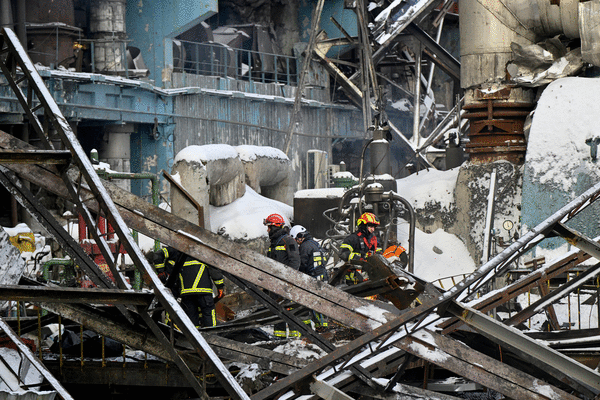
It’s tempting to dismiss peace talks between Russia and Ukraine when missiles and drones continue targeting power plants, leaving people to freeze with no lights.
That is the reality in Ukraine today. Over a recent weekend, Russia launched dozens of missiles and hundreds of drones, many aimed not at military positions but energy infrastructure — power stations, substations, transmission lines, and the workers who repair them. The intent is clear: turn electricity into a weapon, and civilian life into the pressure point.
Maxim Timchenko, the CEO of DTEK, Ukraine’s largest private energy company, underscored that point in an interview. War has taken a toll on his country’s power plants. Crews work day and night to repair the damage and often at personal risk.
“What I see every day is not fear, but determination,” Timchenko said. “People go back to work after sleepless nights filled with attacks, working in freezing temperatures, and under the risk of further strikes. And yet, every day they return.”
Electricity has become one of the central battlegrounds of modern war. Disrupt power, and hospitals falter, water systems fail, and communications go dark. Daily life grinds to a halt. The suffering is immediate and borne almost entirely by civilians.
Russia has been refining this approach for years. Long before missiles routinely smashed transformers and turbines, Russian hackers infiltrated Ukraine’s power grid in 2015 and 2016, briefly cutting off electricity to hundreds of thousands of people. Those cyberattacks were covert and experimental, meant to test vulnerabilities without escalating the conflict. Now, that caution is gone. Cyber sabotage has shifted to open destruction via air strikes.
Winter has become a force multiplier. Today’s strikes are timed to cold snaps, turning outages into humanitarian crises. In this sense, Ukraine is not just fighting an invasion — it is enduring a campaign designed to make life unbearable.
Whether Ukraine can keep the lights on increasingly depends on what it can stop in the sky. Air-defense systems don’t just protect military targets; they shield power plants, substations, and the crews who rush to repair them. When interceptors run short, more missiles get through. When more missiles get through, the grid takes more damage — and blackouts last longer. Delays in U.S. weapons deliveries translate into colder homes, darker hospitals and longer disruptions.
What makes this strategy especially troubling is that Ukraine is no longer the only target.
In late December, Russian-linked hackers allegedly targeted Poland. The attack was stopped just short of cutting electricity to hundreds of thousands of people as temperatures nosedived. Italy has also reported attempted cyber intrusions linked to the Olympics, underscoring that energy infrastructure is fair game.
Over the years, I’ve reported on energy systems that typically operate out of public view — natural gas pipelines, nuclear plants and oil infrastructure that keep economies humming. They are designed to be invisible. However, in Ukraine, those systems are the prey. Power plants, substations and transmission lines are treated as military objectives precisely because they sit at the center of civilian life.
Ukraine has responded by striking Russian oil refineries and fuel depots, aiming to disrupt the economic and logistical foundations of Moscow’s war effort. Energy, once a tool of economic leverage and diplomacy, has become an instrument of direct attack on both sides.
That shift should matter far beyond Eastern Europe. Modern societies are deeply electrified and tightly interconnected. A prolonged blackout in a major city or a rural region alike would ripple through water systems, food supply chains, healthcare and communications. What Ukraine is experiencing is not an anomaly — it is a warning.
Wars are no longer fought only over territory. They are fought over systems: heat, light, power and time. Ukraine’s energy workers understand this better than anyone, returning again and again to damaged sites to keep the lights on for millions of people they will never meet.
Electricity is not just infrastructure; it is daily life. Russia’s campaign shows that modern wars are increasingly fought by attacking what ordinary people depend on most. Whether Ukraine can defend its power system will help determine whether this tactic becomes the norm — or a warning that went unheeded.
_____
ABOUT THE WRITER
Ken Silverstein has covered energy and international affairs for years. He wrote this for InsideSources.com.
_____
©2026 Tribune Content Agency, LLC.





















































Comments