Adam Minter: ICE leaving Minnesota won't heal my community's scars
Published in Op Eds
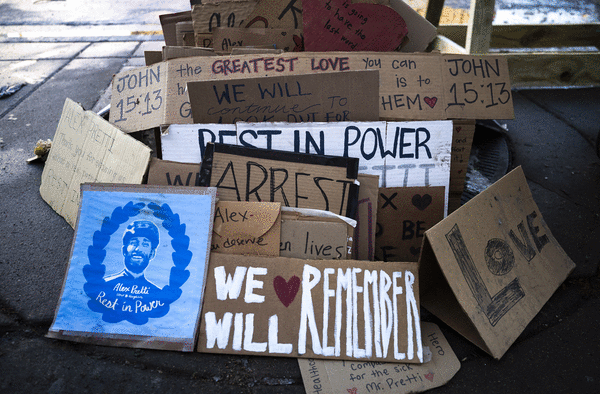
A few hours after White House border czar Tom Homan announced the end of the immigration crackdown in Minneapolis, a steady stream of mourners gathered on the city’s south side. Their destination was the community-built memorial to Renée Nicole Good, located at the spot where her SUV came to a stop after she was shot in the head by an Immigration and Customs Enforcement agent.
Some wiped away tears; others muttered in frustration; a few stared blankly at the flowers, notes, signs, and stuffed animals that were spread out along the curb. Mark Foresman, a 66-year-old retiree who’d arrived from a nearby suburb with his wife, Kathy, captured the mood in a single word: “Skepticism.”
It’s understandable. Over the last two months, this community has built informal support networks for vulnerable kids walking to and from school, and neighbors have warned one another about agents on their streets. Those scars won’t suddenly heal with a policy shift, especially under a fickle administration that can reverse course with a social media post.
Standing beside the memorial, Foresman told me, “Most Americans are ok with lawful immigration enforcement.” But what Minnesota has experienced, he assured me, is not that. “The administration has increased distrust in government, and that’s the last thing we needed.”
That loss of faith has special resonance in Minneapolis, where murals featuring George Floyd’s face are painted throughout the city. In recent weeks, I’ve seen Good's name woven with ribbon into chain-link fences, and her portrait — alongside Alex Pretti’s — pasted to buildings, utility poles, and lamp posts.
They are stirring memorials; they are also sources of anxiety in a city that doesn’t need new reminders of how state power can turn on its citizens and become lethal.
In my neighborhood, home to a significant immigrant population, residents eye every SUV with tinted windows as a possible ICE enforcement vehicle. News of the drawdown hasn’t changed the tenor of comments and messages on neighborhood chats. People are still on guard.
Local leaders feel it, too. Shortly after Homan’s Thursday morning announcement, Elliott Payne, president of the Minneapolis City Council, spoke for many Minnesotans when he told the Star Tribune: “I’ll believe it when I see it and will continue patrolling my community.”
Who can blame him? ICE has shown little regard for spaces that should be free from intimidation. For example, they’ve surveilled Catholic churches during Mass, unsettling parishioners and contributing to emptier pews.
They’re a regular presence in health care facilities, scoping out staff and asking patients about their countries of origin. Providers say fear keeps people away. At Children’s Minnesota, emergency room visits have dropped by almost 25%. When families do seek care, some have waited so long that their children require hospitalization.
The pattern recalls delayed or skipped care during Covid, when minor problems sometimes turned into bigger ones. But in 2026, it's not a virus turning minor problems into serious ones. It’s federal agents.
Similar impacts have struck schools. As enforcement ramped up, many students — citizens, legal residents, and undocumented kids alike — stayed home. Some districts report attendance declines of nearly one-third, and with good reason. ICE agents have lurked around bus stops and outside schools, detaining parents and students alike.
Even kids who don’t see ICE in person feel it, thanks to Liam Conejo Ramos, the 5-year-old taken into custody with his father, and others like him. “You hear stories about kids who simply don’t show up at school one day,” says Kathy Foresman, as we chat at Good’s memorial. “What does that do to the other kids?”
It’s a crucial question that highlights the long-term effects of the crackdown on children. That dread of being abducted at a school bus stop won’t simply go away because federal agents say they're going home. Research shows that immigration enforcement in schools is associated with a wide range of bad outcomes, including drops in enrollment and a widening of racial disparities in student experiences.
It’s no wonder that the nervous habits ICE’s presence created will linger.
But perhaps, in our stubborn watchfulness, there is hope, too. The trauma runs deep, but so do the community bonds that have been formed. Neighbors helped neighbors — and their defiance forced Homan to save face by announcing that the nation’s largest-ever immigration enforcement action would leave town.
That, too, is a memory worth keeping, and an accomplishment in which my traumatized state can take pride.
____
This column reflects the personal views of the author and does not necessarily reflect the opinion of the editorial board or Bloomberg LP and its owners.
Adam Minter is a Bloomberg Opinion columnist covering the business of sports. He is the author, most recently, of “Secondhand: Travels in the New Global Garage Sale."
©2026 Bloomberg L.P. Visit bloomberg.com/opinion. Distributed by Tribune Content Agency, LLC.








































Comments