Commentary: Why Tucker Carlson's civil war narrative is dangerous for America
Published in Op Eds
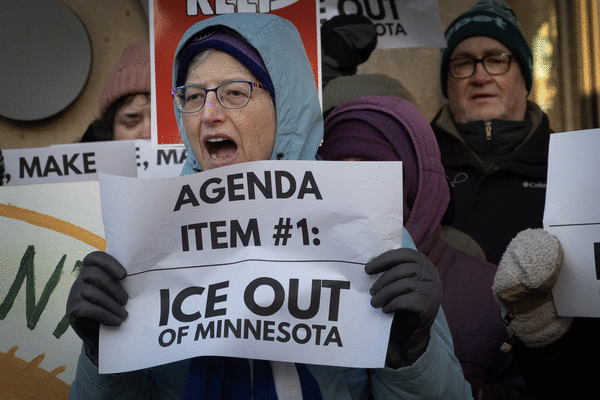
Tucker Carlson says liberal cities such as Minneapolis are pushing America toward disaster and civil war. The uncomfortable truth is that his argument helps normalize the very use of federal force that makes democratic breakdown more likely.
Carlson’s narrative is emotionally charged — warning of spiraling “chaos” if the liberal cities are not reined in. However, it is empirically false and assumes that local disorder precedes state force and that resistance morally and politically justifies federal escalation.
But the evidence from Minneapolis (and from Chicago months earlier) shows the opposite: Protest followed aggressive federal enforcement, not the reverse.
In Minneapolis in January, a dramatic deployment of federal agents into residential neighborhoods was followed by the fatal shooting of a civilian, Renee Good, during an operation. (The fatal shooting of another civilian, Alex Pretti, followed two weeks later.) Conflicting official accounts and the federal government’s refusal to submit the investigation to independent local oversight created a legitimacy crisis. Only then did large-scale protests unfold.
That pattern matters in democracies because coercive power must be perceived as legitimate to be accepted. When it is interpreted as selective, partisan or punitive, it produces resistance, not compliance.
New national survey data collected by the University of Chicago-based Chicago Project on Security & Threats, or CPOST, from Jan. 22 to 26 underscores why Carlson’s false narrative is dangerous.
Nearly one-third of Republicans (31%) already say they support President Donald Trump “using the U.S. military to stop protests against the Trump agenda,” and most (59%) “approve of the way President Trump is handling immigration enforcement, including deportations.” Carlson’s narrative already has a willing audience.
At the same time, nearly three-quarters of Democrats (74%) view federal forces — including Immigration and Customs Enforcement operations — in liberal cities as a “hostile military occupation,” and the same share believe deployments are meant “to impose new political leadership on liberal cities.” So, both Democrats and Republicans see federal enforcement not as protection but as an occupying force to compel liberals to bow to Republican political goals.
That snapshot reveals both the power and peril of elite narratives: They shape not just what people think, but also how they interpret force itself.
Importantly, the survey also points to a potential de-escalator that Carlson ignores. Solid majorities of both Democrats (71%) and Republicans (63%) agree that a “reasonable compromise on immigration would be to work together to deport undocumented immigrants with felony convictions.”
That suggests there are areas of bipartisan agreement on targeted enforcement — but only if the conversation shifts away from existential framing and toward practical policy.
Carlson’s framing collapses the causal sequence and recasts resistance as evidence of failure, rather than as a reaction to state-initiated escalation. In Chicago, hundreds of immigration raids — most targeting immigrants who have no criminal record— disrupted schools, businesses and entire neighborhoods. A civilian, Silverio Villegas-Gonzalez, was killed during a traffic stop. Protest followed. Federal officials described dissent as disorder. Enforcement intensified. The cycle repeated. These cases do not prove urban collapse. They illustrate how state action without shared legitimacy transforms routine policy into political confrontation.
In democratic systems, coercive force does not generate obedience through strength alone. It does so through perceived neutrality, restraint and shared purpose. Force interpreted as partisan or punitive erodes legitimacy and invites resistance.
Carlson’s insistence that unrest in cities is the cause rather than the consequence of escalation absolves decision-makers of responsibility for that collapse — and provides a moral rationale for expanding force.
This framing is not abstract. It shifts public expectations and lowers the threshold for the acceptability of coercion against fellow citizens.
America is a long way from a civil war. But one does not begin when citizens protest; it begins when leaders and influential voices convince the public that coercion against political opponents is governance rather than failure.
If Americans want to avoid that future, we must stop misdiagnosing the source of conflict — and stop celebrating the escalation that creates it.
____
Robert Pape is a professor in the political science department and director of the Chicago Project on Security and Threats at the University of Chicago.
___
©2026 Chicago Tribune. Visit at chicagotribune.com. Distributed by Tribune Content Agency, LLC.


























Comments