Commentary: What history tells us about fighting the repression we are seeing here
Published in Op Eds

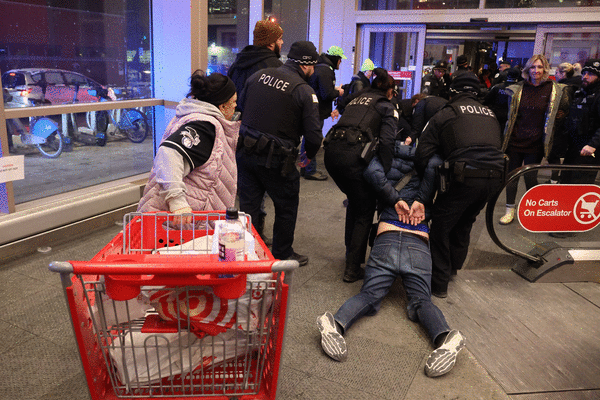
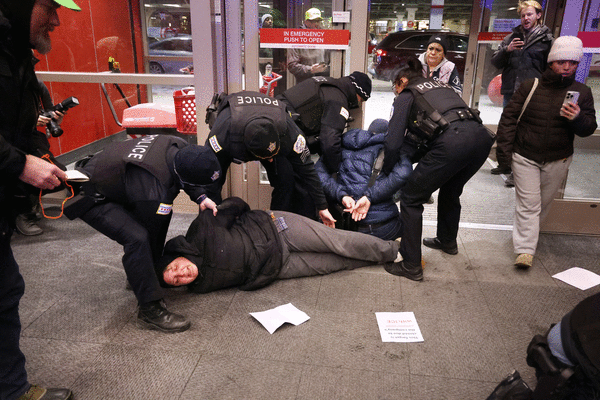


The U.S. government is using unaccountable federal forces to violently suppress dissent and reinforce its power through force and fear. This behavior is designed to make the people feel powerless and the governing authority impenetrable. It may feel shocking in America today, but it’s a common approach used by repressive regimes around the world.
Pushing back on this is difficult and scary, but history has shown us how and under what circumstances citizens have built effective resistance. The good news is that the people across targeted U.S. cities have been doing just that.
When and how do social movements succeed against abusive governments? We have many historic examples to draw on.
Poland’s communist government brutally suppressed the Solidarity Movement during the 1980s as the country’s workers used protests, labor organizing and labor strikes to fight for rights and freedoms.
The 1980s saw a similar popular movement in Chile against Augusto Pinochet who had seized power in a military coup in 1973. Organized civil resistance grew, with regular protests involving widespread evening noise, honking horns and banging pots and pans in solidarity, and “lightning” protests that organized and dispersed quickly.
Students founded the Otpor movement in Serbia in 1998 to resist the regime’s repression of universities. Its focus soon shifted to ousting dictator Slobodan Milosevic, using mass demonstrations and a general strike across the provinces to make its point.
Each of these movements were met with violence and repression, with activists arrested in the thousands, beaten and harassed, but they continued resisting with nonviolence. Gradually, concessions were secured, culminating in elections that the violent regimes lost and ultimately conceded.
America’s own Civil Rights Movement tells the story and success of generations of resistance in the face of violent repression, but its leaders’ deep commitment to nonviolence and persistence won the support of the American public and political leadership and ultimately dismantled legal segregation and disenfranchisement.
None were quick successes, but all achieved remarkable outcomes. In recent years, experts have built databases to study hundreds of examples of civil resistance movements, and the outcomes reveal some lessons and trends.
Social mobilization against governments tend to be most effective when they are nonviolent, align with public opinion, have media coverage and are ultimately supported by elite actors (business or political figures with influence on public opinion or government actors). These elements all help grow public support and pressure. Nonviolent movements are about twice as likely to succeed as violent ones.
Social media have enhanced the power of another useful tool: real-time video. Exposing government violence before the government sells a different story undermines support for and trust in the government, which in turn reinforces support for the social movement against it.
All of this plays into what Erica Chenoweth, an expert on political violence, calls the “ 3.5% rule,” which asserts that “no government has withstood a challenge of 3.5% of the population mobilized against it” at one time. This conclusion was based on analysis of over 300 movements since 1900. The study focuses on efforts to oust incumbent leaders and has exceptions, but the conclusion is broadly applicable: a movement that can generate this much active public support has a high chance of success.
For context, the most recent nationwide mobilization was the No Kings protest in October, with about 7 million participants, or about 2% of the U.S. population, and this happened well before federal forces killed two U.S. citizens in the streets. The response so far in targeted cities seems beyond the 3.5% threshold already.
Residents of Los Angeles, Chicago and Minneapolis, which have each faced heavy-handed federal crackdowns, are showing us how this is done. They have deployed rapid-response networks of community groups and volunteers to witness, document and track aggressive federal officer activity in their cities. Their videos have turned American public opinion squarely against these operations and undercut the administration’s justifications for use of force. They have secured the support of big and small businesses.
The effort to do so continues. Just last week, protesters were arrested demonstrating at a Target in Chicago’s West Loop as they pressed Target stores to deny entry to immigration agents and call for Immigration and Customs Enforcement to leave Illinois and Minnesota.
Activist groups such as Indivisible have trained tens of thousands of people in nonviolent tactics. As federal agents try to scare and provoke, in a way that could easily undermine the cause, such training is essential to ensure peaceful protesters do not take the bait.
And it’s working. Los Angeles succeeded in ousting thousands of National Guard forces the administration had deployed to aggressively back up its immigration operation. Last week, U.S. Border Patrol Cmdr. Gregory Bovino was stripped of leadership of the Minneapolis operation, and the Department of Homeland Security has announced that it is drawing down numbers of immigration officers there and would be issuing the remaining ones body cameras, a policy that gradually will be expanded nationwide. These are small but important concessions.
Ending this government repression will take a sustained and organized effort well beyond these cities. But if more Americans are ready to stand up with similar conviction, I have faith that the people will succeed.
____
Elizabeth Shackelford is a senior adviser with the Institute for Global Affairs at Eurasia Group and a foreign affairs columnist for the Chicago Tribune. She is also a distinguished lecturer with the Dickey Center at Dartmouth College. She was previously a U.S. diplomat and is the author of “The Dissent Channel: American Diplomacy in a Dishonest Age.”
___
©2026 Chicago Tribune. Visit at chicagotribune.com. Distributed by Tribune Content Agency, LLC.















































Comments