Commentary: What power do ordinary citizens have to keep federal agents accountable?
Published in Op Eds
When I first sat down to write this piece last month, this was the opening paragraph:
Renee Good was not the first person to be shot and killed by a federal immigration agent, and she likely will not be the last. My quiet block in the Old Irving Park neighborhood in Chicago was not the first to be tear-gassed, and it will not be the last. As abhorrent as these events were, what makes the situation worse — and what people are only now starting to talk about — is that Immigration and Customs Enforcement and Customs and Border Protection agents are almost entirely immune from criminal and civil accountability.
Now, in the wake of the death of Alex Pretti, it’s more important than ever to raise the level of public awareness and discourse about the significant barriers that exist to holding ICE and CBP accountable for their actions.
To be sure, there is no reason to believe any federal prosecutor under the administration of President Donald Trump will ever bring criminal charges against an ICE or CBP/Border Patrol agent, and, so far, no state or local prosecutor has dared. One reason is the Supremacy Clause of the United States Constitution, which provides a strong legal defense to federal agents in state-based prosecutions. Another is the probability that an agent so charged would be successful in arguing to a judge they acted reasonably under the circumstances, particularly in cases involving the use of deadly force. But perhaps the most significant barrier to a state-based criminal prosecution of an ICE or CBP agent is the fact that the Trump administration can use the FBI to take over the investigation and prevent state and local authorities from accessing critical evidence, as they did following Good’s killing and are doing with the investigation into Pretti’s.
Worse still, unlike the way someone whose rights were violated by a state or local police officer can sue for money damages in federal court, federal law does not provide the same relief to victims of ICE and CBP’s brutality. This is because the Constitution does not provide a civil remedy for the violation of the Bill of Rights. Instead, Congress had to pass a law to allow for state and local government officials, such as police officers, to be sued in federal court for money damages. Congress passed this law — Section 1983 — six years after the end of the Civil War as part of the Civil Rights Act of 1871, also known as the Ku Klux Klan Act.
But Congress has never passed a Section 1983 equivalent for federal officials. In other words, there is no federal law that allows you to sue a federal officer for the violation of your federal civil rights. The only way to sue a federal agent for the violation of your constitutional rights is via a judicially created cause of action commonly referred to as a Bivens action. In short, the Supreme Court allowed Webster Bivens to sue six unknown agents of the Federal Bureau of Narcotics in 1971 for the violation of his rights under the Fourth Amendment. Since then, however, the Supreme Court has significantly limited its decision that relates to Bivens, so much so that unless your name is Webster Bivens and you’re suing six unknown agents, your odds of prevailing are incredibly low.
While most Americans will be surprised to learn this, the people calling the shots in the Trump administration and at the Departments of Homeland Security and Justice — Stephen Miller, Pam Bondi, Kristi Noem, Tom Homan — are well aware of these barriers to accountability for ICE and the CBP and are intentionally exploiting them. Miller has suggested on more than one occasion that ICE and CBP agents are “absolutely immune” from prosecution. While that’s not legally correct, he’s not far off in practical terms. The result is a federal immigration force that believes it can behave however it wants without fear of facing any real consequence for agents’ actions.
So where do we go from here? How do we change the landscape of the hellish dystopian nightmare we’re currently living in? The answer is simple: ICE and CBP agents should face the same criminal and civil liability under state and federal law as would a Chicago police officer. But that accountability will never come unless Congress and state and local leaders act, which is not as simple. Congress is as feckless and fractured as ever, and any state or local prosecutor who has the temerity to bring a criminal case against an ICE or Border Patrol agent for their lawless behavior will no doubt be on the receiving end of Trump’s weaponized Department of Justice.
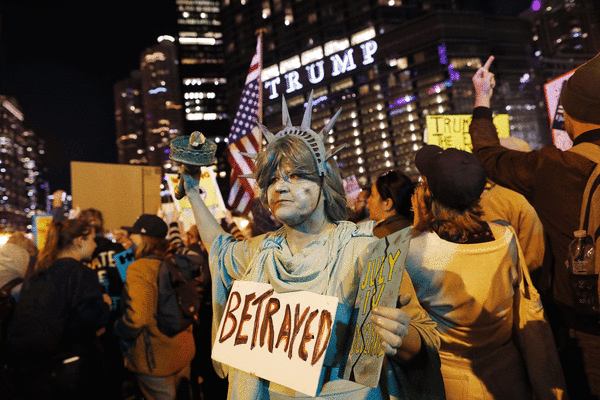
Bleak as this reality may be, we as American citizens have an obligation to do all that we can to challenge the Trump administration’s lawlessness. We cannot be cowed into quiescence. We must loudly and publicly protest its abuses at every opportunity. We have to put maximal pressure on our elected leaders at the federal, state and local level to do everything in their power to bring accountability to the Trump administration. Imagine what could happen if every person reading this called their member of Congress and demanded the lawmaker refuse to fund DHS any further unless and until Congress passes a Section 1983 equivalent for federal officials.
Don’t wait until another American citizen is killed by their own government. Act now.
____
Brian Kolp is a former attorney for the city of Chicago’s Law Department and the Illinois attorney general’s office and a former prosecutor with the Cook County state’s attorney’s office.
___
©2026 Chicago Tribune. Visit at chicagotribune.com. Distributed by Tribune Content Agency, LLC.





















































Comments