Commentary: Black History Month 2026 -- When memory becomes a moral test
Published in Op Eds
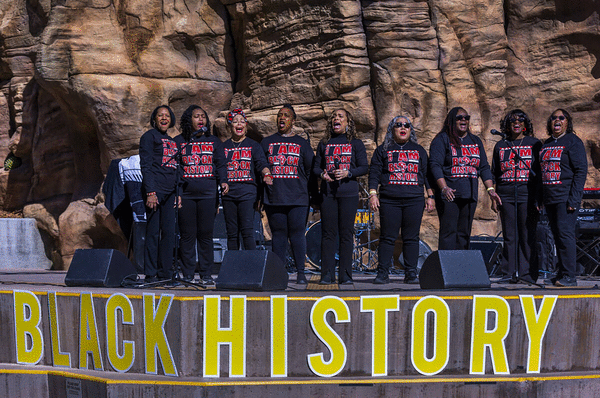
Imagine opening a history textbook and not seeing the faces of key contributors to America's story. Every February, America observes Black History Month. It started in 1926 as Negro History Week, founded by historian Carter G. Woodson, and was never meant to be just a ceremony. Its purpose was to make the nation face the truth after erasing Black people from its official story. Woodson knew something we still struggle with: history is not only about the past. It reflects our present.
We celebrate Black resilience, yet increasing policies of exclusion expose a deep national contradiction. Honoring Dr. King’s dream has become a hollow ritual amid policies echoing Jim Crow and the resurgence of surveillance targeting Black communities. Our praise for pioneers like Frederick Douglass rings empty while state power is deployed with suspicion against the same communities they fought to liberate. This contradiction is not just an idea. We see it on our streets.
Under the Trump administration, federal enforcement became more militarized and extended beyond border control. ICE now acts as a domestic force with the power to detain, deport, and disrupt entire communities. Operations like Operation Metro Surge, which took place in Minneapolis, detained refugees, legal residents, and asylum seekers. The stories of Renée Good and Alex Pretti stand for those harmed by excessive force, showing what happens when law enforcement loses its sense of humanity. This tragedy caused fear in communities, making many people avoid public services or community events and leaving vulnerable groups even more isolated. Families were separated, and local businesses suffered as trust between residents and authorities broke down, showing how these actions affect more than just one person.
Black history shows us that when the state treats some people as suspicious, disposable, or unwanted, injustice soon follows. Slave patrols once roamed the South. Black codes and vagrancy laws made survival a crime. The federal government watched civil rights leaders as if they were threats. Today, ICE raids and deportations use the same thinking: deciding who gets human rights and who does not.
Immigration is a key part of Black America’s story because excluding Black immigrants today repeats the same patterns of racial injustice that Black history warns us about.
Black immigrants from Africa, the Caribbean, and Latin America already face disproportionate detention and deportation. According to a 2019 report by the Black Alliance for Just Immigration, Black immigrants are approximately twice as likely to be incarcerated during immigration proceedings, several times more likely to be placed in solitary confinement, and are denied asylum at a higher rate than non-Black immigrants. That was before the Trump administration expanded visa bans on dozens of mostly African and Caribbean nations and ended Temporary Protected Status for Somalis, Haitians, and others fleeing instability and violence.
These policies show a basic truth: they keep racial hierarchies in place by deciding who belongs and who does not, repeating old patterns of exclusion that Black history records.
In American history, immigration law has often sorted people by race. The Chinese Exclusion Act, the national origins quotas of the 1920s, and the preference for Europeans are examples. Each time, the country said it was protecting itself, but it was really deciding who could belong. Today, Black migrants suffer from this same old lie in a new way.
At the same time, something remarkable is happening across the Atlantic. Countries like Benin are offering citizenship to descendants of enslaved people, recognizing the crime of forced removal and reaching out to make things right. Where the transatlantic slave trade once took away homeland and dignity, some African countries are now saying: you are still part of us.
In contrast, the United States is moving the other way.
We detain legal refugees, take away humanitarian protections, and let armed agents decide who deserves safety. A country built by forced migration now treats newcomers as threats. When government policy is based on fear of changing demographics, it turns into a politics of replacement. When enforcement is measured by numbers instead of justice, it creates more suffering. When the law loses its sense of right and wrong, it becomes cruel.
Black History Month should push us to face hard truths and fight exclusion, not just celebrate achievements.
Howard Thurman once asked, “What are the churches for?” In times like these, the answer cannot be comfort or silence. Faith, like history, should move us to act. Dr. King said the moral arc bends toward justice only when people pull it. But this call to action is not just for religious groups. Secular activism is also important, encouraging everyone, including students from all backgrounds, to stand up against injustice. Each person can help create real change, no matter their faith or beliefs.
We cannot honor our ancestors or talk about the Underground Railroad while supporting policies that criminalize people fleeing oppression or accept state violence as policy. Black history is not just something to look at in a museum. It is a warning. It shows us that when a nation decides some lives matter less, injustice spreads. It reminds us that freedom is never secure when fear is in charge. The fight for Black dignity is always tied to the fight for human dignity.
This February, we have a choice. We can remember, or we can repeat the past.
____
Rev. Dr. F. Willis Johnson is a spiritual entrepreneur, author, scholar-practioner whose leadership and strategies around social and racial justice issues are nationally recognized and applied.
_____
©2026 The Fulcrum. Visit at thefulcrum.us. Distributed by Tribune Content Agency, LLC.














































Comments