Commentary: Close the gaps in our frayed social safety net
Published in Op Eds
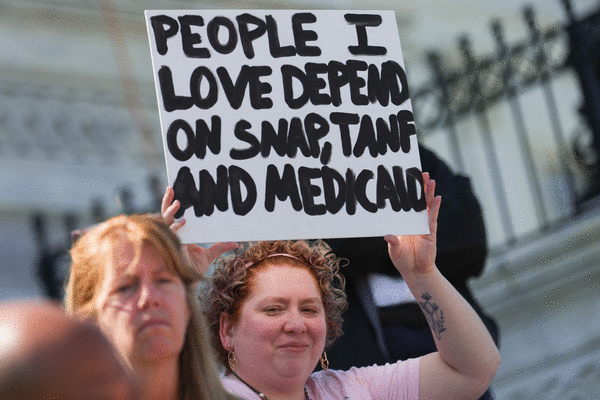
In a country as wealthy as the United States, it is a bitter irony that millions of people still fall through the cracks of a social safety net meant to protect them.
Welfare programs exist, but they are fragmented, riddled with arbitrary rules and built around abrupt cutoffs that punish progress. Missing a form, filing late or earning slightly too much can erase months of support overnight. Life is unpredictable, and safety nets that leave gaps are not safety nets at all — they are fragile scaffolding, easily shattered by misfortune.
The numbers illustrate the problem. In Raleigh, N.C., Medicaid eligibility for a single adult ends when their earnings exceed roughly $21,000 per year, while the MIT Living Wage Calculator estimates a true living wage for that area at about $54,000 per year.
Similar cutoffs exist nationwide: A 2019 Urban Institute analysis found that for a single parent with two children, losing housing or child care subsidies can result in an effective marginal tax rate of more than 70%, meaning each additional dollar earned can reduce net resources by more than two-thirds.
“Income disparities in the United States are wider than at any point since the Great Depression,” longtime poverty policy Peter Edelman writes in his book, “So Rich, So Poor: Why It’s So Hard to End Poverty in America.” “Even with programs like SNAP and the Earned Income Tax Credit, millions remain in deep poverty because cash assistance has largely disappeared, leaving dangerous holes in the nation’s safety net.”
Food stamps, housing assistance and health care rarely coordinate. A family earning more than $22,000 a year may lose Medicaid, see SNAP reduced and become ineligible for subsidized childcare — creating a net loss despite higher income.
Analysis by the Congressional Budget Office shows that when taxes and benefit phase-outs are combined, many low-income households face high effective marginal tax rates as earnings rise, meaning each additional dollar earned can be partially absorbed by higher tax liability and reduced benefits.
This is not just an economic problem; it is a moral one. People in crisis do not have time to tend to endless paperwork. They need immediate, reliable support to survive and build toward stability. When families are secure, they contribute more effectively to their communities, participate fully in the economy, and can plan for the future. Stability is empowerment. Empowerment is investment in the future.
Gapless welfare is a solution. It is a system proposed by Edelman in which benefits taper gradually as income rises, ensuring that every additional dollar earned adds to a family’s stability rather than taking it away. Guaranteed access to food, housing, health care and child care allows people to focus on work, education and family, rather than constantly calculating whether a modest raise will push them off essential programs.
Opponents argue that welfare expansion discourages work or fosters dependency. Research shows the opposite. A 2021 study by the Brookings Institution found that guaranteed benefits increased employment by enabling recipients to pursue better jobs, attend training programs and manage health crises without risking destitution. Families with consistent support are healthier, more productive and better able to escape cycles of poverty. Safety nets remove desperation, not incentive.
The current system also disproportionately harms marginalized communities. Single parents, people with disabilities and people of color are more likely to encounter benefit cliffs and bureaucratic obstacles. A gapless welfare system would reduce these inequities by rewarding effort instead of penalizing progress. By eliminating abrupt cutoffs, it allows families to move up the economic ladder without risking collapse with every incremental step.
Implementing gapless welfare is practical. It requires coordinating programs, streamlining eligibility and tapering benefits gradually so that support never disappears abruptly as income rises. This transforms welfare from a fragile patchwork into a robust, predictable safety net.
Gapless welfare is not radical — it is evidence-based, economically sound and morally necessary.
Closing the gaps in our social safety nets allows people to thrive rather than merely survive, ensures that ambition is rewarded and strengthens society as a whole. Anything less is a failure of policy, compassion and justice.
____
Shaquille Nelson is a physics student at Wake Tech Community College in North Carolina. This column was produced for Progressive Perspectives, a project of The Progressive magazine, and distributed by Tribune News Service.
_____
©2026 Tribune Content Agency, LLC.

















































Comments