Adam Minter: It's ICE that 'engineered chaos' in my Minneapolis community
Published in Op Eds
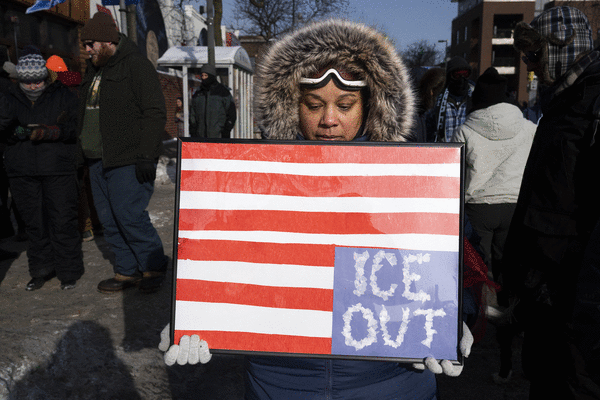
On Saturday morning, Border Patrol agents fatally shot Alex Pretti on a busy Minneapolis street. The Trump administration wasted no time in doing a bit of preemptive inoculation.
In a post on X Saturday, Vice President JD Vance claimed that “far left agitators, working with local officials,” had “engineered chaos” in Minneapolis. President Donald Trump echoed the sentiment in a series of social media posts on Sunday, blaming local authorities for refusing to cooperate with Immigration and Customs Enforcement. The messages from the president and vice president were clear: If the city erupts, it won't be ICE’s fault. Responsibility would belong to Governor Tim Walz and Mayor Jacob Frey.
But Vance and Trump had the story backwards. What local officials engineered wasn’t chaos. It was a firewall. By separating local law enforcement from ICE operations, they’ve earned public trust and reminded wary Minneapolis residents that ICE is the source of the city's recent tumult.
It’s been a daunting task.
Since launching in December, Operation Metro Surge, as ICE calls the crackdown, has become the agency’s largest-ever immigration enforcement action. It’s a striking escalation of aggression in a state that isn’t on the US–Mexico border, given the Trump administration’s stated emphasis on the southern border as the epicenter of immigration challenges. As of Sunday, roughly 3,000 agents were taking part, a number roughly triple the number of sworn police officers in Minneapolis and St. Paul.
For me and thousands of other Twin Cities residents, they’re a pervasive source of dread and anger.
In my neighborhood, which is west of Minneapolis and home to numerous immigrants, community group chats are filled with messages about ICE vehicles, staging areas, and masked enforcers. We learn the worst. Agents target school bus stops; cars are left behind, sometimes in the middle of the road after arrests; and citizenship is no protection if you speak with the wrong accent.
These tactics strike an especially sensitive nerve in Minneapolis, where the police department spent decades harassing and terrorizing Black neighborhoods. The 2020 riots that followed the murder of George Floyd were a tragic outcome that forced the city to confront law enforcement that operates with impunity.
What’s followed is five years of reform efforts that have begun to restore trust and instill needed accountability in local law enforcement. Progress has been slow but tangible — and now it’s under pressure.
Needless to say, Operation Metro Surge wasn’t intended to build upon civic progress. Like other ICE enforcement operations, it demands collaboration, support, and supplication.
Some communities across the country cooperate and partner to locate, arrest, and deport people, perhaps hoping that ICE will go easy on them.Others, including Minneapolis, seek to limit cooperation except where their policies or specific legal obligations require it, such as when complying with judicial warrants or public‑safety situations. In December, as ICE’s operations in Minnesota intensified, Minneapolis, under Mayor Frey, explicitly prohibited city resources from supporting immigration enforcement. There will be no shared data access, intelligence sharing, or joint operations for civil immigration enforcement purposes.
It’s a sanctuary city policy, that solves a couple of problems at once. First, it ensures that immigrants feel comfortable calling the police — for a traffic accident, a robbery, a domestic assault — without inviting deportation. Second, it aligns Minneapolis with the community and against federal overreach.
Of course, one city can’t do it alone. Walz has fortified the separation at the state level and revealed something important. Where ICE operates through intimidation and secrecy, Minnesota’s response has been visible and humane. Where ICE escalates, Minnesota and its leaders seek ways to lower the temperature.
A critical test came on Saturday, when the city’s fragile peace felt as if it might shatter. Following Pretti’s death, Walz deployed the National Guard to key Minneapolis locations. They did not wear masks. Instead, members wore yellow reflective vests not unlike what a school crossing guard might wear. The point was to distinguish Guard personnel from ICE, and they did.
Purposely or not, the crossing guard wear also conveyed a friendlier, more local image when I encountered them. It’s a point the Guard seemed determined to telegraph loudly this weekend. On Sunday, they distributed coffee and donuts to anti-ICE protestors at a government building that houses ICE detainees.
Gestures like these aren’t going to prevent ICE from violating constitutionally guaranteed rights. Indeed, there’s no reason to believe the agency plans to change its ways any time soon. Likewise, there are other factors that may have contributed to the calm, including cold weather, lessons learned from 2020, and widespread calls for de-escalation.
On Sunday, the restraint was evident at the impromptu memorial of flowers, pictures, candles and other items that had sprouted at the site of Pretti’s death. The local police presence was up close and personal, yet the trickle of mourners in the -10 degree weather didn't seem bothered by it. Five years ago, when I visited the site of Floyd’s murder, law enforcement remained blocks away, when they were present at all.
That shift, from absence born of fear to presence born of confidence, is the firewall’s true achievement.
Whether the peace holds is only partly under Minneapolis’ control. Warmer weather might encourage more audacious protests; ICE may decide to build a permanent presence. But for now, the city seems to have learned the power of empathy. As ICE continues to sow chaos, that’s the kind of message Minneapolis needs.
____
This column reflects the personal views of the author and does not necessarily reflect the opinion of the editorial board or Bloomberg LP and its owners.
Adam Minter is a Bloomberg Opinion columnist covering the business of sports. He is the author, most recently, of “Secondhand: Travels in the New Global Garage Sale."
©2026 Bloomberg L.P. Visit bloomberg.com/opinion. Distributed by Tribune Content Agency, LLC.























Comments