Commentary: Eligibility changes, NIL contracts and the transfer portal have brought chaos to college sports
Published in Op Eds
The current trajectory for college sports is unsustainable. Big-revenue sports such as football and basketball have undergone massive transformations over the past decade, facilitated by a number of policy changes. Yet the changes they’ve undergone provide a clue as to how to salvage them.
The transfer portal was created in 2018 to facilitate athletes moving between schools. Then the COVID-19 pandemic in 2020 gave every athlete at that time an additional season of eligibility. Discussions are underway to give all athletes five years of eligibility. To further muddy eligibility requirements, new legal rulings under consideration may exclude years played in junior college or even professional leagues. Lastly, beginning in 2021, name, image and likeness (NIL) contracts have permitted athletes to monetize their visibility by engaging with nonuniversity entities and signing contracts that pay them directly.
Debate over these changes happened in a siloed manner. The discussions have not included the impact of these changes on each other and how the combined effect would transform college sports in unexpected ways.
NIL contracts draw the most headlines. Though the value of NIL contracts is rarely disclosed, estimates suggest that some of the highest-profile athletes earn millions of dollars each season. This has encouraged wealthy boosters to make sizable donations to facilitate such funding. Mark Cuban, now a minority owner of the Dallas Mavericks and a graduate of Indiana University, did not shy away from announcing his donations to his alma mater and how he hopes such funds will keep the success of the Indiana football team rolling.
Yet money by itself cannot do much on its own. That is where the eligibility relaxation comes in.
Players who develop their skills in junior college or overseas can join a college team at 20 or 21 years old, with four or five years of remaining eligibility. By the time such players are in their final year of eligibility, they will be several years older than freshmen coming directly out of high school. The physical dominance of these older players gives them a decided advantage. NIL contracts also incentivize them to stay in college for their entire eligibility period.
Yet NIL contracts and eligibility relaxation cannot win championships without the third component: the transfer portal.
The transfer portal permits every athlete to move between schools without the penalty of sitting out one season. Given that every school can provide their own collection of NIL opportunities, athletes can choose where to play based on how much they will be paid.
In the past, an athlete chose to transfer to another school because of a coaching change or perhaps in search of more playing time. With NIL contracts available, financial opportunities are now the driving factor behind many of these transfers. With no penalty for transferring, the benefits resulted last spring in over one-third of college basketball players entering the transfer portal.
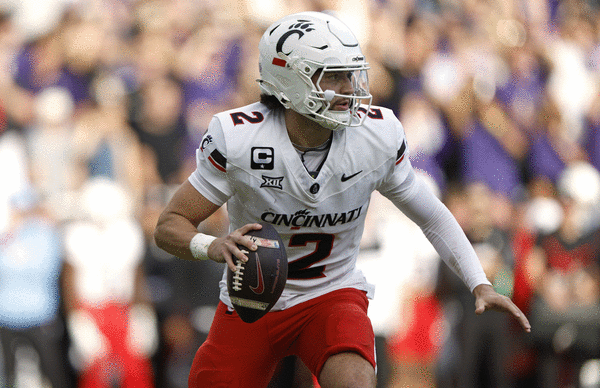
The absurd negative synergy created by these three policy changes was on full display when Cincinnati Bearcats football quarterback Brendan Sorsby recently decided to transfer to Texas Tech. His NIL contract at Cincinnati was structured so that he would owe them a $1 million buyout if he did not stay at Cincinnati. At Texas Tech, Sorsby is expected to receive around $5 million thanks to his NIL agreement, possibly placing him among the highest-paid college football players next season.
All these changes have tarnished college sports. Yet if any one of these changes was reeled in, the negative effects on college sports would be significantly dampened.
If NIL contracts did not exist, the athletes would have less motivation to transfer every academic year. If the transfer portal did not exist, and athletes could not freely move between schools without sitting out one year, team rosters would stabilize. If eligibility was limited to four years and affected by time playing in junior colleges and overseas, athletes would have a more restricted window of eligibility, giving them less time to move between schools, which would create more homogeneity in age and maturity and a more level playing field.
The likelihood that any one of these will be tightened anytime soon is remote. The NCAA recently reduced the time window in the transfer portal, hoping to tame the transfer portal wildfire. Yet this is nothing more than a cosmetic change, simply forcing the athletes to work more quickly to achieve the same objective.
NIL is not going away, nor is the transfer portal. This leaves the eligibility policy lever as the remaining tool to rein in the problems we now see in college sports.
No one considered the synergy that the three changes would fuel and their negative consequences on college sports. Each was instituted in response to circumstance or legal rulings — but collectively, they have spawned chaos.
It is nearly impossible to put the genie back in the bottle, but colleges and universities can and should determine the core societal value college sports offer and build everything around that.
____
Sheldon H. Jacobson, Ph.D., is a computer science professor in the Grainger College of Engineering at the University of Illinois Urbana-Champaign. As a data scientist, he uses his expertise in risk-based analytics to address problems in public policy, public health, security, air travel and sports.
___
©2026 Chicago Tribune. Visit at chicagotribune.com. Distributed by Tribune Content Agency, LLC.
















































Comments