Editorial: Kids need to go to school. And schools need to give them a reason to show up
Published in Op Eds
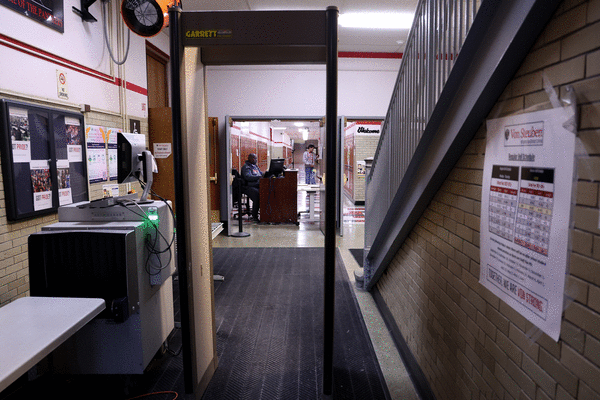
We spend tens of billions of dollars each year on K-12 public education in Illinois. We argue endlessly about how best to invest that money to improve student outcomes, and we despair when those investments don’t produce an adequately literate and numerate student population.
But our fixation on budgets and balance sheets may be obscuring something just as essential to learning — and far harder to buy.
Trust.
So says new research from the University of Chicago Consortium on School Research, which highlights “relational trust” as a critical factor associated with academic achievement and school improvement.
This feels like such an obvious revelation, and yet we rarely hear the concept discussed regularly in the politicized, day-to-day doings of our education system.
Trust is an important component of our adult lives. We try not to employ people without integrity or who lack basic competence. We don’t follow advice from someone we don’t respect. And we don’t spend time with people when we think they don’t really care about us.
When it comes to their classrooms, kids, of course, often have no choice — they’re required to go to a specific school, whether their teachers embody these positive virtues or not.
Many kids, however, opt not to go to class.
Today, over 40% of students at Chicago Public Schools miss 18 days of school or more per year, according to state data. Before COVID, in 2019, less than 25% of students were chronically absent, showing the problem has gotten far worse since the pandemic shutdowns that disrupted schools across the country.
It’s a serious problem, as “both grades and standardized test scores go up with higher attendance, and down with lower attendance,” according to the U. of C. report.
That’s certainly the case here in Chicago. In 2019, nearly 38% of CPS students in grades three through eight met or exceeded reading expectations, according to state data. By 2024, the final year before Illinois changed its proficiency standards, that figure had dropped to about 31%.
These post-COVID declines are well documented, and we’ve previously expressed concern about the downward trend in students’ ability to read and do math at grade level. What makes the attendance crisis especially troubling is that it compounds those academic losses.
So why are so many Illinois kids missing class?
For some students, absence isn’t defiance, it’s avoidance of a place that no longer feels safe or worth their time.
The flipside of that question, though, is: What would get kids to come to school?
Here’s what the University of Chicago researchers say matters the most: safety (first and foremost), strong relationships with teachers and peers, relationships between parents and teachers, and a classroom environment in which kids find value and meaning.
Nurture these things, the report implies, and better results should follow. Ignore them — or leave in place systems and problems that obstruct the development of trust — and good luck finding kids in school, where they are supposed to be.
A district of the size and complexity of CPS will always have its fair share of problems, but disturbing headlines in recent months show just how much work needs doing. Chicago’s challenges are far from unique, but they are at scale here.
Too often, students in Chicago deal with violence near school, such as the shooting near a Little Village elementary school earlier this week, as well as violence and bullying within the schools themselves. A 33-year-old Chicago mom, Corshawnda Hatter, said she told school officials her 9-year-old son had been the victim of bullying for years and saw no action. As a now-viral video reveals, a group of kids violently attacked Hatter and her children near Orville T. Bright Elementary School last November.
We wrote just a few days ago about the “pervasive” problem of adult-on-student sexual misconduct, a pernicious problem that rightly erodes kids’ ability to connect with the grownups in their schools.
COVID didn’t just disrupt learning, it accelerated the breakdown of routines, trust and students’ sense that school is a place worth being.
At the same time, we feel optimistic about the power of strong teachers, coaches and school leaders to encourage and influence kids in a positive way.
Many of us have had the good fortune to be taken under the wing of a caring teacher, or teachers, and can appreciate what a difference that makes. But we know teachers alone can’t be asked to solve the absenteeism problem.
As the U. of C. authors acknowledge, “schools alone are neither the cause nor the solution to increases in chronic absenteeism rates”: factors at home and in the community also affect students’ attendance.
But unlike transportation budgets, housing supply or health crises, school climate is something individual schools and educators can meaningfully influence and make dynamic change.
If Chicago wants kids back in its classrooms, it can’t treat attendance as a compliance problem or a spreadsheet metric. Trust between students and teachers, schools and parents isn’t some theoretical ideal. It’s a prerequisite for learning.
_____
©2026 Chicago Tribune. Visit chicagotribune.com. Distributed by Tribune Content Agency, LLC.
















































Comments