Editorial: A positive change for Venezuela but a diminishment of US moral authority for years to come
Published in Op Eds
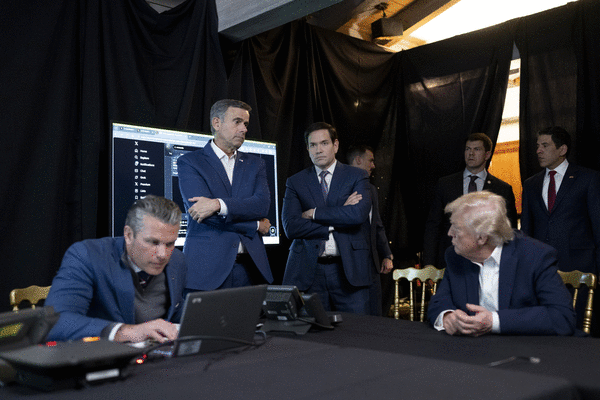
No sooner had the new year dawned than President Donald Trump introduced a new level of stress to the world, grabbing the leader of a sovereign nation without congressional approval, hauling Nicolás Maduro, the president of Venezuela, off to a New York jail cell and installing Secretary of State Marco Rubio as the de facto viceroy of Venezuela. All while trapping well-heeled American elites on Caribbean beaches as weekend, return-to-work flights from the region were nixed by the Federal Aviation Administration, citing safety concerns.
What a year. And it’s only Jan. 5.
Predictably, America’s left-wing mayors howled in protest at the weekend actions. New York’s Zohran Mamdani expressed concern for the Venezuelans in New York and accused Trump of violating international law. Mamdani let it be known he had called Trump to register his opposition to this actions, the honeymoon between those two men apparently having come to a swift conclusion. That was, of course, purely a performative act, as was the Chicago Teachers Union’s weekend “stop the bombings” rally with various socialist co-sponsors and Chicago Mayor Brandon Johnson’s statement that “the illegal actions by the Trump administration have nothing to do with defending the Venezuelan people; they are solely about oil and power.”
The problem the socialist mayors faced immediately was that many of the Venezuelans they claimed to be defending looked pretty happy to see the former bus driver and union leader go, not least because of the illegitimacy of his election in the first place, not to mention his presiding over a corrupt government known for its human rights abuses and diminishment of press freedoms. All that and grinding poverty, too. No wonder there was dancing in the streets and talk of a free Venezuela.
Moreover, it looks pretty clear that Trump’s notably clean removal operation was something of an inside job. The Miami Herald reported that the Venezuelan Vice President (and supposed Maduro loyalist) Delcy Rodríguez, had “reached out” (so to speak) to the Trump administration, suggesting she might just be a more acceptable leader when it comes to U.S. interests.
Reportedly, there were secret talks held in Qatar, with a member of the UAE’s ruling royal family in the room, along with Rodríguez’s brother. One can assume the U.S. interest in Rodríguez, at least in the short term, was to leave someone in power who could manage the “transition” without totally blowing up and rebuilding Venezuela, not to mention getting more useful information on the seemingly nonchalant but actually increasingly paranoid Maduro’s whereabouts.
“She’s essentially willing to do what we think is necessary to make Venezuela great again,” Trump told reporters of Rodríguez. Translation: She will do what we want because she knows who is in charge. Rodríguez, however, is already showing signs that she won’t be so easily controlled.
Purely observationally, the events in Caracas offer yet another lamentable reminder of how much the liberal, old world order has disintegrated in the age of Trump and Putin. We now live on a planet dominated by raw, authoritarian, executive, centralized power, with subnational figures like mayors (not to mention members of the U.S. Congress and European leaders) all reduced to bleating inconsequentially on the sidelines.
Simply put, Maduro was deemed by Trump to be incompatible with U.S. interests, which naturally includes the extraction of oil and the disruption of the supply of illegal drugs, so the administration simply unleashed the power of the U.S. military to go in and remove him. This will appeal to those who believe in American exceptionalism; there are similarities with Trump’s interventionist plan for a Gaza more aligned with U.S. and Israeli (and UAE) interests.
Tacitly, the action sends a message to other nations with similarly incompatible governments that the U.S. won’t hesitate to take invasive action. How one feels depends really on how benign one feels U.S. interests to be, globally speaking.
If that were not enough, Trump openly stated a desire now to “run” a sovereign nation of some 28 million people, although Rubio walked that back some on Sunday morning.
Aside from being yet another example of Trump’s inconsistency, seemingly going from isolationist to interventionist over the Mar-a-Lago holiday buffets, any such “running” requires a confidence in the wildly impulsive Trump that we simply do not have, and nor should those who won’t miss the Venezuelan status quo. Congressional approval for this kind of action exists for good reasons, including the need for a clear plan for the aftermath.
We don’t lament Maduro’s exit for a moment and we’ll even allow that the removal action, if those are the right words, was impressive and reasonably light on collateral damage (although some 40 lives were lost). But the consequences likely will extend far into the future and far beyond Venezuela.
What moral authority does the U.S. now have if, say, China, removes the Taiwanese leadership, deeming it incompatible with Chinese interests? Not much. And this action surely weakens the moral argument against Vladimir Putin, though Ukrainian President Volodymyr Zelenskyy is now hoping Russia’s leader is the next authoritarian Trump takes out.
Howling in protest does little, of course. Elections have consequences. Maduro is gone from Venezuela and he will not be missed. We will have more to say as events unfold but, at this juncture, we urge the Trump administration to stop this hubristic talk of running things, involve the U.S. Congress in its plans for the future of Venezuela and focus on empowering the Venezuelan people and their democratically elected leaders.
___
©2026 Chicago Tribune. Visit at chicagotribune.com. Distributed by Tribune Content Agency, LLC.















Comments