Commentary: Beware of panic policies
Published in Op Eds
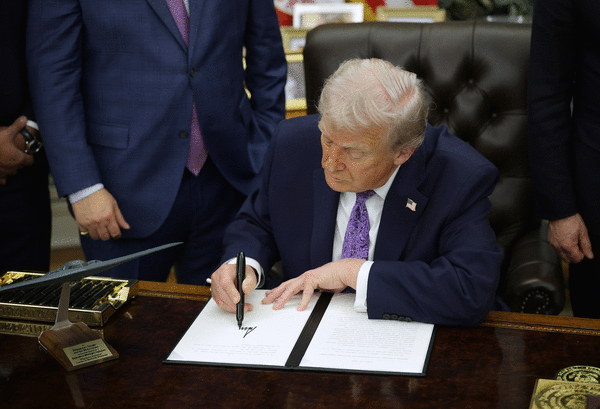
"As far as human nature is concerned, with panic comes irrationality."
This simple statement by Professor Steve Calandrillo and Nolan Anderson has profound implications for public policy. When panic is highest, and demand for reactive policy is greatest, that's exactly when we need our lawmakers to resist the temptation to move fast and ban things.
Yet, many state legislators are ignoring this advice amid public outcries about the allegedly widespread and destructive uses of AI. Thankfully, Calandrillo and Anderson have identified a few examples of what I'll call "panic policies" that make clear that proposals forged by frenzy tend not to reflect good public policy.
Let's turn first to a proposal in November of 2001 from the American Academy of Pediatrics. For obvious reasons, airline safety was subject to immense public scrutiny at this time. AAP responded with what may sound like a good idea: require all infants to have their own seat and, by extension, their own seat belt on planes. The existing policy permitted parents to simply put their kid — so long as they were under two — on their lap. Essentially, babies flew for free.
The Federal Aviation Administration permitted this based on a pretty simple analysis: The risks to young kids without seatbelts on planes were far less than the risks they would face if they were instead traveling by car. Put differently, if parents faced higher prices to travel by air, then they'd turn to the road as the best way to get from A to B. As we all know (perhaps with the exception of the AAP at the time), airline travel is tremendously safer than travel by car.
Nevertheless, the AAP forged ahead with its proposal. In fact, it did so despite admitting that they were unsure of whether the higher risks of mortality of children under two in plane crashes were due to the lack of a seat belt or the fact that they're simply fragile.
A group of pediatricians stepped in to quash the AAP’s unfounded proposal. They reported that “even if the policy led to no increase in car travel and cost only $20 per round trip per young child, the cost per life saved would be about $4.3 million per discounted life-year.”
As difficult as it may be to put a price tag on saving the life of an infant, in a world of scarce legislative attention and sparse resources, policymakers cannot avoid such analysis. Thankfully, the FAA sided with reason, resisted popular pressure, and rejected the AAP’s proposal.
Unfortunately, there’s no guarantee that reason will win out over panic policies. Following a number of tragic school bus incidents in the 1960s and 1970s, Congress faced mounting calls to insist on heightened safety regulations for school buses. The resulting proposal would have increased the cost of school buses by 25 percent by virtue of shoring up their safety measures. How do you think school districts would have responded?
Stick with the older buses for longer, right? Few school districts have spare funds lying around. Yet, this somewhat obvious response by districts appears to have been lost on the chief proponents of the policy.
The upshot is that policymaking that occurs in the heat of public panic is precisely when we ought to slow down, rely on evidence, and avoid enacting laws that will actually do more harm than good. It is undeniable that extensive use of AI tools has resulted in tragic outcomes for several young Americans.
How best to respond, though, is not as clear-cut as many may have you believe. It’s highly questionable that existing reports about the pros and cons of AI tools are representative of users. It’s also highly probable that proponents of bans are not adequately weighing the fact that there’s a massive shortage of psychiatrists to address the growing need among children and teens for specialized support. This is especially for children in rural and economically-insecure communities.
Finally, and most importantly, it’s nearly certain that by stigmatizing the use of AI, proponents of panic policies may undermine uses of tools that have already shown their effectiveness. Not all AI is created equal. While there may be a case for limiting and even banning certain uses of certain AI tools, such policies should be grounded in evidence, not vibes.
To be clear — as someone who suffered from mental health issues as a child, I am not at all opposed to the motivations of those paying close attention to the misuse of AI. I applaud their devotion and attention to this issue.
However, I’m vehemently opposed to allowing panic to distract us from adhering to good public policy. This is an emotional topic, which often makes it difficult for nuanced conversations, but the well-being of our youth demands that we rise to the occasion — leaning on research, investigation, and deliberation rather than acting on headlines and speculation.
____
Kevin Frazier is an AI Innovation and Law Fellow at Texas Law and author of the Appleseed AI substack.
_____
©2025 The Fulcrum. Visit at thefulcrum.us. Distributed by Tribune Content Agency, LLC.























Comments