David Fickling: A city without water is a harbinger of a thirsty planet
Published in Op Eds
The history of our cities has been written in water.
In Mesopotamia, Egypt and the Indus valley, the first urban settlements were built around irrigated farmland. Flooded terrace fields for rice, corn and quinoa accompanied the spread of civilization in East Asia and the Americas. Without water, the megacities that will define the 21st century would wither and perish.
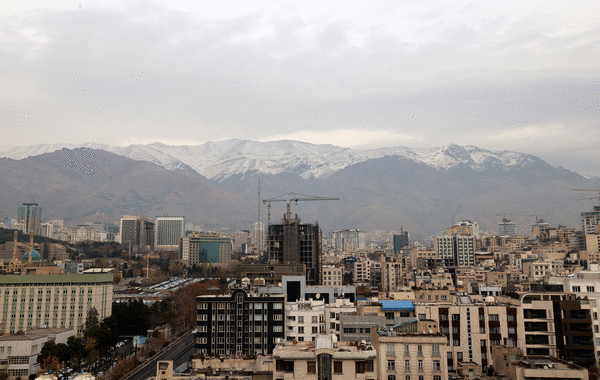
That's looking like a risk factor in an increasing number of locations. Cape Town and Chennai in recent years endured punishing droughts that left them on the brink of crisis. Similar conditions afflicted the upwardly-mobile Indian cities of Bengaluru and Hyderabad last year. Now Tehran (biggest of all, with about 15 million people) is facing the same emergency.
Residents of Iran’s capital are having their taps turned off for hours at a time to ration usage, amid a five-year drought and rainfall that’s been running at 96% below average levels. The city may have to be evacuated altogether if a current dry spell doesn’t break soon, President Masoud Pezeshkian said last month. That underlines a grim fact of modern life: Even relatively affluent and sophisticated cities might be just a few dry years away from “day zero” — the point where life-giving water supplies run out.
Tehran’s desperate situation has its origins in the same mania for food and energy security that’s causing many nations to raise trade and regulatory barriers to clean power right now. A commitment to food self-sufficiency following the 1979 Iranian revolution — spurning imports of nutritional energy in favor of home-grown wheat and rice — has drained aquifers and reservoirs to feed thirsty crops. More than 90% of water goes to agriculture, leaving precious little left over for the needs of urbanites.
That might be excusable given the widespread sanctions that have crippled Iran’s economy for decades, but it’s been accompanied by wasteful usage, too. Per-capita water resources are greater than in Germany, India or South Korea, so should be sufficient to supply most of Iran’s needs, if they were well managed. That’s not what’s happened. Flood irrigation, an ancient practice that wastes immense amounts of H2O through evaporation when compared to drip irrigation that uses pipes, is still the predominant method of watering fields.
Tariffs and subsidies mean trade with more productive countries is fragile. China and India are the biggest producers of grain, and also major participants in the barter-style oil trade that gets around international sanctions on Tehran. China, however, barely exports food to Iran, while India’s basmati farmers have to contend with occasional import bans imposed whenever the Iranian government wants to prop up its local growers.
Comments from energy minister Abbas Aliabadi earlier this month supporting the import of “virtual water” — thirsty crops that should be produced in countries with more abundant rainfall — are a rare official admission that the drive to self-sufficiency is failing, and more food is going to need to come in from overseas.
This crisis is a sign of a planet whose cycles are increasingly slipping out of balance. While a shortage of water is crippling Iran, on the other side of the Indian Ocean an excess from monsoonal rains has caused $20 billion of flood damages from Sri Lanka to Vietnam. Both situations would have been unlikely without the effects of climate change. Whereas Iran can now expect a drought like that of 2025 every 10 years, in a pre-warming world it would have happened as rarely as once a century. As the world’s sixth-biggest emitter and one of the largest exporters of oil, it bears much of the responsibility for the warming now making Tehran unlivable.
It’s not alone. Many of the countries hit by the recent Asian floods could find their current conditions flipping to Tehran-style droughts in future. In a 2020 study of 12 megacities in developing countries at risk of water shortages, the city ranks relatively low. To meet a basic standard of health and hygiene, Lagos, Jakarta, Mumbai, and Kolkata all need at least 50% more water per person than their systems are capable of supplying. Tehran’s deficit is a relatively modest 29%.
Evacuation isn’t the solution. Like pollution-choked Delhi and the sinking metropolis of Jakarta, Tehran has reached a scale where it will become impossible to move it to another location, regardless of the wishes of businesses or government officials.
Better options are available. Reduce the barriers to food imports, to lessen the strain on local fields. Use Iran’s vast reserves of oil and gas to churn out hoses and pipes, to ensure the water it does have isn’t lost to evaporation. Most of all, use that barter trade with China to switch to renewable energy. Iran’s future will only be truly secure when it starts cutting its own carbon footprint.
____
This column reflects the personal views of the author and does not necessarily reflect the opinion of the editorial board or Bloomberg LP and its owners.
David Fickling is a Bloomberg Opinion columnist covering climate change and energy. Previously, he worked for Bloomberg News, the Wall Street Journal and the Financial Times.
©2025 Bloomberg L.P. Visit bloomberg.com/opinion. Distributed by Tribune Content Agency, LLC.



















































Comments