Commentary: What Democrats can learn from the British left under Margaret Thatcher
Published in Op Eds
U.S. politics this coming year will be defined by the midterm elections, and if current trends continue, Democrats could take back Congress.
According to recent Marist polling, Democrats lead by 14 points on the national ballot question, while President Donald Trump’s approval rating is at a new low of 36%.
The question is whether, and how, Democrats can keep the momentum going to turn out voters.
There are lessons to be learned from November’s elections. That both progressives and moderates swept to victory might suggest that the way to go for Democrats in 2026 is to build a bigger tent to successfully navigate the choppy waters of a polarized electorate. But the real lesson of 2025 is that voters want a compelling alternative to the kind of politics that have made a safe, dignified and joyful life increasingly impossible for many people across the country.
Just think of New York City Mayor-elect Zohran Mamdani’s campaign, which was a master class in uncompromising and unapologetic concern for all people that emphasized people’s real concerns about affordability. Or consider Virginia Gov.-elect Abigail Spanberger’s emphasis on her competence and ability to address the high cost of living, rather than running on a platform of opposition to Trump.
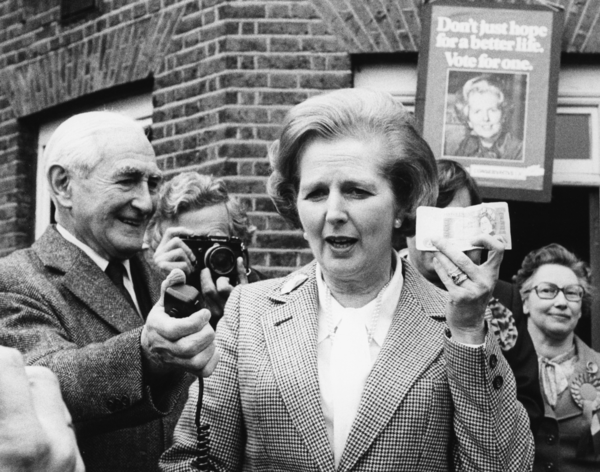
This is not a new approach. In an influential 1979 article, the British cultural theorist Stuart Hall offered a diagnosis of the rise of the British new right and Labour’s inability to mount a defense. His analysis holds important insights for the current political moment in the United States.
In the midst of economic crisis, Margaret Thatcher was able to generate popular support for economic policies that hurt most ordinary Brits. Hall examined why British social democrats failed to stop what he aptly called “the great moving right show.”
According to Hall, Thatcher’s genius was to amplify people’s fears of economic loss and downward social mobility and recast them as a natural response to an assault on the British way of life. This way of life, ostensibly supported by the silent majority of ordinary British people, was built on individual responsibility, fairness and merit. It was threatened, or so Thatcher claimed, by irresponsible and unmeritorious immigrants, welfare scroungers and labor unionists who exploited the social safety net and dragged the country into economic crisis.
Sound familiar?
This narrative allowed Thatcher to build popular consent for economic austerity measures that purportedly punished welfare queens and lazy do-nothings but actually hurt the very Brits in whose interest Thatcher claimed to act.
Many on the British left took Thatcher’s electoral success as a sign of people’s confusion about which party really represented their interests. So social democrats saw it as their job to point out voters’ mistake and make them understand that their interests aligned them with the Labour Party. Yet instead of building a platform around those interests to give voters a compelling alternative to Thatcherism, Labour offered more of the same: New Labour championed the very neoliberal reforms that were Thatcherism’s signature project.
Voters’ desire for a response to their fears combined with their resentment of the condescension of social democratic elites and a sense of being heard by Thatcher’s appeal to the common sense of ordinary Brits. So, when Labour opted to respond to Thatcherism by meeting it on its own turf, voters asked to choose between two neoliberal reform projects preferred to talk to the organ grinder rather than the monkey.
Today’s Democratic Party would be wise to learn from Labour’s mistakes. If they hope to take back Congress in 2026, they should take seriously Americans’ fears of economic loss and remind them who is responsible: Republicans shut down the government, Republicans refuse to fund health care and Republicans are denying Supplemental Nutrition Assistance Program benefits to hungry Americans. Democrats should also point out that groceries have become more expensive under Trump, inflation has risen on his watch, the labor market is at its weakest since the Great Recession in 2009 and Trump’s tariffs are leading to higher prices for everything from coffee to furniture.
More importantly, Democrats have to engage voters in articulating a shared vision for the country’s future. Not being Trump will not cut it.
Scholars in my field of political theory have long argued that what matters in politics is that people feel heard, are inspired to participate in collective decision-making about their lives and are provided with the infrastructure — from free buses to affordable housing and groceries and free child care — that allows them to do so. Even though Hall wrote in, and about, 1970s Britain, his analysis has not lost any of its perspicacity or relevance.
U.S. Democrats are caught in the same moving right show as British social democrats were in the 1970s. Over the last decade, the Democratic Party’s response to Trumpism has been to declare itself the last hope against authoritarianism, while at the same time accepting Trumpism’s central premises — on immigration, welfare, health care and education, to name just a few. But playing the political game on your opponent’s terms is a surefire way to lose — especially if your opponent isn’t playing in good faith.
For Democrats clamoring to take back Congress in 2026, victory will neither be found in the center nor in a bigger tent, but in a way of doing politics that engages voters in a project of collective world-building.
____
Verena Erlenbusch-Anderson is an associate professor of philosophy and political science at the University of Illinois Urbana-Champaign and a public voices fellow with The OpEd Project.
___
©2025 Chicago Tribune. Visit at chicagotribune.com. Distributed by Tribune Content Agency, LLC.




















































Comments