Commentary: The fight to sustain PEPFAR
Published in Op Eds
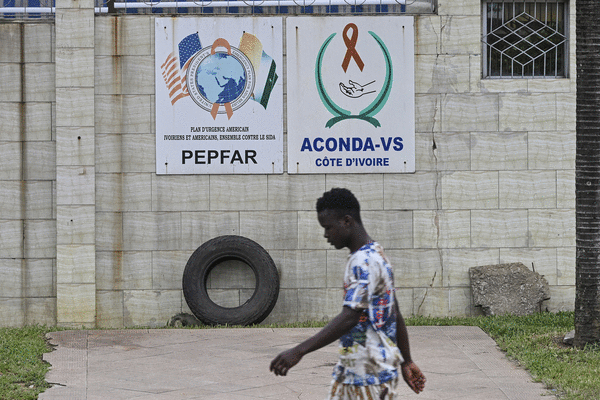
Every year on Dec. 1, World AIDS Day isn't just a time to look back, but it’s a call to action.
This year, that call echoes louder than ever. Even as medicine advances and treatments improve, support from political leaders remains shaky. When the Trump administration threatened to roll back the President's Emergency Plan for AIDS Relief (PEPFAR), it became clear just how vulnerable such critical programs can be.
The effort to weaken or even dismantle PEPFAR wasn't just a policy debate; it lifted the curtain on how fragile moral commitments are. Revealing how easily leaders can forget the human stakes when political winds shift.
Despite these challenges, PEPFAR endures. It remains among the world's most effective global health efforts. For over 20 years, it has received bipartisan backing, saved more than 25 million lives, and strengthened public health systems across dozens of countries, notably in Africa and the Caribbean.
Its ongoing existence stands as a testament to what is possible when compassion and strategic investment align. Yet the program's continued effectiveness is anything but guaranteed. As attempts to chip away at its foundation recur, PEPFAR's future depends on unflagging advocacy and renewed resolve to keep it robust and responsive.
The threat to PEPFAR revealed something deeper: as HIV became easier to treat and faded from daily headlines in wealthier countries, our collective sense of urgency weakened. Political attacks on such programs expose an even broader societal amnesia—a willingness to let remarkable progress slip away through neglect or partisan infighting.
But for millions, especially Black communities, queer and Indigenous people, and those without reliable access to healthcare—the AIDS epidemic endures, ever-present and often invisible to the privileged. World AIDS Day, especially now, is about more than recommitting to aid spending: It's a test of whether America can recover the moral memory that first sparked global action and avoid letting history repeat itself through complacency or carelessness.
Today's medical reality would have seemed miraculous a generation ago: antiretroviral drugs make HIV manageable, while preventative medications and rapid testing have transformed both outcomes and expectations. But science hasn't reached everyone, nor has it erased the longstanding inequities the epidemic exposed. Disparities persist here in the United States. Black Americans comprise roughly 13 percent of the population, but nearly 42% of new HIV cases, while the South continues to suffer the highest rates due to poverty and lack of access to care. The most significant risk now isn't ignorance: it's losing focus, letting attention drift, and leaving the most vulnerable behind.
Moments of instability when PEPFAR faces budget cuts or operational threats cause immediate harm: clinics strain under funding losses, prevention efforts stall, and access to medication wavers. Though PEPFAR still stands, its position is less secure than it appears. Each debate about its future puts lives in the balance and makes it harder to rebuild relationships and infrastructures lost to even brief lapses.
So the current landscape brings into sharper focus not just the challenges of policy, but the underlying drift of our public conscience. Attacks on PEPFAR aren't grounded in evidence of its failure, but in politics, ideology, or skepticism toward global engagement itself.
Yet HIV's stubborn presence is a mirror held up to global values. Diseases ignore borders, and so must our compassion. When wealthier nations let programs like PEPFAR atrophy, they accept a world in which birthplace determines fate—abandoning the vision of global solidarity that programs like PEPFAR once embodied. Eroding that foundation risks not just progress, but also hope and trust.
On World AIDS Day, we ought to imagine what comes next. In many faith communities, Advent brings an obligation to carry memory into present action—not just to recall the past, but to act with a sense of duty shaped by difficult lessons. Strengthening PEPFAR and securing its future depends on that same ethic. This neighborliness pushes us to recognize that the well-being of a mother in Tanzania and a young man in Alabama is interconnected. The ongoing fight against stigma remains critical. Even as language has softened, prejudice persists, making care harder to seek and receive, faith organizations and advocates must continue their work to stamp out shame—putting human dignity and compassion first.
Revitalizing public concern will take more than statistics. Amplifying the stories and experiences of people living with HIV, supporting bold education campaigns, and building real coalitions matter more than ever. HIV has not disappeared; it remains preventable and disproportionately targets the marginalized.
Commemorating World AIDS Day is, at its heart, a refusal to forget. It honors not just those lost, but those who survived, resisted, and built communities of support. Accurate remembrance is only the beginning; absolute honor resides in protecting the living and keeping life-saving programs like PEPFAR beyond the reach of short-term political games.
The ongoing struggle against HIV and AIDS tests both domestic priorities and global leadership. Will the U.S. step up as a trusted partner and healer, or keep retreating behind suspicion and isolation? Keeping PEPFAR strong is only the first step. The deeper challenge is to rekindle the public conscience to approach suffering as a call to action, not a distant trouble.
Managing HIV and AIDS with the tools of medicine alone isn't enough. World AIDS Day demands memory and action. It takes courage to insist that the vulnerable are never left to fend for themselves. And it takes imagination to envision an end to the epidemic hand in hand with a broader struggle for dignity, justice, and solidarity.
____
Rev. Dr. F. Willis Johnson is a spiritual entrepreneur, author, scholar-practioner whose leadership and strategies around social and racial justice issues are nationally recognized and applied.
_____
©2025 The Fulcrum. Visit at thefulcrum.us. Distributed by Tribune Content Agency, LLC.















































Comments