Martin Schram: Ka-ching! The sound of policy being made
Published in Op Eds
The priorities that drive the making of President Donald Trump’s urgent, yet sometimes helter-skelter, international security initiatives – from the Ukraine war to the Middle East – can best be understood by viewing them through the eyes and insights of his secretary of state.
After all, Marco Rubio’s years on the Senate’s Foreign Relations and Intelligence Committees gave him far more experience with global crises than Trump’s family and business associates have, even though Trump tasked them with forging his recent peace initiatives.
Recently, for instance, Rubio was able to provide U.S. senators with vital insight into what was really going on – or wasn’t going on (so don’t worry) – in the latest Ukraine war peace plan.
Also recently, Rubio also was in a perfect position to provide us with a crucial insight into what he once voiced quite passionately about a Middle East controversy. But he chose to keep his thoughts to himself. That’s OK, today we’ll share his original thinking with you – even if he didn’t.
But first, let’s recall what really happened just weeks ago, when Team Trump released that original 28-point Ukraine peace plan that was all the rage. It had ignited a world of criticism because it said Ukraine must give Russia major land and other concessions. (It was the product of talks between the Russians and Trump’s businessman special envoy Steve Witkoff, Trump’s son-in-law Jared Kushner, and a diplomatic newcomer, Army Secretary Daniel Driscoll.)
On Saturday, November 22, Rubio telephoned Republican and Democratic senators attending the Halifax International Security Forum in Nova Scotia. According to Sen. Mike Rounds, R-S.D., Rubio assured them it was actually just a Russian wish list and the U.S. and Ukraine would be able to make changes later. But what Rubio seemed not to know was that, while he was assuring his former Senate colleagues it was just a Vladimir Putin wish list, Trump and his spinners were assuring us it was very much an American document – and Ukrainian President Volodymyr Zelenskyy better accept it. “He’ll have to like it,” Trump said. “And if he doesn’t like it, then they should just keep fighting, I guess.”
A diplomatic oops. But Rubio got more actively involved; Zelenskyy made key changes. And Team Trump’s diplomatic optimism seemed perhaps plausible. So Witkoff and Kushner met with Putin in Moscow this week. Five hours later, Putin had rejected their latest compromise.
And so it goes. Our news media has become adept at spotlighting world leaders confronting global horrors. But we often fail to keep shining our lights on all that we know about the deeds and motives of the powerful. And that allows some of the powerful to operate in the shadows – and keep us in the dark.
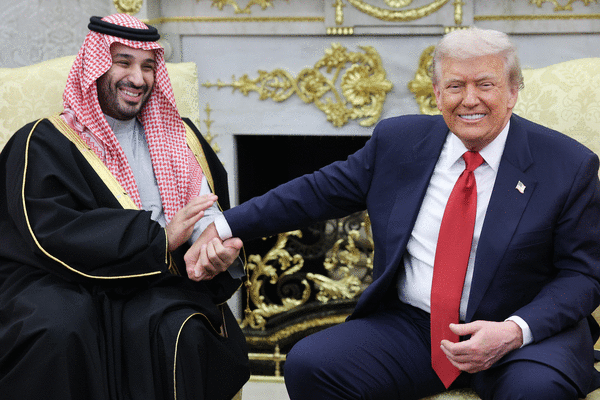
Consider what we knew and about the various motives that were at work in that bizarre November 18 meeting when Saudi Arabia’s king-to-be, Crown Prince Mohammed bin Salman (shorthanded as “MBS”), sat next to America’s most king-like president in his now gold-festooned Oval Office.
Trump began by gushing about how wonderful MBS was. Then they both enriched us all by regaling us with big numbers – all the Saudi petro dollars MBS would be spending on Trump’s America (unsaid but obvious: to buy their way back into respectability after that bone saw murder). Trump bragged that the Saudis would invest $600 billion in America. A minute later, MBS upped that to “almost $1 trillion of investment.”
Meanwhile, just two seats away, sat another famous fellow who could have enlightened us by sharing anew all that he really thought about just how loudly that Saudi money seems to be talking today. Especially considering how outspoken he’d been on the subject right after the bone saw murder.
“There's not enough money in the world to buy back our credibility on human rights if we do not move forward and take swift action” concerning the Khashoggi crime, then-Sen. Marco Rubio, R-Fla., declared on CBS in 2018. He pressed the theme at his other media stops. In 2018, Rubio told CNN: “Just because a country we’re working with did it doesn’t mean the U.S. can just shrug its shoulders and say nothing happened here.”
In the Oval Office a reporter asked Trump about the murder. The president didn’t say nothing happened; rather he said: “Things happen.” And he defended MBS: “He knew nothing about it and we can leave it at that.” His secretary of state silently left it at that.
And of course, hanging over that meeting was the other way Saudi money talks these days. The Saudi monarchy has been enriching The Trump Organization, Inc. (the president’s family business) with billions of dollars of business deals. They began in Trump’s first term; they’re working new deals now. One is a massive development project in Diriyah, just outside the Saudi capital of Riyadh. The crown prince is chairman of the board. Other projects include a Trump tower and Trump plaza in Jeddah. Kushner’s investment fund received $2 billion from the Saudi sovereign wealth fund.
The sound of policy being made should never be confused with the making of sound policy. After all, we remember when Trump loved to attack former President Joe Biden by attacking his son, Hunter, for seeking consulting deals with a Ukrainian oil company and another in China, when his dad was vice president. Trump began calling our 46 th president “Crooked Joe.” His sons might call Hunter’s deals chump change.
Perhaps Trump will explain to us someday what he sees as the difference between what Hunter did back then and what Don Jr., Eric and Jared are doing today. Maybe Trump will even invent a nickname that he thinks now befits America’s 45 th and 47 th president.
_____
_____
©2025 Tribune Content Agency, LLC.






Comments