David M. Drucker: It's getting harder for governors to run for president
Published in Op Eds
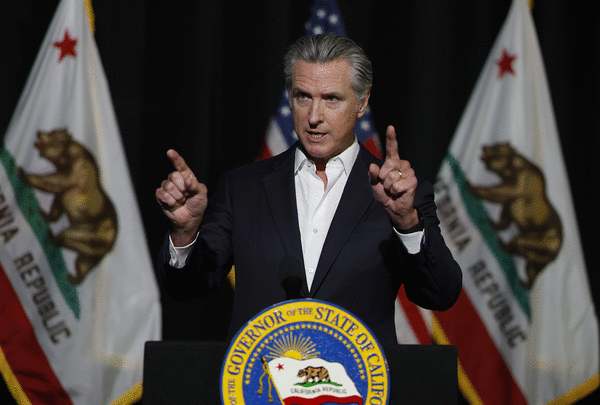
There’s a reason George W. Bush was the last governor to win the White House: In the 25-plus years since, governors have proven incapable of weathering the intense public scrutiny and navigating the media barrage of gotcha questions that accompany running for president.
There are reasons for that.
As local television news divisions have shrunk and as local and regional newspapers have done the same — or ceased operations entirely — the press corps devoted to covering governors (and state legislatures) in America’s 50 capital cities has followed suit.
Governors might enjoy the freedom to maneuver, politically and legislatively, without the biblical flood of questions from reporters. But it’s cost them valuable experience dealing with pressure from an often-hostile media that picks apart every nook and cranny of a candidate’s personal life, political service and private-sector career while posing sometimes inane questions that are nonetheless damaging if not parried properly. Remember Scott Walker, then Wisconsin’s governor and a candidate seeking the 2016 Republican presidential nomination, fumbling the ball when asked if he believed President Barack Obama was a Christian?
Contrast the cloistered existence of most governors with that of an average US senator.
Senators are accosted daily by a robust Capitol Hill press corps (which once included me and occasionally still does). Reporters covering the Senate and the House of Representatives pepper members of Congress with questions about national issues, local issues, cultural issues, domestic and foreign policy issues. We barrage them with questions about politically charged, newsworthy topics they tend to categorize as “gotcha.” Sometimes they’re right. We scrutinize their personal financial disclosures; their campaign finance reports; their private lives and business dealings.
No wonder senators are more prepared to run for president and have been more successful doing so since the turn of the century.
“Senators spend their time marinating in the DC media environment which deploys every four years to cover presidential candidates. So, they have the muscle memory for whatever the political media zeitgeist is at any given moment,” David Kochel, a Republican operative from Iowa who has advised multiple GOP presidential campaigns, told me.
From 1976 to 2000, voters chose current or former governors for president: Georgia’s Jimmy Carter was followed by California’s Ronald Reagan in 1980. Arkansas’s Bill Clinton, elected in 1992, was followed by Texas’s Bush. The only exception during that period was then-Vice President George H.W. Bush’s victory over then-Massachusetts Governor Michael Dukakis in 1988. Since 2000, governors have mostly struck out, save for Mitt Romney. The former Massachusetts governor received the GOP presidential nod in 2012, then lost.
Otherwise, senators have been the most competitive candidates.
That includes John Kerry of Massachusetts, the Democratic nominee in 2004; Obama, who won the Democratic nomination in 2008 while in his first term as an Illinois senator; and 2016 nominee Hillary Clinton, a former senator from New York. In 2020, the Democratic nominee was former Vice President Joe Biden, who had spent decades in the Senate representing Delaware. Yes, President Donald Trump broke the mold. But he was a creature of the national media and adept at handling the press — political or otherwise.
And by the way: The runners-up for the GOP nomination in 2016 and the Democratic nomination in 2020 were Texas Senator Ted Cruz and Vermont Senator Bernie Sanders, respectively. Meanwhile, in 2024, the one-time frontrunner for the Republican nomination, Florida Governor Ron DeSantis, folded his campaign after finishing a distant second to Trump in the Iowa caucus.
But some political observers I’ve talked to about this phenomenon believe the pendulum could swing back toward the governors in 2028, at least on the left side of the aisle. That’s in part because the Democrats could field a collection of nationally prominent governors, at least some of whom are savvy social media warriors, compensating for any inexperience with an unforgiving national media ecosystem — broadcast and cable television; digital and print publications; podcasters and radio talk show hosts; and keyboard jockeys on X and BlueSky, TikTok and other social media platforms.
“I suspect strongly that from a communications standpoint, the successful candidates in 2028 will be the ones who can harness non-traditional media best,” said Brian Rosenwald, a scholar in residence at the Partnership for Effective Public Administration and Leadership Ethics at the University of Pennsylvania.
“If the biggest swing constituencies these days are less tuned-in, low-propensity voters, then the key becomes how do you reach them? And to me, that’s not jousting with the national press or doing interviews with reporters, because those people don’t consume political news,” Rosenwald added. “The game has changed.”
The other counter to my theory of governors’ White House curse is that Democrats, at least, are on the cusp of seeing three charismatic and combat-ready chief executives run for president in the next election. They are governors who have tasted the national media spotlight by getting into public spats with Trump and have positioned themselves as foils to the term-limited president’s agenda. They are California Governor Gavin Newsom; Illinois Governor JB Pritzker; and Pennsylvania Governor Josh Shapiro.
Michael Kryzanek, professor emeritus of political science at Bridgewater State University in Bridgewater, Massachusetts, pointed to Newsom and Pritzker in particular.
“These are individuals that know how to respond in a way that is effective in today’s environment. They’re willing to go after the president of the United States and they have a capability to express themselves in a way that the American people are looking for, in terms of the Democratic Party,” Kryzanek told me. “We can’t ignore the role that a governor can play.”
Newsom in particular intrigues some White House watchers because he’s quick on his feet, relishes sparring with just about anybody and wields social media a lot like Trump; in other words, effectively. That the Sacramento press corps, of which I was once a member, has diminished considerably since the aughts is not a compelling reason to count out Newsom, according to many who view the governor as a 2028 frontrunner, if not the frontrunner.
Maybe so.
But still unknown is what happens when eight years of Newsom’s leadership in California are inevitably dissected under a far more powerful microscope. He has an uneven record on crime, education, homelessness, management of state tax dollars and that nettlesome issue of affordability. Newsom might be able to absorb the pressure. He might even thrive in it. The question is whether voters will like what they see once his record is exposed.
____
This column reflects the personal views of the author and does not necessarily reflect the opinion of the editorial board or Bloomberg LP and its owners.
David M. Drucker is a columnist covering politics and policy. He is also a senior writer for The Dispatch and the author of "In Trump's Shadow: The Battle for 2024 and the Future of the GOP."
©2025 Bloomberg L.P. Visit bloomberg.com/opinion. Distributed by Tribune Content Agency, LLC.






























Comments