Review: Suda’s new hero doesn’t quite hit mark in ‘Romeo Is a Dead Man’
Published in Science & Technology News


You can’t talk about Goichi Suda without mentioning Travis Touchdown, the protagonist of the “No More Heroes” series. The bombastic otaku has always been “the representative character of Grasshopper Manufacture, like a mascot in a way,” according to the video game developer.
But after nearly 20 years of working on Travis stories, Suda wanted a new project. In a conversation through an interpreter, he said he wanted to develop a new character, one that could possibly overtake Travis. That’s how he settled on Romeo Stargazer from “Romeo Is a Dead Man,” a new work and his foray into science fiction.
ADAPTING A GRAND VISION
It’s a game that started as an ambitious project. “The original plan was to have this game mostly take place in this town of Deadford, but through a handful of different time periods,” he said. “We got to a certain point in development where we were like, ‘OK, wait a second, if we continue on like this, and we make this game we originally set out to make, we’re going to be like several tens of millions of yen overbudget.”
To actually finish the game with the resources they had, the team had to reshape the project. That effort takes players through eight chapters, as players step into the shoes of Romeo, a deputy in the town of Deadford. He falls in love with an amnesiac named Juliet, but unfortunately, he dies while investigating a peculiar incident, but his genius interdimensional grandfather, Benjamin, resurrects him. Their whole relationship echoes Rick and Morty. Although Romeo is alive, he has changed and is outfitted with cybernetics.
He joins the FBI space-time countermeasures division and lives aboard a ship called the Last Night. Their job is to apprehend or defeat criminals who mess with the fabric of the universe, and that nearly always sends them to Deadford at different points in its history. Romeo’s goal is to find the Juliet from his dimension, a mysterious character who is more than she seems.
SOME OF GRASSHOPPER’S BEST IDEAS
“Romeo Is a Dead Man” carries over distinct hallmarks of Suda’s style, including retro-inspired flourishes and mixed media storytelling. It’s also incredibly strange, like all of his works, as players dig through several layers of conspiracies.
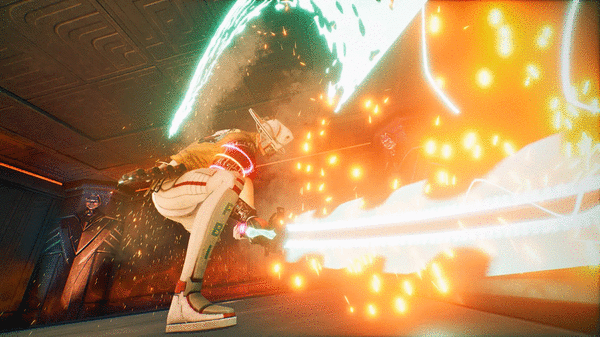
What’s clear, though, is that the gameplay is an amalgam of the best ideas from Grasshopper’s past, along with new touches. The combat’s foundation echoes the action-forward hack-and-slash style of Suda’s other works. As Romeo, players come armed with up to eight weapons that players will use to defeat swarms of enemies in each dimensional rift.
Players can acquire four melee weapons — a katana, a spear, knuckles and a heavy sword — and four firearms — a pistol, a machine gun, a shotgun and a rocket launcher. They can all be upgraded, but in the campaign, ranged weapons are more useful because of their distinct functionality, which targets specific enemies’ weaknesses. The blades are fine, but players will gravitate toward one style and power it up for the rest of the campaign.
ADDING DEPTH
The more notable twist in combat is that players have Pokémon-like allies called Batards that they can summon in battle. They have a limited-time effect but can provide valuable firepower, healing or other benefits. Players find these Bastards as seeds, grow them and harvest the creatures about the ship. They can also fuse them together to gain more powerful ones. Unfortunately, it’s an onerous process that can take a while as players sit through harvesting animations and plan out the best combinations.
While in combat, Romeo also has food items that offer stat boosts, but he has a way to permanently upgrade his health and other traits through a convoluted minigame called DeadGear CannonBall. Players use Emerald Flowsions to play the diversion to make him more powerful.
LEVEL DESIGN AND STORY PROBLEMS
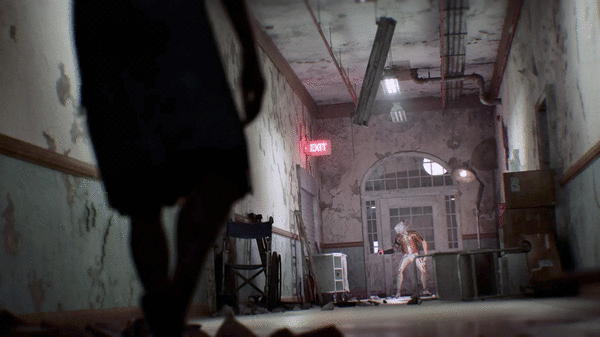
That’s a solid base, but the level design and narrative is where “Romeo Is a Dead Man” falters. The campaign has some great stages such as Chapter 5: Atonement, in which Romeo explores an asylum. It has horror elements, stealth situations and a comprehensible story. Meanwhile, others can be frustrating as players navigate the subspace and figure out how these labyrinthine and abstract areas connect to the real interdimensional worlds. It can lead players to wander, back track and puzzle over how to navigate the strange realm.
The pattern with subspaces is that the more of them players encounter, the more complex the stage is. That tends to happen more at the end of the narrative. “Romeo Is a Dead Man’s” best levels have a good balance of these confusing spaces and the real-world counterparts.
The other issue is that the premise of the campaign is simple, but it devolves and grows stranger toward the end. It gets so weird that players may lose the plot. That’s a symptom of Suda and his team condensing their grand vision into a smaller experience. The saving grace for the title is the fantastic music, which is worth listening to on its own.
As of now, Romeo isn’t quite the hero that Travis Touchdown is. The FBI agent will need more personality and better adventures before he can measure up to Suda’s best hero.
Romeo Is a Dead Man
Two stars
Platform PlayStation 5, Xbox Series X and Series S and PC
Rating: Mature
©2026 MediaNews Group, Inc. Visit at mercurynews.com. Distributed by Tribune Content Agency, LLC.






Comments