'Dry to the bone': Drought squeezes Everglades airboat operators
Published in Science & Technology News
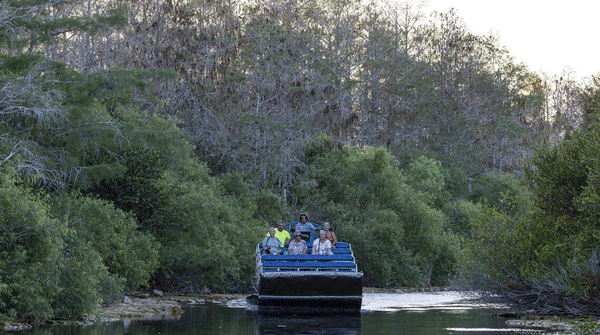
MIAMI — Instead of whizzing through the open marsh of the Everglades like he usually does, Tristan Tigertail steers his airboat alongside the man-made canal along Tamiami Trail.
On one side, cars speed past on the two-lane road that bisects the southern part of the state. A telecommunications tower looms above the landscape. On the other, shrubs, marsh grasses and tree islands stretch out toward the vast field.
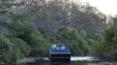
Tigertail, 36, who captains airboat tours through the Everglades, is navigating his boat through the only route available given how dry the park has gotten this year. This is the driest he’s seen the Everglades in a decade and the first time since the family business opened about 30 years ago that this canal is the only viable route.
But if he doesn’t take his boat down the canal, Tigertail Airboat Tours would be forced to shut down like some of the other airboat operators that line the road. The Herald spoke with half a dozen operators. Many had to stop tours temporarily because of the drought or reroute their tours to the canal, though a few operators on the southern side of Tamiami Trail said that their area still has enough water to reach the greater Everglades.
“We might not have reprieve until we have rain which could come in May or could come in September,” Tigertail said. “This is an abnormal drought.”
Airboat trails that once looked like shallow rivers now resemble beaten-down walking paths. The tall sawgrass has an ombre of brown and gold at its tips. Limestone juts out of the ground with water pooled in its small crevices, making it too dangerous to even attempt to navigate an airboat there.
With the last pools of water drying up, gar, killifish and mosquito fish that manage to cross scattered puddles have been pushed to the edges of the swamp, where they congregate. Anhingas dive into the water like seals to feed on them.
An animal rehabilitation center on a tree island that Tigertail would normally bring tourists to is unreachable by airboat now. Before it got too dry, he said they had to bring all the gators and turtles housed there back to the main reservation site.
There are still plenty of wildlife sightings from the canal, gators sprawled out across the limestone and countless eyes peeking out of the tea-colored water. Tigertail said he’s been seeing more wildlife in the canal as the drought worsens. In a man-made basin carved out along the canal, small minnows darting in the water look like raindrops as juvenile gators, less than a year old, snap them up.
Robin Sinclair, a visiting snowbird from Canada, said the tour was great but “a shame you can’t go in and really see its beauty.”
Tours can only run in the evenings because the Miccosukee use the canal for other operations during the day. The channel is narrow, forcing drivers to coordinate with other boats and dodge bumping limestone when the boat stops.
Curtis Osceola, the chief operations officer of the Miccosukee Tribe, said they were taking the opportunity during the dry down to rehabilitate the tree islands that were historically drowning during the wet season, to hopefully get mammals like deer and bear to come back.
“This is very, very dry relative to what we normally see,” Osceola said.
Shades of brown
The extreme drought conditions didn’t happen overnight. It’s the result of more than a year of drier-than-average conditions, and climate change is expected to make droughts like this even more extreme.
This year water levels in Everglades National Park are more than six inches lower than last year and over a foot lower than the year before that, the Everglades Foundation reported. Meteorologists are calling it the driest drought Florida has seen in 25 years.
The few scattered storms are a welcome help, but won’t make the difference needed — experts say it would take at least a foot of rain in the next month for things to begin improving.
Steve Davis, chief scientist at the Everglades Foundation, took a Miami Herald reporter in a small airplane over the wetlands last week.
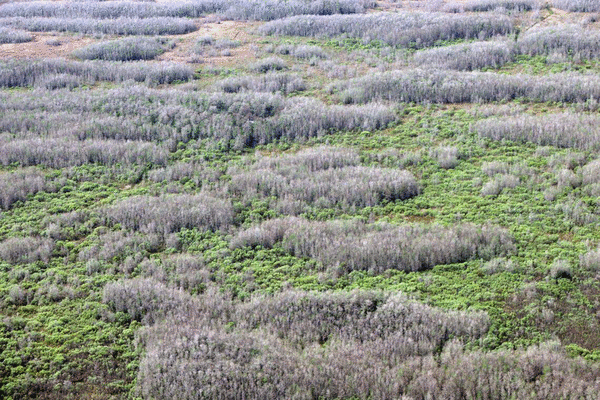
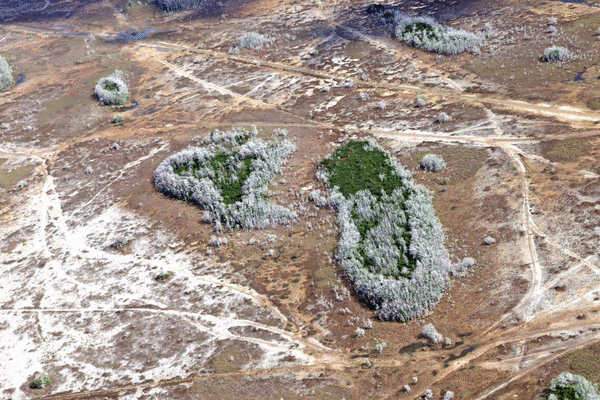
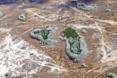
Much of the landscape was shades of brown. The deepest marshes were barely visible from 10,000 feet.
“Wow, this is just dry to the bone out here,” Davis said. “Even during a normal dry year, you don’t see these conditions until April.”
But just beyond the marsh, just south Lake Okeechobee where the Everglades meets the neatly lined fields of the agricultural zone, which is mostly sugar farms, the landscape got greener.
Water distribution tracked by the South Florida Water Management District and the Army Corps of Engineers shows that about 30 billion gallons moved through canals serving agricultural areas in February, while only roughly 3.7 billion gallons flowed into Everglades marshes during that time.
Decades ago, water was drained from the Everglades to create farmland and protect coastal cities from flooding. Those canals, levees and roads broke up the natural flow of the water.
Without the wide, slow sheet flow that once carried water south, the wetlands mostly only get whatever water moves past agricultural areas. But during this year’s drought, much of that water is evaporating before reaching the marshes, Davis said.
Because the Everglades’ natural flow has been altered, the cyclical wet seasons and dry seasons can swing to extremes — too much water that can kill tree islands, not enough and bog fires can spark and destroy habitat. Fire is a natural part of the ecosystem and helps cycle nutrients. It becomes a problem in extreme drought because the fires grow too intense.
But sending more water south isn’t as simple as just opening up a gate.
Nearly half a million acres of mostly sugarcane fields make up Everglades Agricultural Area, the biggest agricultural region on the eastern side of the Mississippi. Those farms have long-standing water-use permits that guarantee a set amount of water, even during droughts.
The Everglades have mandated “minimum levels” to prevent “severe” damage to the system. That minimum first considers what’s required to keep the Biscayne Aquifer, which is a source of drinking water for 3 to 4 million people in South Florida, from getting too low and risking saltwater intrusion.
The water allocation giving priority to agriculture frustrates Everglades advocates.
“People in South Florida are subjected to cutbacks in water usage, while the Everglades Agricultural Area, and mainly two industrial sugar cane growers, get near-perfect irrigation,” said Eve Samples, the Executive Director of Friends of the Everglades.
But farmers and landowners argue that their industries bring in billions to Florida’s economy, and during this drought, they are hurting, too.
“The drought only exacerbates my concerns since we just experienced the worst freeze in Florida agriculture’s recent history. As you have likely seen from the Florida Department of Agriculture and Consumer Services report, Florida fruit and vegetable growers and sugarcane growers may experience losses of $3.1 billion,” Ryan Weston, Chief Executive Officer of the Florida Sugar Cane League, wrote in a statement to the Herald.
“American sugarcane farmers in Hawaii and Texas have already gone out of business. We don’t need to lose any of our remaining farmers in the United States,” he said.
Davis, the scientist, pointed out that it didn’t help that water was released from Lake Okeechobee during the wet season to lower its levels, so the lake isn’t as full as usual.
Miami-Dade County is still under voluntary conservation measures from the South Florida Water Management District. A SFWMD spokesperson said that no decisions have been made as far as mandatory water restrictions. But even if implemented, it won’t apply to indoor household use in South Florida.
Replumbing the Everglades
The challenge isn’t only about who gets the water, but how the plumbing system was built.
To restore the ecosystem, experts agree that more water in Lake Okeechobee needs to flow south through Everglades National Park and down into Florida Bay.
That’s why the $4 billion Everglades Agricultural Area Reservoir (EAA) is being built.
The massive project — touted as the “crown jewel” of Everglades restoration — is designed to hold 240,000 acre-feet of water and release it as needed. After the Miami canal is backfilled, it should allow the sheet flow of water to spread out under Alligator Alley all the way down to Tamiami Trail.
That water, polluted with runoff from cattle farms, suburbs and sugar fields, will first be filtered through a series of 6,500 acres of man-made marshes. If everything works as hoped, the marsh plants will soak up the pollution from the water before it continues into the Everglades.
But some environmentalists have cast doubt on the plan as it is. Samples with Friends of the Everglades said the reservoir needs more water storage and water treatment. The environmental group is calling on the state to buy 100,000 more acres of land to turn into marshes to clean the water and build a shallower reservoir.
In the meantime, airboat operators are hoping for more rain, and Osceola is hoping the Everglades "plumbing" issues get resolved.
“I think everyone’s hoping that we have fewer of these man-made problems, and more natural flows and wet seasons and dry seasons,” Osceloa said.
_____
(Ashley Miznazi is a climate change reporter for the Miami Herald funded by the Lynn and Louis Wolfson II Family Foundation and MSC Cruises in partnership with Journalism Funding Partners.)
_____
©2026 Miami Herald. Visit miamiherald.com. Distributed by Tribune Content Agency, LLC.






Comments