What Trump's new tariffs mean for climate tech
Published in Science & Technology News
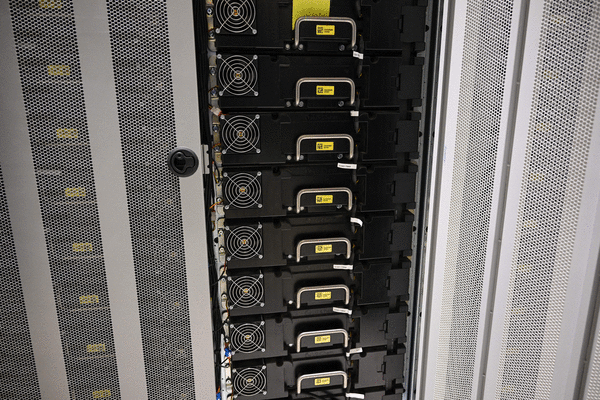
The Supreme Court’s recent decision to strike down President Donald Trump’s global tariffs is shaking up the climate tech trade.
The Feb. 20 ruling is good news for companies like Tesla Inc., which have seen production costs soar since last spring. In the third quarter of 2025 alone, the tariff costs on its energy storage business stood at roughly $200 million, the company said in its October earnings call.
Countries such as China, whose exporters will now face lower trade barriers, will benefit as well. But the relief could be short-lived as the administration threatens to use other policy tools to rebuild its tariff regime. Trump announced plans for a 15% global levy using a different mechanism in the wake of the court’s ruling. It rolled out that effort on Tuesday, setting an initial 10% rate.
These twists and turns are adding to the uncertainty facing clean tech companies. While the exact impact of the policy changes will take time to sort out and the rates could change, here is what we know about what the ruling and Trump’s reworked global tariffs mean for the energy transition.
Battery storage, EVs and wind
Not every green technology will benefit from the Supreme Court decision. Tariffs on wind power equipment and electric vehicles and their components — including batteries — were not affected by the ruling, according to Matthew Hales, a BloombergNEF analyst specializing in trade and supply chains. That means they will remain largely unchanged.
While the high court’s decision lowers tariffs for solar photovoltaic cells and modules, India and Indonesia – two countries that were supposed to benefit most from the change – now face additional levies targeting their solar exports after the U.S. Commerce Department said Tuesday it preliminarily determined that the industry there received unfair subsidies.But the high court’s decision will still benefit American companies seeking batteries for energy storage. The U.S. imported about $10 billion worth of utility-scale lithium-ion batteries in the first seven months of 2025, according to the most recent data available from BNEF. With tariffs for energy storage batteries going down, costs will be lower for U.S. project developers, Hales said.
This comes as the U.S. races to install more giant batteries to help power data centers, store energy from intermittent renewables and avoid blackouts. The country added 13.3 gigawatts of new storage capacity in 2025, up nearly 10% from 2024 levels, according to BNEF.
Under the court ruling, U.S. importers can seek refunds on struck-down tariffs paid over the past year, though that process is likely to be complex and Trump warned of “years of litigation.”
There’s also the looming threat of new levies. In addition to the 15% tariffs Trump announced, his administration is considering new national security tariffs on a half-dozen industries, including large-scale batteries. Energy storage developers in the U.S. also have to grapple with so-called “foreign entity of concern” rules, which prevent them from relying entirely on Chinese products if they wish to qualify for domestic tax credits.
China stands as a winner
In the short term, Chinese exporters are among the winners of the court ruling, Hales said. Even if tariff rates reach 15%, the nation’s battery suppliers will still enjoy lower rates than before. Battery exporters in other countries won’t be so lucky, though. While the 10% rate that took effect on Tuesday will benefit Japanese and South Korean companies, that advantage will be erased if tariffs hit Trump’s full goal of 15%.
But no matter where the imports come from, American battery factories will be “a lot more exposed to competition,” at least for now, Hales said. That adds another challenge for U.S. clean tech companies already under pressure amid Trump’s policy assault and the rollback of government incentives.
©2026 Bloomberg L.P. Visit bloomberg.com. Distributed by Tribune Content Agency, LLC.






Comments