Sleek, lithe and extremely rare: This elusive California fox has finally been GPS-collared
Published in Science & Technology News
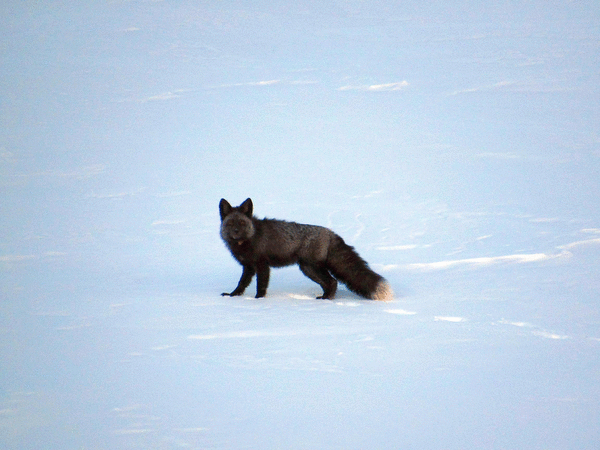
The stunning Sierra Nevada red fox is one of the nation's rarest and most critically threatened mammals with fewer than 50 believed to remain in the Sierra. And now, for the first time, a specimen has been successfully GPS-collared and released back into the region — marking a major victory for conservation efforts to protect the elusive vulpine.
The species' existence in the Sierra Nevada was only confirmed in 2010 when a motion camera north of Yosemite National Park captured a photo of the creature and its trademark white-tipped tail. Researchers previously believed the fox was wiped out from the region in the 1920s.
For the last decade, wildlife biologists have been using remote cameras and scat surveys to track the movements of the fox in the southern Sierra. For the last three years, they have been carrying out intensive trapping efforts.
But the fox has proved stubbornly difficult to capture.
The speedy and delicate species is extremely wary of humans. The few remaining individuals live in barren, rugged terrain at high elevations.
But in January years of hard work finally paid off when biologists from the California Department of Fish and Wildlife captured a fox near Mammoth Lakes and fitted it with a GPS collar. Photos shared by the department show a silvery gray fox bounding majestically across a white snowy plain beneath towering, sunlit alpine peaks.
Julia Lawson, an environmental scientist with the department, said in a statement that her team was thrilled to reach this milestone. "Our goal is to use what we learn from this collared animal to work toward recovering the population in the long term," she said.
The GPS collar will provide researchers with insights into the seasonal movements and daily lives of the Sierra Nevada red fox, which can in turn help guide conservation strategies.
The Sierra Nevada red fox is a distinct lineage from the common red fox known for residing in high-elevation, remote mountainous regions. To survive in these tough conditions, the species has developed an unusually thick winter coat and extra furry feet that can provide snowshoe-like support as they traverse deep snow.
Unfortunately, this beautiful coat, which ranges in color from a reddish tan to a dark granite, also made them attractive prey for trappers. Although scientists don't fully understand the factors that contributed to the species' near-extinction, they believe unregulated hunting in the 20th century played a key role.
In addition to the Sierra population, there are about 20 Sierra Nevada red foxes living in the Cascade mountain range of Northern California. These lithe creatures also have been observed in alpine areas of Oregon, but no population estimate is available there.
In winter 2018, Fish and Wildlife researchers successfully attached GPS collars to one male and two female foxes in the Lassen Peak area of the Cascade Range.
This allowed biologists to locate several dens and gain a better understanding of the foxes' reproductive patterns. Researchers also learned that these 7- to 10-pound creatures, which are not much larger than a house cat, are impressively agile and travel about seven miles a day in extremely rugged territory.
Because the foxes in the Sierra Nevada are isolated from their relatives living in the Lassen Peak area, the collaring of this fox offers scientists a rare opportunity to better understand the ecology and conservation needs of this remote group. The Sierra Nevada population is considered an endangered species under the federal Endangered Species Act.
©2026 Los Angeles Times. Visit at latimes.com. Distributed by Tribune Content Agency, LLC.






Comments