Illinois Rewilding Law, first in US, a step toward state wetland protection
Published in Science & Technology News
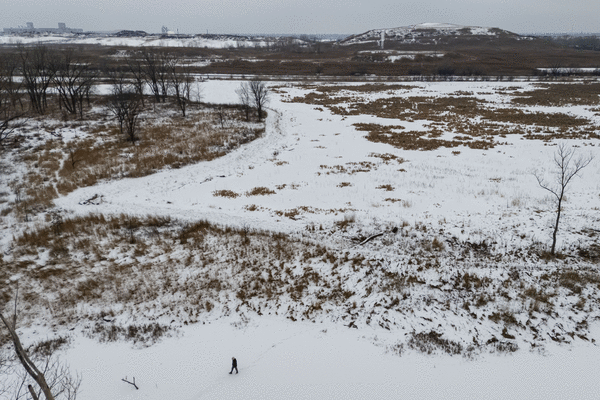
CHICAGO — As sweeping changes to the federal Clean Water Act in recent years have weakened protections for wetlands, Illinois has become the first state in the nation to officially recognize a conservation tactic known as rewilding.
The Illinois Rewilding Law, which took effect last month, empowers the Illinois Department of Natural Resources to pursue projects that restore land to its natural state, said Illinois Rep. Anna Moeller, an Elgin Democrat and primary sponsor of the bill.
The law could encompass the reintroduction of keystone species that improve ecosystems, like beavers and bison. But officials and environmentalists say closing the federal gaps in wetland protection is their focus right now. Largely symbolic, the Rewilding Law is the first step toward enacting legislation with permitting powers, they say.
“Wetlands are hugely important for our water quality, for preventing flooding, for helping native species that are endemic to those areas,” Moeller said. “Once we lose them, they’re gone forever.”
In 2023, the U.S. Supreme Court curtailed federal wetland protections in Sackett v. EPA, limiting federal Clean Water Act protections to only wetlands with visible connections to major waterways. The ruling suspended protections for more than 118 million acres nationwide.
The U.S. Environmental Protection Agency went a step further in November with its revised Waters of the United States rule, which narrowed the scope of wetlands shielded from pollution and destruction.
Illinois has 563,000 acres of unprotected wetlands, according to a University of Illinois Urbana-Champaign study released in September. This means over half of all wetlands in the state lack any federal, state or local protections, said Robert Hirschfeld, director of water policy at the Prairie Rivers Network.
Since the EPA’s November rule revision, Hirschfeld estimated the percentage of at-risk wetlands in Illinois has likely increased to at least 67%.
The Rewilding Law, which does not mandate any specific actions, affirms the state’s authority to protect, manage and conserve natural resources and wildlife, said IDNR in a statement to the Tribune. The agency said it has no projects planned under the law and no plans to bring back apex predator populations like wolves at this time.
Now, Moeller and other Illinois legislators are working to pass the Wetlands Protection Act, which would give IDNR authority over wetland permitting on private land before construction begins. Certain agricultural activities would be exempt.
Paul Botts, president and executive director of the Wetland Initiative, said the proposed legislation would be “no-net-loss” as it would require developers who want to remove a wetland to contribute to a mitigation bank to fund restoration work elsewhere.
“This is about acknowledging the great majority of the wetlands that have been lost,” Botts said. “There isn’t enough money in the world to put all that back … But we can restore where it makes sense and where it’s doable and where people are willing to have it done, and we can protect as best we can without putting anybody out of business on the few remaining wetlands that we do have.”
The act would simply restore what Illinois lost, he said.
“The state bill is not going any further than what was suddenly yanked away,” Botts said. “It’s simply bringing it back.”
Why protect wetlands
Wetlands are uniquely climate resilient, helping ecosystems, communities and native species withstand increasingly unpredictable weather, from extreme floods to droughts, Botts said.
“From the perspective of biodiversity, the value of wetlands in the flat Midwest just actually rises in the context of a changing climate,” he said.
Lindsay Keeney, conservation director at the Illinois Environmental Council, explained that restoring native ecosystems helps Illinois weather more extreme and frequent flood events.
“When we see removal of wetlands and native prairies,” Keeney said, “that’s where we see incredible flood damage, stormwater runoff and backup and a lot of damage to homes and human life and major flood events, which we’re seeing more and more of with climate change and more 100-year-flood events happening two, three or even four a year.”
Restoring wetlands is one of the most cost-effective strategies for flood mitigation in both urban and rural communities — far cheaper than building new wastewater treatment facilities or flood-control infrastructure, Keeney said.
Although Illinois has already lost more than 90% of its original wetlands, restoration efforts across the state offer signs of recovery; Botts has made it his mission to restore what he can of Illinois’ native ecosystems.
“The Midwest is all built up,” Botts said. “The easy (wetlands) have all been protected already. We’re about the hard cases, the brownfields, putting wetlands back in the farm belt without buying out farms.”
In the Southeast Side, Botts is working on bringing wetlands back in Chicago’s industrial corridor at Square Marsh and Indian Ridge Marsh, encompassing an area at least twice the size of New York City’s Central Park, said Botts. This massive effort is in partnership with The Nature Conservancy, the Illinois International Port District, Audubon Great Lakes and the Chicago Park District.
At the Dixon Waterfowl Refuge in Putnam County and Midewin National Tallgrass Prairie near Joliet, native plants and wildlife are returning to wetlands once used for agriculture and ammunition production.
At Midewin, the Wetlands Initiative partnered with the U.S. Forest Service to restore the prairies, reduce nitrate pollution and reintroduce bison to support healthy grassland ecosystems. Midewin is now the largest prairie restoration east of the Mississippi, according to the Wetland Initiative.
Similar efforts at the Dixon refuge have focused on restoring wetlands and improving habitat for migratory birds and other wildlife. Botts said these projects recognize that wetland restoration includes all kinds of ecosystems.
“Dixon Waterfowl Refuge, which is a 3100-acre place, includes a lot more than wetlands because we realized that there’s various species of birds and amphibians and other things that, oh, actually, we have to have the prairie and all that,” Botts said. “It’s all a system. It’s not just an isolated thing.”
Botts is also pushing beyond traditional rewilding by working directly with farmers to install constructed wetlands on working farmland. What Botts calls “micro-wetlands” are small installations placed along ditches and streams of farmlands that reduce nitrate runoff and improve water quality.
“These tiny, little micro-wetlands on working farms are designed to maximize one specific benefit, which is water quality, the nitrate takeout, because that’s critical,” Botts said. “That is the water quality issue of our age in the Midwest. And it is enormous, and it is overwhelmingly about agriculture.”
Nitrate runoff is a major concern for water quality in the Great Lakes and the Mississippi River Basin, and is driven by wetland loss, said Botts.
Constructed wetlands, he added, offer a natural solution. Installing these scattered “sponges” across Illinois farmlands will make these landscapes more resilient.
“The vision is that you end up one day with these constructed wetlands being just normal across the vast Midwestern farm belt,” Botts said.
That shift will take decades, said Botts. But demand is already outpacing the Wetland Initiative’s capacity to install these micro-wetlands, a signal that farmers are buying into the benefits.
“Reducing their flood risk, increasing their yields, building soil health, ensuring access to clean water, all of those benefits are going to provide a more sustainable long-term agriculture economy in Illinois,” Keeney said.
Future-proofing
The Trump administration has rolled back numerous environmental protections, weakening air and water quality regulations and proposing to further cut the EPA’s budget by more than half in 2026.
The Rewilding Law is part of a statewide commitment to “future-proof” against continued federal rollbacks, Keeney said.
“This bill is important and the first in the country because at IEC and in Illinois, we are really thinking about the sways at the federal level and reducing that impact here in our state,” said Keeney.
Moeller said that urgency is driving her efforts to advance the Wetlands Protection Act, in the hopes that Illinois can catch up to other Midwestern states like Michigan that have already enacted their own state wetland protections.
Although agriculture lobbyists like the Illinois Farm Bureau have opposed previous iterations of wetland protection programs, Moeller said she is hopeful this bill will move forward as she begins negotiations with the IDNR.
When asked by the Tribune to comment on the wetlands restoration bill, IDNR said it cannot comment on pending legislation.
The Farm Bureau also declined to comment when asked about the wetland protections bill.
Moeller hopes rewilding can be a stepping stone, “an example of a state that now values our land and the native species that live here. Because it’s healthy for everybody.”
Supporters of the wetland protection bill say the moment offers Illinois a chance to reclaim its legacy as a conservation leader.
Illinois once pioneered the modern forest preserve system with the creation of the Forest Preserve District of Cook County, a precedent Keeney said should guide lawmakers as they debate the future of wetlands.
Other groups are joining the effort. In Chicago, the Shedd Aquarium has officially designated the first week of February as Wetlands Week, and the aquarium is urging visitors to contact Gov. JB Pritzker to support the bill and defend the remaining wetlands in Illinois.
____
©2026 Chicago Tribune. Visit at chicagotribune.com. Distributed by Tribune Content Agency, LLC.






Comments