NASA's Artemis II launch delayed until at least March after test run falls short
Published in Science & Technology News
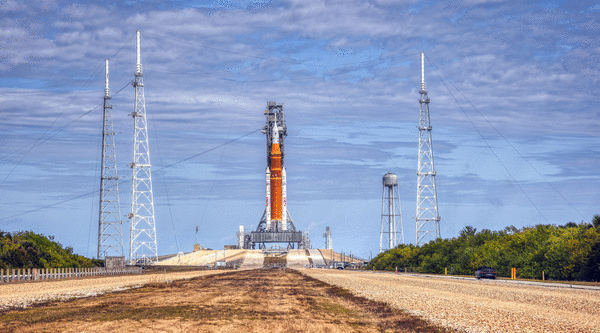
NASA’s test run of its Artemis II countdown ran into problems Monday at Kennedy Space Center that ultimately forced a decision to call off any chance to launch the moonbound mission this month.
“With the conclusion of the wet dress rehearsal today, we are moving off the February launch window and targeting March for the earliest possible launch of Artemis II,” said NASA Administrator Jared Isaacman. “With more than three years between SLS launches, we fully anticipated encountering challenges. That is precisely why we conduct a wet dress rehearsal.”
Artemis II is a planned 10-day mission that will fly four crew by the moon, but not land, on a test mission to ensure the Orion spacecraft is safe for future Artemis missions.
NASA astronauts Reid Wiseman, Victor Glover and Christina Koch as well as Canadian Space Agency astronaut Jeremy Hansen will now have to wait with the next launch windows falling to March 6, 7, 8, 9 and 11, then April 1, 3, 4, 5 and 6. The quartet had been in quarantine in Houston since Jan. 23 and were expected to arrive to KSC later Tuesday had there been a viable February launch opportunity.
Teams ran into issues at Launch Pad 39-B similar to tanking headaches seen during the Artemis I testing and launch attempts in 2022 involving cryogenic liquid hydrogen. NASA had to pause propellant loading of the Space Launch System rocket topped with the Orion spacecraft several times on Monday, although ultimately was able get the rocket filled with the 700,000 gallons of liquid hydrogen and liquid oxygen.
But the leak in an umbilical supply line at the base of the rocket core stage grew stronger during the post-fill operations at the pad causing the test run to be called off with 5:15 on the countdown clock. The countdown automatically stopped when sensors detected a spike in the liquid hydrogen leak rate. Teams then safely offloaded the propellant.
“These tests are designed to surface issues before flight and set up launch day with the highest probability of success,” Isaacman said.
The plan for the test, which had begun Saturday night about two days before a planned target T-0, was to perform operations as if it were a launch day, but without crew on board.
The closeout crew, however, who would be in charge of sealing the astronauts into the Orion capsule, did venture onto the pad where they encountered their own issues. A valve related to Orion’s hatch pressurization vented unexpectedly and it took much longer than planned to finish operations.
NASA said the test also faced intermittent ground audio dropouts and cold-weather impacts to some cameras.
“As always, safety remains our top priority, for our astronauts, our workforce, our systems and the public,” Isaacman said. “We will only launch when we believe we are as ready to undertake this historic mission.”
He said teams will review this test’s data, troubleshoot each issue and make repairs with plans to perform a second wet dress rehearsal on the pad and then target a March launch date.
Artemis II will be the first time humans will ride on the Orion spacecraft, and mark the first time a crew has ventured past low-Earth orbit in more than half a century.
The 600,000-mile trip will take them about 6,000 miles past the far side of the moon breaking the record set by the Apollo 13 crew as the farthest any human has traveled from Earth. Glover will become the first Black man, Kock the first woman and Hansen the first non-American to venture out to the moon.
‘Nine of the Apollo program’s missions flew to the moon with six making a landing. Only 12 men have ever set foot on the moon.
NASA looks to change that with the follow-on mission Artemis III, which the Trump administration is vying to fly before the end of 2028.
“This is just the beginning. It marks the start of an Artemis program that will evolve to support repeated and affordable missions to the moon, in line with President Trump’s national space policy,” Isaacman said. “Getting this mission right means returning to the moon to stay and a future to Artemis 100 and beyond.”
----------
©2026 Orlando Sentinel. Visit at orlandosentinel.com. Distributed by Tribune Content Agency, LLC.






Comments