Measles is spreading: Is your child's North Carolina school vulnerable?
Published in Science & Technology News
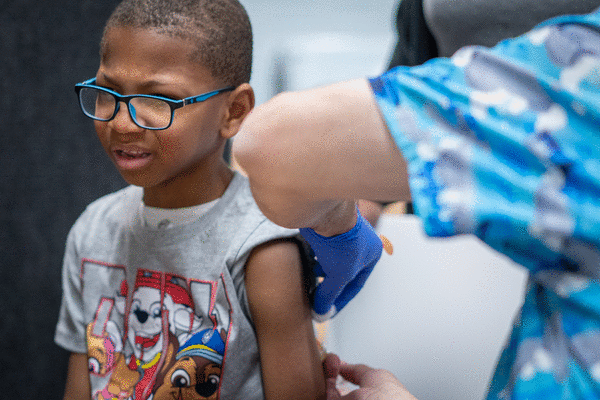
CHARLOTTE, N.C. — About 106,000 — or one in six North Carolina children — attend elementary schools where the risk for measles outbreaks run high, according to the best available state analysis.
Their schools are designated high risk because fewer than 90% of kids there are vaccinated. Nearly 18,000 of kids at the schools are not vaccinated, which means they’re almost certain to catch the measles if they’re exposed, according to public health officials.
Importantly, the risk doesn’t end at their school yards. Schools are prime breeding grounds for viral infections that spill into surrounding communities.
“Schools oftentimes are drivers of outbreaks, and not even just for measles, but for the flu and stuff like that,” said Claire Perrin Smith, a postdoctoral scholar with the UNC Gillings School of Global Public Health. “Any parent knows that if there’s something going around the preschool, everyone in the house is going to get sick.”
About 234,00 children — 16,000 of them unvaccinated — go to schools where 90 to 95% of kids are vaccinated, which also carry heightened risk during community spread, but less so.
The highly contagious disease that can turn deadly or cause lifelong health issues has spilled from Spartanburg County, South Carolina to the Tar Heel state. This is occurring at a time when young children here are less protected by vaccines than they have been in years.
Annual data on kindergarten vaccination rates show an increasing rate of North Carolina parents aren’t fully vaccinating their kids at the start of the school year.
What explains vaccination shifts?
Schools with kindergartens are key to preventing measles because state law compels parents by enrollment to fully vaccinate their kids against the measles and other diseases or submit a religious or medical exemption.
In step with the nationwide surge of vaccine hesitancy, a growing share of parents in North Carolina are sending their kids to school with religious exemptions. Various Christian faith healing groups, which believe in prayer over medicine, and Christian Scientists, which believe illness is an illusion, oppose vaccines. Some people of other faiths may reject vaccines because of their use of animal products or fetal DNA.
But that doesn’t account for all of the state’s unvaccinated kids in schools, especially in Mecklenburg County, said Raynard Washington, Mecklenburg County’s public health director.
Sometimes parents just don’t get around to the task and schools enroll them anyway, Washington said.
“We would like to have compliance with the law. What’s happening right now in our community and nearby is evidence about why it’s important,” Washington said.
No matter the reason, the current trend leaves kids — and their surrounding community — in a vulnerable place. The measles vaccine is one of the most effective and the disease is one of the most contagious airborne pathogens.
State public health officials during a news conference last week urged people to get vaccinated, promoting vaccines as the most effective way to prevent measles from spreading. But the North Carolina Department of Public Health doesn’t have authority to force schools into compliance, according to a state spokesperson.
Even small declines in coverage can cause outbreaks at a local level, said Perrin Smith, a creator of the state’s measles vaccination dashboard, which uses about 10 years of data to model current measles vaccine coverage for schools around the state.
“We’re going to experience more outbreaks and kids are going to get sick and some kids are going to get very, very sick,” Perrin Smith said during an interview. “And there’s a whole host of repercussions that come along with that. Schools shut down, you lose school days. Parents have to take time off work.”
“Closer to home”
The measles virus can live up to two hours in the air. Nine in 10 unvaccinated people exposed to it will get infected, Kelly Kimple, director of the North Carolina Division of Public Health, told reporters last week.
Symptoms typically include a high fever, cough, runny nose, red watery eyes and a rash. Sometimes they escalate into diarrhea, pneumonia and brain swelling, Kimple said.
As measles has spread to hundreds of people around Spartanburg County, South Carolina, the risk of being exposed to the disease is growing in North Carolina, Kimple said. More than 400 people in Spartanburg County have caught the measles since October and at least 200 people are currently quarantined, according to the South Carolina Department of Public Health.
South Carolina public health staff said they’ve confirmed measles cases in elementary, middle and high schools. Unvaccinated kids exposed to the disease are pulled from school for 21 days, to reduce the risk of further spread.
Nearly half of the elementary schools in Spartanburg County started the school year with vaccination rates low enough to easily give way to an outbreak, according to South Carolina data.
North Carolina public health officials have tied four cases, one in Polk County and three in Buncombe County, to the outbreak in South Carolina. Another case cropped up in Rutherford County at the end of last week but officials haven’t pinned down a source as of Jan. 9, which means there are likely other undetected cases in North Carolina, according to the North Carolina Department of Health and Human Services.
And on Monday, Mecklenburg County Public Health announced the measles virus was detected in county wastewater.
Nearly 5,300 elementary school children in Mecklenburg are not vaccinated, according to an Observer analysis of Perrin Smith’s measles dashboard. Almost 2,800 of them go to schools at high risk for outbreaks due to the number of unvaccinated children.
County health director Washington said Mecklenburg County employs nurses at public schools who work with parents whose kids aren’t vaccinated. County public health also zeroes in on schools with troubling rates and brings immunization clinics to them, he said.
In response to the South Carolina outbreak, the county is adding more elementary schools and a child care center to its pop-up clinic circuit, Washington said.
“This outbreak in South Carolina is getting closer to home,” Washington said.
Pockets of vulnerability
North Carolina, overall, has a higher vaccination rate among kindergarteners than most other states. Federal data estimates that 94.2% of these children were vaccinated for measles during the 2024-2025 school year here.
That’s pretty close to what public health officials call “herd immunity,” when enough people are protected from a disease to prevent it from spreading easily. But when measles sneak into a community, it doesn’t really matter for the people who live there what the statewide rate or even the county rate is, Perrin Smith said.
What matters is whether the people they interact with regularly are vaccinated. Pockets of student populations around the state are vulnerable to community spread.
More than 400 schools around the state run a high risk for a measles outbreak, according to the Observer analysis of Perrin Smith’s data.
High-risk schools skew smaller in student enrollment: the median size of a high-risk elementary is about 180, while the median size of schools with higher immunization rates is about 370.
Outbreaks at small schools are unlikely to spark spread outside the school, Perrin Smith said.
But more than 100 high risk schools are just as large, if not larger, than the typical school with medium or low risk.
North Carolina requires vaccines without enforcement
State law compels North Carolina school principals to require that kindergartners get seven vaccinations within 30 days of the start of the school year. The vaccines protect against measles, Chickenpox, mumps and rubella and polio among other illnesses. Kids with weakened immune systems or allergies to vaccine ingredients can pass with a doctor’s note.
As in most states, parents here can opt out if they say their religions oppose vaccines.
A handful of Republican state legislators, including some from counties surrounding Mecklenburg, introduced a “conscientious objection” option during the last legislative session to expand that exemption but their bill never made it out of committee. Just 15 states allow personal exemptions for measles vaccines.
North Carolina’s religious exemption, however, comes without scrutiny, Washington said. Schools are supposed to prohibit kids without either proof of vaccines or exemptions from coming to class. They’re also supposed to annually report to the state how many kids fall into each category.
If parents don’t want to vaccinate their kids, they submit a written statement including their kids’ name, birthday and the reason they don’t want to seek immunizations. There’s no form or template. These statements don’t have to be notarized or signed by religious leaders.
Measles vaccine has prevented serious illness
Before the first vaccine launched in 1963, nearly all American children caught the measles. Every year, 400 to 500 people died, 48,000 were hospitalized and 1,000 had brain swelling, according to the U.S. Centers for Disease Control and Prevention.
A CDC study found that routine childhood vaccinations between 1994 and 2023 prevented about 508 million cases, 32 million hospitalizations and more than 1 million deaths.
By 2000, the virus was declared eliminated in the U.S., meaning it stopped continuously spreading for more than a year. But we may lose that designation this year. Canada already has.
Nationwide, last year marked the largest number of measles cases since a second dose of the vaccine became widely used in the early 1990s, according to a North Carolina public health update.
About 92.5% of U.S. kindergartners started last school year vaccinated for the measles, down from 95.2% in 2019 – just before Covid-19 struck and a new wave of vaccine skepticism followed.
Vaccines are sometimes “victims of their own success,” Perrin Smith said. The shots were so effective at eliminating devastating childhood illness that many people have not seen the consequences of the measles in their lifetime.
“People have trouble believing things they don’t see with their own eyes,” she said.
The North Carolina Department of Health and Human Services published a dashboard that estimates the measles immunization rate for each school, and each grade within. The dashboard was developed by the Atlantic Coast Center for Infectious Disease Dynamics and Analytics at the University of North Carolina's Gillings School of Global Public Health. They used about 10 years worth of data to model the estimates.
I wanted to know how many unvaccinated kids there are, where they're highly concentrated and how many students attend schools deemed at high risk for outbreaks. The dashboard doesn't display the information that way. So I created a scraping tool to pull what was available on the backend of the website: each school's name, vaccination rate and enrollment. That allowed me to calculate the number of unvaccinated kids per school.
To map those findings, I used files from the state's GIS website containing public and private school addresses. For schools that didn't exist in either file, I looked up the addresses. That allowed me to use a geocoding service to get latitude and longitude for each school and build a map.
To assess change over time at the schools, I used online state health department data for 2021, 2022, 2023 and 2024 that listed each school and what percent of their kids were up to date on all state-required vaccines.
The state had 2020 data available, but I excluded that because so many students were remote that year due to the COVID-19 pandemic. I also excluded schools lacking four years of consecutive data, or schools that told me they reported bad data to the state.
©2026 The Charlotte Observer. Visit at charlotteobserver.com. Distributed by Tribune Content Agency, LLC.


Comments